The Messapic language (Yapigsky) is a relict language of the group of Illyrian languages [1] . The carriers are the tribes of the Yapig ( Iapods ): messups , singers and long ago .
| Messap language | |
|---|---|
| Countries | Italy |
| Regions | Puglia |
| Status | extinct |
| Extinct | to the beginning of the 1st century A.D. |
| Classification | |
| Category | Languages of Eurasia |
Indo-European family
| |
| Writing | messapic alphabet , greek letter |
| Language Codes | |
| ISO 639-1 | - |
| ISO 639-2 | - |
| ISO 639-3 | cms |
| IETF | |
| Glottolog | |
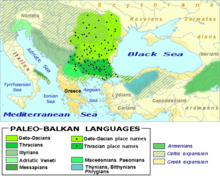
It was distributed in the southeast of the Apennine Peninsula in the territory of the modern region of Puglia. To the beginning of n. e. was supplanted by the Latin language. About 300 inscriptions of the VI — I centuries are known. BC e., executed mainly by the messapic alphabet. Several inscriptions are made in Greek script.
The Messapian language belongs to the Indo-European languages, its closeness to the Illyrian language is most recognized (together they, apparently, form the Illyrian branch ). Some reflexes bring Messapian closer to Greek and Italian . Although the Messianic one reveals many similarities with the Illyrian one in the onomastic root word, word formation, and partly in phonology, there are some features (in particular, the development of * s, * -s-> h-, -h-, which brings Messapan closer to Greek and Albanian, but separates it from Balkan Illyrian), is forced to interpret Messapic as a special language.
Short and long vowels a, u, e, i, ā, ō, ū, ē, ī and 5 diphthongs (au, eu, ai, oi, ei) are represented in vocalism. Short ǒ turned into ǎ. Consonantism is represented by phonemes p, t, k, b, d, g, s, j, v, m, n, l, r, š, z, θ, h, possibly also x, q, c, dz, ɲ, ʎ. In Messap, palatalization and lengthening of combinations of the anterophone t, d, l, n, s, r with i / j are known : Dazetθes (compare illir. Dazetius ), where θ (th) transmits some palatal or palatalized sound like t y or č. Messapian is characterized by the reduction of three series of Indo-European synonyms to two with the coincidence of voiced and voiced aspirates; Indo-European Velar have mainly Kentum reflexes.
In case morphology, five cases are distinguished. In the verb, some forms of perfection, aorist and optative are known. Despite the abundance of inscriptions, they are in most cases difficult to interpret and uninformative due to the predominance of personal names.
Content
- 1 Messapian Alphabet
- 2 notes
- 3 Literature
- 4 References
Messapic Alphabet
The Messapic alphabet developed on the basis of the Greek script of the neighboring city of Tarento ( Taranto ), where the Dorian version was used. At the same time, it has many Ionian characteristics.
Notes
- ↑ Illyrian language // Great Soviet Encyclopedia : [in 30 vol.] / Ch. ed. A.M. Prokhorov . - 3rd ed. - M .: Soviet Encyclopedia, 1969-1978.
Literature
- Conway RS, Whatmough J., Johnson S. The Prae-Italic Dialects of Italy. 3 vols. 1933.
- De Simone C. Die messapischen Inschriften und ihre Chronologie / H. Krahe (ed.). Die Sprache der Illyrier II. Wiesbaden: Harrassowitz, 1964.
- De Simone C. La lingua messapica. Tentativo di una sintesi // Le genti non greche della Magna Graecia. 1974.
- De Simone C. , Marchesini S. Monumenta Linguae Messapicae. 2 vols. Wiesbaden: Reichert Verlag, 2002.
- Haas O. Messapische Studien. Heidelberg: Winter, 1962.
- Il messapico // Nuovi material per la ricerca indoeuropeistica, Pisa, 1981. Pp. 139-60.
- Parlangeli O., Santoro C. Il Messapico // Prosdocimi AL (ed.), Popoli e civiltà dell'Italia antica, vol. 4, Lingue e dialetti, Rome, 1978. pp. 913–47.
- Parlangèli O. Studi Messapici. 1960
- Ribezzo, Francesco. Corpus inscriptionum Messapicarum , a cura e con introduzione di Ciro Santoro. Bari: Edipuglia srl, 1978
- Santoro C. Nuovi studi messapici, 1982.
- Santoro C. Nuovi Studi Messapici. 2 vols. 1983.
- Santoro C. Nuovi Studi Messapici. Primo supplemento. 1984.
- Untermann Jürgen. Die messapischen Personennamen / H. Krahe (ed.). Die Sprache der Illyrier II. Wiesbaden: Harrassowitz, 1964.