A hypersurface is a generalization of the concept of a surface of 3-dimensional space for an n-dimensional space; this is a manifold of dimension n that is embedded in a Euclidean space by a unit of greater dimension {\ displaystyle n + 1}  .
.
Hypersurface as an object plays an important role in differential geometry; many important theorems of mathematical analysis are easily reformulated using hypersurfaces (for example, the Stokes formula and its special cases).
Hypersurface is the most common subject of space bundle.
An example is the stratification of the configuration space (the space of all possible states of the system) in terms of energy. This particular case is called the one-dimensional bundle of space (since each hypersurface we can associate with some real number - energy).
Differential operators ( rotor , etc.) are also formulated in terms of hypersurfaces. Considering, for example, the flow of a vector field through a surface (it is a hypersurface) in three-dimensional space, we obtain some characteristic of this field, which can be visualized.
In the multidimensional case, the visibility of the concept of “vector field flow” is lost; nevertheless, all the basic properties of the hypersurface are preserved ( Ostrogradsky – Gauss theorem ).
Due to the presence of some properties that are equally inherent in all hypersurfaces ( Stokes theorem ), a hypersurface is distinguished as a separate object.
Let a hypersurface be given by parametric equations:
- {\ displaystyle (1) \ qquad \ mathbf {r} = \ mathbf {r} (u ^ {1}, u ^ {2}, \ dots u ^ {n})}

In this case, we will everywhere assume that functions (1) are sufficiently smooth (continuous second derivatives), with a non-degenerate metric tensor {\ displaystyle g_ {ij} = (\ mathbf {r} _ {i} \ cdot \ mathbf {r} _ {j})} 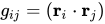 . Coordinate vectors {\ displaystyle \ mathbf {r} _ {i} = {\ partial \ mathbf {r} \ over \ partial u ^ {i}}}
  at the point of diversity {\ displaystyle P}
  define an affine subspace that is tangent to the manifold of a hyperplane. The orthogonal complement to the hyperplane is the straight line {\ displaystyle L}
  passing through a given point of the manifold and perpendicular to it. We choose (one of two possible) directions of this line and put the unit vector on the line {\ displaystyle \ mathbf {n}}
  . In the neighboring (close to the point {\ displaystyle P} ) point {\ displaystyle P '}
  manifolds orthogonal line {\ displaystyle L '}
  will be close in a straight line {\ displaystyle L} , therefore, the projection of the vector onto {\ displaystyle L '} already clearly sets the positive direction on the line {\ displaystyle L '} . Put a straight line in this positive direction {\ displaystyle L '} unit vector {\ displaystyle \ mathbf {n} '} . Thus, moving from one point of the manifold to another in a certain region of the manifold, we obtain a vector function:
- {\ displaystyle (2) \ qquad \ mathbf {n} = \ mathbf {n} (P) = \ mathbf {n} (u ^ {1}, u ^ {2}, \ dots u ^ {n})}
This function will be continuous (since the hypersurface (1) is smooth, without singular points). Let's try to extend the function to the whole variety . This can be done in the case when, moving along any closed path that lies in the hypersurface, starting from the point {\ displaystyle P} and calculating the normal vector by continuity, we return to the point {\ displaystyle P} with the same direction of the normal vector. Such a hypersurface is called bilateral , or approximate . But there are also such hypersurfaces when, bypassing some closed contour, we return to the point {\ displaystyle P} with the opposite normal vector. Such hypersurfaces are called one-sided , or non-orientable . Examples of one-sided hypersurfaces are a Mobius strip and a Klein bottle .
From the orthogonality of the normal vector to the coordinate vectors of the hypersurface, we have the equation:
- {\ displaystyle (3) \ qquad (\ mathbf {n} \ cdot \ mathbf {r} _ {i}) = 0}
and the unit length of the normal vector is described by the equation:
- {\ displaystyle (4) \ qquad \ mathbf {n} ^ {2} = (\ mathbf {n} \ cdot \ mathbf {n}) = 1}
From the expression
- {\ displaystyle (5) \ qquad \ mathbf {r} _ {ij} = \ Gamma _ {ij} ^ {k} \ mathbf {r} _ {k} + \ mathbf {b} _ {ij}}
and the fact that there is only one direction {\ displaystyle \ mathbf {n}} orthogonal to vectors {\ displaystyle \ mathbf {r} _ {i}} , it follows that all vectors are collinear to the vector {\ displaystyle \ mathbf {n}} , i.e. we can write:
- {\ displaystyle (6) \ qquad \ mathbf {b} _ {ij} = \ mathbf {n} b_ {ij}}
The numbers {\ displaystyle b_ {ij}} are projections of vectors {\ displaystyle \ mathbf {b} _ {ij}} per normal vector {\ displaystyle \ mathbf {n}} , and therefore can be both positive and negative. According to formula (6), the curvature of all geodesic lines passing through a fixed point {\ displaystyle P} manifolds parallel to the vector {\ displaystyle \ mathbf {n}} (the centers of curvature lie on a line orthogonal to the manifold):
- {\ displaystyle (7) \ qquad \ mathbf {k} = \ mathbf {b} _ {ij} \ tau ^ {i} \ tau ^ {j} = \ mathbf {n} b_ {ij} \ tau ^ {i } \ tau ^ {j} = \ mathbf {n} k}
- {\ displaystyle (7a) \ qquad k = b_ {ij} \ tau ^ {i} \ tau ^ {j}}
Differentiation with respect to the coordinates of the manifold of formula (4) gives:
- {\ displaystyle (8) \ qquad {\ partial \ over \ partial u ^ {i}} \ mathbf {n} ^ {2} = 2 (\ mathbf {n} \ cdot \ mathbf {n} _ {i}) = 0}
that is, derivatives of the unit normal vector {\ displaystyle \ mathbf {n} _ {i} = {\ partial \ mathbf {n} \ over \ partial u ^ {i}}} orthogonal to the normal vector itself {\ displaystyle \ mathbf {n}} , and therefore lie in the tangent to the manifold of the hyperplane. We can decompose the vector {\ displaystyle \ mathbf {n} _ {i}} on the basis vectors of the tangent space:
- {\ displaystyle (9) \ qquad \ mathbf {n} _ {i} = \ alpha _ {i} ^ {j} \ mathbf {r} _ {j}}
Find the decomposition coefficients {\ displaystyle \ alpha _ {i} ^ {j}} . To do this, we multiply the left and right sides of formula (9) scalarly by the vector {\ displaystyle \ mathbf {r} _ {k}} .
For the left side we have:
- {\ displaystyle (10) \ qquad (\ mathbf {n} _ {i} \ cdot \ mathbf {r} _ {k}) = \ partial _ {i} (\ mathbf {n} \ cdot \ mathbf {r} _ {k}) - (\ mathbf {n} \ cdot \ mathbf {r} _ {ik}) = - b_ {ik}}
And for the right:
- {\ displaystyle (11) \ qquad \ alpha _ {i} ^ {j} (\ mathbf {r} _ {j} \ cdot \ mathbf {r} _ {k}) = \ alpha _ {i} ^ {j } g_ {jk} = \ alpha _ {ik}}
From formulas (9-11) we obtain the following formula for calculating the derivatives of the unit normal vector through the tensor of full curvature:
- {\ displaystyle (12) \ qquad \ mathbf {n} _ {i} = - b_ {i} ^ {j} \ mathbf {r} _ {j}}
Note that the vector {\ displaystyle \ mathbf {n}} is orthogonal to the coordinates on the manifold, and therefore its covariant derivative coincides with the partial derivative (like a scalar gradient ):
- {\ displaystyle (13) \ qquad \ nabla _ {i} \ mathbf {n} = \ partial _ {i} \ mathbf {n} = \ mathbf {n} _ {i}}
For a geodesic line , which we will consider as a curved line in an enveloping (n + 1) -dimensional Euclidean space, the normal vector to the hypersurface {\ displaystyle \ mathbf {n}} will coincide with the main normal vector to the curve if the number {\ displaystyle k} in formula (7a) is positive, or will be the opposite vector (if {\ displaystyle k} <0). Find the torsion of a geodesic {\ displaystyle {\ boldsymbol {\ varkappa}}} :
- {\ displaystyle (14) \ qquad {d \ mathbf {n} \ over ds} = - k {\ boldsymbol {\ tau}} + {\ boldsymbol {\ varkappa}}}
- {\ displaystyle (15) \ qquad {d \ mathbf {n} \ over ds} = \ mathbf {n} _ {i} {du ^ {i} \ over ds} = \ mathbf {n} _ {i} \ tau ^ {i} = - b_ {j} ^ {i} \ tau ^ {j} \ mathbf {r} _ {i}}
- {\ displaystyle (16) \ qquad {\ boldsymbol {\ varkappa}} = {d \ mathbf {n} \ over ds} + k {\ boldsymbol {\ tau}} = (- b_ {j} ^ {i} \ tau ^ {j} + k \ tau ^ {i}) \ mathbf {r} _ {i}}
From formula (16) we see that the torsion of the geodesic line will be zero if the tangent vector {\ displaystyle \ tau ^ {i}} and will be an eigenvector of the matrix {\ displaystyle b_ {j} ^ {i}} :
- {\ displaystyle (17) \ qquad b_ {j} ^ {i} \ tau ^ {j} = k \ tau ^ {i}}
Symmetric tensor {\ displaystyle b_ {ij}} in tangent at a point {\ displaystyle P} to a hypersurface of a vector space defines a linear transformation:
- {\ displaystyle (18) \ qquad y_ {i} = b_ {i} ^ {j} x_ {j}}
and we can put the problem on the eigenvalues and vectors of this transformation. First, let's move to the coordinate system, which will be a rectangular Cartesian at a point {\ displaystyle P} . Since the metric tensor at this point is unit ( {\ displaystyle g_ {ij} = \ delta _ {ij}} ), then the covariant and contravariant coordinates of the tensor {\ displaystyle b_ {ij}} will be the same, therefore, transformation (18) is carried out by a symmetric matrix {\ displaystyle b_ {i} ^ {j}} . As is known from matrix theory, a symmetric matrix has {\ displaystyle n} mutually orthogonal eigenvectors {\ displaystyle {\ boldsymbol {\ tau}} ^ {(s)}, \; s = 1,2, \ dots n} (we can also consider them unitary), and all eigenvalues corresponding to them are real numbers {\ displaystyle k ^ {(s)}} (which can be both positive and negative). In the selected coordinate system, we have:
- {\ displaystyle (19) \ qquad b_ {i} ^ {j} \ tau _ {j} ^ {(s)} = k ^ {(s)} \ tau _ {i} ^ {(s)}}
- {\ displaystyle (20) \ qquad \ sum _ {i} \ tau _ {i} ^ {(s)} \ tau _ {i} ^ {(p)} = ({\ boldsymbol {\ tau}} ^ { (s)} \ cdot {\ boldsymbol {\ tau}} ^ {(p)}) = \ delta ^ {sp} = {\ begin {cases} 1, & s = p \\ 0, & s \ neq p \ end {cases}}}
Formula (19) has a tensor character, and therefore is valid in any coordinate system, the orthogonality of the eigenvectors (20) can also be written in any coordinate system through the metric tensor:
- {\ displaystyle (21) \ qquad g ^ {ij} \ tau _ {i} ^ {(s)} \ tau _ {j} ^ {(p)} = g_ {ij} \ tau ^ {(s) i } \ tau ^ {(p) j} = \ delta ^ {sp}}
Using formula (7a), we can find the curvature of the geodesic line drawn parallel to one of the eigenvectors {\ displaystyle {\ boldsymbol {\ tau}} ^ {(s)}} :
- {\ displaystyle (22) \ qquad k = b_ {ij} \ tau ^ {(s) i} \ tau ^ {(s) j} = k ^ {(s)} \ tau _ {j} ^ {(s )} \ tau ^ {(s) j} = k ^ {(s)}}
Eigenvalues {\ displaystyle k ^ {(1)}, k ^ {(2)}, \ dots k ^ {(n)}} are called the main curvatures of the hypersurface, and the corresponding eigenvectors of them are called the main directions.
In the coordinate system, which is at a point {\ displaystyle P} hypersurface has coordinate vectors coinciding with the main directions, the matrix of the tensor of full curvature {\ displaystyle b_ {ij} = b_ {i} ^ {j}} will be diagonal:
- {\ displaystyle (23) \ qquad B = (b_ {ij}) = {\ begin {bmatrix} k ^ {(1)} & 0 & \ cdots & 0 \\ 0 & k ^ {(2)} & \ cdots & 0 \\\ cdots & \ cdots & \ ddots & \ cdots \\ 0 & 0 & \ cdots & k ^ {(n)} \ end {bmatrix}}}
The same can be written in tensor notation:
- {\ displaystyle (24) \ qquad b_ {ij} = k ^ {(i)} \ delta _ {ij}}
index addition in this formula {\ displaystyle i} not carried out.
We write the spectral decomposition of the tensor {\ displaystyle b_ {ij}} using eigenvalues and vectors. In an arbitrary coordinate system, we have:
- {\ displaystyle (25) \ qquad b_ {ij} = \ sum _ {s} k ^ {(s)} \ tau _ {i} ^ {(s)} \ tau _ {j} ^ {(s)} }
Consider the action of the commutator of covariant derivatives on coordinate vectors:
- {\ displaystyle (26) \ qquad [\ nabla _ {j} \ nabla _ {k}] \ mathbf {r} _ {i} = - R _ {\, ijk} ^ {s} \ mathbf {r} _ { s}}
We can write this commutator through the tensor of full curvature:
- {\ displaystyle (27) \ qquad [\ nabla _ {j} \ nabla _ {k}] \ mathbf {r} _ {i} = \ nabla _ {j} (\ nabla _ {k} \ mathbf {r} _ {i}) - \ nabla _ {k} (\ nabla _ {j} \ mathbf {r} _ {i}) = \ nabla _ {j} \ mathbf {b} _ {ki} - \ nabla _ { k} \ mathbf {b} _ {ji} =}
- {\ displaystyle \ qquad = (\ nabla _ {j} \ mathbf {n}) b_ {ki} + \ mathbf {n} \ nabla _ {j} b_ {ki} - (\ nabla _ {k} \ mathbf { n}) b_ {ji} - \ mathbf {n} \ nabla _ {k} b_ {ji} = - (b_ {j} ^ {s} b_ {ki} -b_ {k} ^ {s} b_ {ji }) \ mathbf {r} _ {s} + \ mathbf {n} (\ nabla _ {j} b_ {ki} - \ nabla _ {k} b_ {ji})}
Comparing formulas (26) and (27), we find:
- {\ displaystyle (28) \ qquad R _ {\, ijk} ^ {s} = b_ {j} ^ {s} b_ {ki} -b_ {k} ^ {s} b_ {ji}, \ qquad R_ {ijkl } = b_ {ik} b_ {jl} -b_ {il} b_ {jk}}
- {\ displaystyle (29) \ qquad \ nabla _ {j} b_ {ki} = \ nabla _ {k} b_ {ji}}
Equation (29) is called the Peterson-Codazzi equation . This equality can be interpreted as follows: the covariant derivative of the tensor of full curvature for a hypersurface is a symmetric tensor with three indices:
- {\ displaystyle (30) \ qquad \ nabla _ {i} b_ {jk} = b_ {ijk}}
We substitute the spectral expansion (25) into formula (28). We find the Riemann tensor:
- {\ displaystyle (31) \ qquad R_ {ijkl} = b_ {ik} b_ {jl} -b_ {il} b_ {jk} = \ sum _ {p, s} \ left (k ^ {(p)} \ tau _ {i} ^ {(p)} \ tau _ {k} ^ {(p)} k {(s)} \ tau _ {j} ^ {(s)} \ tau _ {l} ^ {( s)} - k ^ {(p)} \ tau _ {i} ^ {(p)} \ tau _ {l} ^ {(p)} k {(s)} \ tau _ {j} ^ {( s)} \ tau _ {k} ^ {(s)} \ right) =}
- {\ displaystyle \ qquad = \ sum _ {p, s} k ^ {(p)} k ^ {(s)} \ tau _ {i} ^ {(p)} \ tau _ {j} ^ {(s )} \ left (\ tau _ {k} ^ {(p)} \ tau _ {l} ^ {(s)} - \ tau _ {l} ^ {(p)} \ tau _ {k} ^ { (s)} \ right)}
We introduce the notation of a bivector - oriented area {\ displaystyle {\ boldsymbol {\ sigma}} ^ {(ps)}} built on two vectors of the main directions:
- {\ displaystyle (32) \ qquad {\ boldsymbol {\ sigma}} ^ {(ps)} = {\ boldsymbol {\ tau}} ^ {(p)} \ wedge {\ boldsymbol {\ tau}} ^ {( s)}}
or the same in components:
- {\ displaystyle (33) \ qquad \ sigma _ {ij} ^ {(ps)} = \ tau _ {i} ^ {(p)} \ tau _ {j} ^ {(s)} - \ tau _ { j} ^ {(p)} \ tau _ {i} ^ {(s)}}
These bivectors have a unit area and are mutually orthogonal:
- {\ displaystyle (34) \ qquad | {\ boldsymbol {\ sigma}} ^ {(ps)} | = | {\ boldsymbol {\ tau}} ^ {(p)} || {\ boldsymbol {\ tau}} ^ {(s)} | \ sin \ phi = 1}
- {\ displaystyle (35) \ qquad \ sigma _ {ij} ^ {(ps)} \ sigma ^ {(kl) \, ij} = 0, \; {\ mbox {if}} (ps) \ neq (kl )}
On the right side of formula (31), diagonal terms with identical indices {\ displaystyle p = s} are equal to zero, and the off-diagonal ones are divided into two groups of the same number: terms with {\ displaystyle p <s} , and terms with {\ displaystyle p> s} . Therefore, formula (31) can be rewritten as follows:
- {\ displaystyle (36) \ qquad R_ {ijkl} = \ sum _ {p <s} k ^ {(p)} k ^ {(s)} \ sigma _ {ij} ^ {(ps)} \ sigma _ {kl} ^ {(ps)}}
It is easily seen from formula (36) and the property of the bivector that the Bianchi algebraic identity must hold. After all, for any bivector {\ displaystyle \ sigma) {ij}} (oriented platform) we have the identity:
- {\ displaystyle (37) \ qquad \ sigma _ {ij} \ sigma _ {kl} + \ sigma _ {jk} \ sigma _ {il} + \ sigma _ {ki} \ sigma _ {jl} = 0}
In the coordinate system built on the main directions of the hypersurface, the eigenvectors have the coordinates:
- {\ displaystyle (38) \ qquad \ tau _ {i} ^ {(s)} = \ delta _ {i} ^ {s}, \ qquad {\ boldsymbol {\ tau}} ^ {(s)} = \ {0,0, \ dots 1,0, \ dots 0 \}}
Here in the expression in parentheses, the unit stands at {\ displaystyle s} -th place, the remaining coordinates are zero.
You can easily record the coordinates of the bivectors {\ displaystyle \ sigma _ {ij} ^ {(ps)}} using formulas (33):
- {\ displaystyle (39) \ sigma _ {ij} ^ {(ps)} = {\ begin {cases} 1, & i = p, \, j = s \\ - 1, & i = s, \, j = p \\ 0, & {\ mbox {for any other}} i, j \ end {cases}}}
From (39) and (36) we find nonzero components of the Riemann tensor:
- {\ displaystyle (40) \ qquad R_ {ijij} = - R_ {ijji} = k ^ {(i)} k ^ {(j)}, \ qquad i \ neq j}
Further, since in the chosen coordinate system the metric tensor is equal to the identity matrix, we find the Ricci tensor and scalar curvature :
- {\ displaystyle (41) \ qquad R_ {ij} = \ sum _ {s} R_ {isjs} = 0, \ qquad {\ mbox {if}} i \ neq j}
- {\ displaystyle (41a) \ qquad R_ {ii} = \ sum _ {j \ neq i} R_ {ijij} = k ^ {(i)} \ sum _ {j \ neq i} k ^ {(j)} }
- {\ displaystyle (42) \ qquad R = \ sum _ {i, j \ over i \ neq j} k ^ {(i)} k ^ {(j)} = 2 \ sum _ {i <j} k ^ {(i)} k ^ {(j)}}

For each point of the hypersurface {\ displaystyle \ mathbf {r} = \ mathbf {r} (u ^ {1}, u ^ {2}, \ dots u ^ {n})} we have the unit normal vector {\ displaystyle \ mathbf {n} = \ mathbf {n} (u ^ {1}, u ^ {2}, \ dots u ^ {n})} (Formula 3), which we will postpone from the beginning of the Cartesian coordinate system in Euclidean {\ displaystyle (n + 1)} -dimensional space. The end of this vector (point) lies on the hypersphere of unit radius. Let us consider what the image of the entire hypersurface may be on this hypersphere.
If the hypersurface is flat, then its image will be only one point on the hypersphere. The image of the cylinder or cone will be a line on the hypersphere (circle - for a circular cylinder or cone). In a more general case, this will be a certain region on the hypersphere, which can, in particular, cover the entire hypersphere, even repeatedly. So for a closed manifold, we have some integer characteristic - how many times its image covers the unit hypersphere. Obviously, with small deformations of the manifold, this characteristic does not change and is a topological invariant of the hypersurface.
To derive an integral formula for calculating this invariant, we need a formula for transforming volumes when reflected into a unit hypersphere {\ displaystyle \ mathbb {S} ^ {n}} .
First, we consider a small segment on the manifold, which we represent as a vector {\ displaystyle d \ mathbf {r} = \ mathbf {r} _ {i} du ^ {i}} . His image on the hypersphere will be a segment:
- {\ displaystyle (43) \ qquad d \ mathbf {n} = \ mathbf {n} _ {i} du ^ {i} = - (b_ {i} ^ {j} du ^ {i}) \ mathbf {r } _ {j}}
Now we can consider a box built on {\ displaystyle n} vectors:
- {\ displaystyle (44) \ qquad (d \ mathbf {r}) ^ {(1)} = \ mathbf {r} _ {1} du ^ {1}, \; (d \ mathbf {r}) ^ { (2)} = \ mathbf {r} _ {2} du ^ {2}, \; \ dots \; (d \ mathbf {r}) ^ {(n)} = \ mathbf {r} _ {n} du ^ {n}}
The volume of this box will be the size of a multivector composed of the following vectors:
- {\ displaystyle (45) \ qquad d {\ boldsymbol {\ tau}} ^ {(\ mathbf {r})} = (\ mathbf {r} _ {1} \ wedge \ mathbf {r} _ {2} \ wedge \ cdots \ wedge \ mathbf {r} _ {n}) du ^ {1} du ^ {2} \ cdots du ^ {n}}
Images of vectors (44) on the hypersphere {\ displaystyle \ mathbb {S} ^ {n}} there will be such vectors:
- {\ displaystyle (46) \ qquad {\ begin {matrix} (d \ mathbf {n}) ^ {(1)} = \ mathbf {n} _ {1} du ^ {1} = (- \ sum _ { i_ {1}} b_ {1} ^ {i_ {1}} \ mathbf {r} _ {i_ {1}}) du ^ {1} \\ (d \ mathbf {n}) ^ {(2)} = \ mathbf {n} _ {2} du ^ {2} = (- \ sum _ {i_ {2}} b_ {2} ^ {i_ {2}} \ mathbf {r} _ {i_ {2}} ) du ^ {2} \\\ cdots \\ (d \ mathbf {n}) ^ {(n)} = \ mathbf {n} _ {n} du ^ {n} = (- \ sum _ {i_ { n}} b_ {n} ^ {i_ {n}} \ mathbf {r} _ {i_ {n}}) du ^ {n} \ end {matrix}}}
From these images we also make a multivector:
- {\ displaystyle (47) \ qquad d {\ boldsymbol {\ tau}} ^ {(\ mathbf {n})} = (\ mathbf {n} _ {1} \ wedge \ mathbf {n} _ {2} \ wedge \ cdots \ wedge \ mathbf {n} _ {n}) du ^ {1} du ^ {2} \ cdots du ^ {n} = (- 1) ^ {n} \ det (b_ {j} ^ { i}) \, d {\ boldsymbol {\ tau}} ^ {(\ mathbf {r})}}
From formula (47) it can be seen that the image of the multivector is proportional to the original with the proportionality coefficient, which we denote as follows:
- {\ displaystyle (48) \ qquad K ^ {[n]} = (- 1) ^ {n} \ det (b_ {j} ^ {i}) = (- k ^ {(1)}) (- k ^ {(2)}) \ cdots (-k ^ {(n)})}
and call it the Gauss curvature {\ displaystyle n} degree. This coefficient , up to a sign, is equal to the product of the main curvatures of the hypersurface.
The properties of the product of the main curvatures of a two-dimensional hypersurface were first studied by the German mathematician Karl Friedrich Gauss in 1827 .
Consider a closed hypersurface {\ displaystyle M} (similar to a sphere, a torus, etc.), and we integrate the Gauss curvature over the entire hypersurface (this is the Gaussian integral):
- {\ displaystyle (49) \ qquad I = \ int _ {M} K ^ {[n]} d \ tau ^ {(\ mathbf {r})}}
Due to (47), the integrand is equal to the volume element of the unit hypersphere {\ displaystyle \ mathbb {S} ^ {n}} taken with a plus or minus sign depending on the sign of the Gauss curvature. An image on the hypersphere can have folds when the same point of the hypersphere is covered with a plus sign for one point of the manifold, and with a minus sign for some other point of the manifold. In this case, the corresponding contributions to the integral (49) are compensated. But since the image does not have ragged edges (for bilateral hypersurfaces), it should cover the entire hypersphere, possibly several times. This fact can be written as the following formula:
- {\ displaystyle (50) \ qquad \ int _ {M} K ^ {[n]} d \ tau ^ {(\ mathbf {r})} = N \ omega _ {n + 1}}
Where {\ displaystyle N} Is an integer (for bilateral hypersurfaces), which can be either positive or negative, and {\ displaystyle \ omega _ {n + 1}} - volume of a single hypersphere:
- {\ displaystyle (51) \ qquad \ omega _ {n + 1} = \ omega (\ mathbb {S} ^ {n}) = {2 \ pi ^ {n + 1 \ over 2} \ over \ Gamma ({ n + 1 \ over 2})}}
For one-sided hypersurfaces, formula (50) is also valid, but the number {\ displaystyle N} is half-integer (since the same point of the manifold has two images - diametrically opposite points on the hypersphere).
Note that not for all integers and half-integers {\ displaystyle N} there exists a smooth closed hypersurface for which equality (50) holds. For example, for a hypersurface dimension n = 1, that is, a curve in the plane, the number {\ displaystyle N} cannot be half-integer (in a drop-shaped curve, there is a tail in which the normal vectors are opposite, but this point is not a regular point). Whole numbers {\ displaystyle N} are realized by curves that (due to self-intersections) {\ displaystyle N} times wrap around a fixed point on the plane. Formula (50) for the curve {\ displaystyle L} will be written like this:
- {\ displaystyle (51) \ qquad - \ oint _ {L} kds = 2 \ pi N}
Where {\ displaystyle k} - the curvature of the curve, taken with a plus or minus sign, depending on whether the curve is bent clockwise or counterclockwise. Number {\ displaystyle N} N = 0 is realized for a figure-eight curve.
For two-dimensional hypersurface {\ displaystyle S} ( {\ displaystyle n = 2} ) in three-dimensional space, the number {\ displaystyle N} equal to half the Euler characteristic:
- {\ displaystyle (52) \ qquad N = {1 \ over 2} \ chi (S)}
therefore, it can take all integer and half-integer values less than or equal to unity: {\ displaystyle N \ leq 1}
In a two-dimensional space (plane), any closed curve is a hypersurface