Marsovo Pole - a square in the center of St. Petersburg .
| Memorial park | |
| Champ de Mars | |
|---|---|
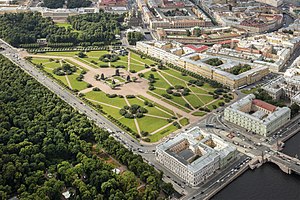 View of the Field of Mars from a height | |
| A country |  Russia Russia |
| City |  St. Petersburg St. Petersburg |
| Project Author | Architects: I. A. Fomin , L. V. Rudnev |
| First mention | XVIII century |
| Construction | The memorial was created in 1917 - 1919 |
| Key dates | |
| XVIII century - the appearance of the Big Meadow (Tsaritsyna Meadows) 1798-1801 - installation of obelisks, the appearance of the name "Field of Mars" 1917-1919 - the creation of the memorial | |
| Status |  An object of cultural heritage of the peoples of the Russian Federation of federal significance. Reg. No. 781520316720006 ( EGROKN ). (Wikigid database) An object of cultural heritage of the peoples of the Russian Federation of federal significance. Reg. No. 781520316720006 ( EGROKN ). (Wikigid database) |

Content
History
At the beginning of the 18th century, to the west of the Summer Garden there was an undeveloped area called the Comic Field or the Bolshoi , and later Tsaritsyn Meadow . Military parades took place in the meadow. In 1798 - 1801, monuments to the commanders P. A. Rumyantsev (architect V.F. Brenna ) and A.V. Suvorov (sculptor M.I. Kozlovsky ) were erected there. In 1818, the Rumyantsevsky obelisk was transferred to Vasilyevsky Island , but the name of the Field of Mars was established beyond the square (similar to the Field of Mars in ancient Rome and Paris ). From 1918 to 1944 it was called the Square of the Victims of the Revolution.
The reference book “Monuments of St. Petersburg” published by the Museum of Urban Sculpture provides a brief historical reference on the creation of the monument. It says that during the days of the February Revolution of February 23–27, 1917, more than 400 people died and 1382 were injured in the street battles of Petrograd. A special commission was created to organize the funeral ceremonial funeral ceremony, headed by M. Gorky . The writer supported the proposal of a group of architects led by I. A. Fomin about the burial of the dead on the Field of Mars. During the competition for the project of the memorial complex, held in the spring of 1917, the project of architect L.V. Rudnev was recognized as the best. After the October Revolution, the construction commission was headed by A. V. Lunacharsky [1] , he also compiled eight inscriptions for end plates [2] . The design of the inscriptions was completed by the artists V. M. Konashevich and N. A. Tyrsa .
According to the original plan, the memorial, called "Heroes of the freedom fighters of Russia, who fell a victim in this struggle", was supposed to be the pantheon of those who died only in the February Revolution , but with the burial on the inner site in 1918, the V. Volodarsky memorial becomes necropolis of the fallen during the February and October revolutions , as well as the Civil War .
The exterior of the monument opened on November 7, 1919 is restrained in its architectural forms: a square wall plan of rectangular blocks of pink and gray granite, inside which there are 12 memorial plates with the names of the dead heroes. In 1929-1932 in the internal volume on the graves there are memorial plates with the names of the buried.
In 1919, the architectural workshop of the Petrograd Council of Communal Services (Sovkomkhoz) held a competition for the best layout of the Field of Mars. The proposal of A. N. Benois to create a low ground garden on the Champ de Mars was supported. In 1920-1926 according to the project of I. A. Fomin , the layout was completed and a park was set up on Victory Square. In 1934, 16 lanterns were installed that once stood on the Nikolaevsky Bridge .
On November 6, 1957, in the center of the memorial on the Field of Mars, an “ eternal flame ” was built, designed by architect S. G. Mayofis. In 1965, a torch of eternal flame in Veliky Novgorod was lit from a fire on the Field of Mars, and on May 8, 1967, the Eternal Flame at the Tomb of the Unknown Soldier in Moscow .
In the early 2000s, metal decorative fences around the lawn were removed.
In the mid-2000s, the Field of Mars became one of the venues for protests (pickets and rallies) - in defense of political prisoners, for fair elections, against corruption, etc. [3] , and this status of the square as “a place for collective discussion of public significant issues and expressing public sentiment of citizens ”was legalized in December 2012 by a special resolution of the governor [4] . One of the largest actions on the Champ de Mars was an unauthorized rally on June 12, 2017, in which over ten thousand people took part [5] , and as a result 658 people were detained [6] , including MP Maxim Reznik and a number of journalists [7] .
In August 2017, the Field of Mars was excluded from the list of “Hyde Parks” [8] .
Who is buried
The first to be killed on the Champ de Mars were those who died in the February Revolution.
Petrograd workers, who fell during the Yaroslavl uprising on July 6-21, 1918 , participants in the defense of Petrograd from the troops of General N. N. Yudenich , were also buried on the Field of Mars, as well as:
- Moses Solomonovich Uritsky - the first head of the Petrograd Cheka (killed August 30, 1918 by Leonid Kannegiser ). The assassination of Uritsky, along with the attempt on V.I. Lenin , led to the beginning of the Red Terror .
- V. Volodarsky (Moses Markovich Goldstein) - propagandist, commissioner for press, propaganda and agitation (killed on June 20, 1918 by the Socialist-Revolutionary on the way to the rally).
- Several Latvian shooters , including their commissar S. M. Nakhimson . [9] [10]
- Seven victims of the attack on the Kuusinen Club on August 31, 1920, including two members of the Central Committee of the Finnish Communist Party, Jukka Rahya and Väino Jokinen .
- Soviet military leader Rudolf Sievers (1892-1919), who died in battle.
- the young agitator actor Kotya (Ivan Aleksandrovich) Mgebrov-Chekan (1913-1922), who died under strange circumstances and was declared the “hero of the Revolution”.
- Mikhailov, Lev Mikhailovich (1872-1928) - Bolshevik, chairman of the first legal Petersburg Committee of the RSDLP (b).
- Ivan Ivanovich Gaza (1894, St. Petersburg - 1933, Leningrad) - Soviet political figure. Member of the RSDLP (b) since April 1917.
- Nikolai Guryevich Tolmachev (1895, Yekaterinburg - 1919, Krasnye Gory ) - revolutionary, political worker of the Red Army, one of the first military commissars of the Red Army.
Until 1933, Soviet and party workers continued to be buried.
Inscriptions on mass graves
Text writer: A.V. Lunacharsky (1875-1933)
- Against wealth, power and knowledge for a handful you fought a war and fell with honor for the fact that wealth, power and knowledge would become a common lot.
- By the will of tyrants, nations tormented each other. You got up working Petersburg and the first to start the war of all the oppressed against all the oppressors in order to kill the very seed of the war.
- 1917-1918 inscribed great glory in the annals of Russia, mournful light years, your sowing with harvest will ripen, for all the inhabitants of the earth.
- Not knowing the names of all the heroes of the struggle for freedom, who gave their blood, the human race honors the unnamed. For all of them in memory and honor this stone has been set for many years.
- Immortal who fell for a great cause, forever alive among the people who laid down their lives for the people, worked, fought and died for the common good.
- From the bottom of oppression, need and ignorance, you have risen to the proletariat, gaining freedom and happiness for yourself. You will make mankind happy and tear it out of slavery.
- Not victims - heroes lie beneath this grave. It is not grief, but envy that gives birth to your fate in the hearts of all grateful descendants. In the red terrible days you gloriously lived and died beautifully.
- The sons of Petersburg have now joined the host of great heroes of the uprisings of different times who have passed away in the name of the heyday of the heroes of uprisings, to the crowds of Jacobins , 48 fighters , to the crowds of Communards .
Texts of epitaphs on gravestones
- Vladimir Osipovich Lichtenstadt-Mazin 1882-1919 died in battle. Victor Nikolayevich Gagrin 1897-1919 died at the front. Nikander Semenovich Grigoriev 1890-1919 killed in battle.
- Semyon Mikhailovich Nakhimson 1885-1918 was shot by the White Guards in Yaroslavl. Peter Adrianovich Solodukhin died in battle in 1920
- Here are buried those who died in the days of the February Revolution and leaders of the Great October Socialist Revolution, who fell in battles during the Civil War.
- I.A. Rakhia 1887-1920, Yu. V. Sainio 1880-1920, V.E. Iokinen 1879-1920, F. Kettunen 1889-1920, E. Savolinein 1897-1920, K. Linkvist 1880-1920, Yu. T. Viitasaari 1891-1920, T.V. Hurskumurto 1881-1920. Killed by Finnish White Guards 31 VIII 1920
- V. Volodarsky 1891-1918 was killed by the right Social Revolutionaries. Semyon Petrovich Voskov 1888-1920 died at the front.
- Konstantin Stepanovich Eremeev 1874-1931, Ivan Ivanovich Gaza 1894-1933, Dmitry Nikolaevich Avrov 1890-1922.
- The young artist-agitator Kota Mgebrov-Chekan 1913-1922.
- Moses Solomonovich Uritsky 1873-1918 was killed by the right Social Revolutionaries. Grigory Vladimirovich Tsiperovich 1871-1932.
- Red Latvian arrows Indrikis Daybus, Julius Zostyn, Karl Liepin, Emil Peterson who fell during the suppression of the White Guard rebellion in Yaroslavl in July 1918.
- Rakov A.S., Tavrin P.P., Kupshe A.I., Pekar V.A., Dorofeev, Kalinin, Sergeyev died in battle with the White Guards on 29.V.191919.
- Rudolf Fedorovich Sivers 1892-1918 died after the battle from wounds, Nikolai Guryevich Tolmachev 1895-1919 died in a battle with the White Guards.
- Leo Mikhailovich Mikhailov -Politicus 1872-1928, Mikhail Mikhailovich Lashevich 1884-1928, Ivan Efimovich Kotlyakov 1885-1929.
Attractions
In the immediate vicinity are the following monuments:
| Address | Description | Illustration | |
|---|---|---|---|
| Suvorov Square | The monument to Suvorov (sculptors: M. I. Kozlovsky and F. G. Gordeev ; architects: A. N. Voronikhin and K. I. Rossi ) is located on Suvorov Square and part of the former Tsaritsyn Meadow, opposite Troitsky Bridge , between the buildings of the Marble Palace and home of Count Saltykov | ||
| Millionnaya street , house number 5 | Marble Palace (mid- 18th century, architect A. Rinaldi ) | ||
| Millionnaya street , house number 5 | Monument to Alexander III in the courtyard of the Marble Palace | ||
| No. 1-5 | The building of the barracks of the Pavlovsky Life Guards Regiment ( 1817 - 1821 by architect V.P. Stasov ). The Stasov building included the buildings of the Lombard and the Educational Home of Yu. M. Felten that existed on this site. | ||
| Connects Spassky and 1st Admiralty Islands through the Moika River | 2nd Garden Bridge |
on the Champ de Mars
(St. Petersburg)
Crosses the following streets and objects
- The area is bordered by the following objects
- Suvorov Square
- Sadovaya street
- Millionnaya street
- Moika Embankment
- Water arteries
- Moika River
- Swan groove
- Green spaces
- Summer garden
- Mikhailovsky Garden
Drive along the Champ de Mars
Driving along the Field of Mars is actually a street in the Central District of St. Petersburg .
It goes from Millionnaya Street to the Moika River , roughly repeating the tracing of the Red Canal , passing between the Field of Mars and the building of the barracks of the Pavlovsky Life Guards Regiment .
Gallery
“Field of Mars and the monument to Alexander Suvorov”, B. Patersen , 1801
Postcard. Russian National Library
Fragment of the monument
Eternal flame
Notes
- ↑ Moscow Architecture 1910-1935 / Auto-comp. N.N. Bronovitskaya. - M .: Art - XXI century, 2012 .-- S. 61. - 356 p. - ( Monuments of Moscow architecture ). - 2500 copies. - ISBN 978-5-98051-101-2 .
- ↑ Fighters of the revolution, monument :: ENCYCLOPAEDIA OF SAINT PETERSBURG
- ↑ See n: Category: Field of Mars (St. Petersburg)
- ↑ Smolny took Mars Field to Hyde Park // Interfax , December 26, 2012
- ↑ This Day of Russia // Fontanka. Ru, 06/13/2017
- ↑ Doomsday results: no one was acquitted // ZakS.Ru, June 13, 21:06
- ↑ Deputy Reznik is ready to ask the chief of police obscene questions about the detentions on the Field of Mars. Representatives of the three fractions of the Sachs of St. Petersburg want to summon the head of the city Ministry of Internal Affairs to a parliament meeting. // The Telegraph Agency, 2017-06-14 14:34:50
- ↑ Field of Mars has been excluded from the list of “Hyde Parks” (20170821T1834 + 0300Z). Date of treatment May 20, 2018.
- ↑ Petersburg diary, St. Petersburg government publication , No. 40 (150), 10/15/2007
- ↑ Nakhimson TSB, Semyon Mikhailovich
Literature
- Gorbachevich K. S. , Khablo E. P. Why are they so named? On the origin of the names of streets, squares, islands, rivers and bridges of Leningrad. - 3rd ed., Rev. and add. - L .: Lenizdat , 1985 .-- S. 224-225. - 511 p.
- Schwartz V. S. Architectural Ensemble of the Field of Mars / V. S. Schwartz; Reviewer A. G. Raskin ; Artist D.M. Plaksin ; Photographers R. E. Kirillov, B. V. Kuzmin, E. V. Plyukhin, V. P. Samoilov. - L .: Art . Leningra. Department, 1989 .-- 208 p. - 50,000 copies. - ISBN 5-210-00016-8 . (per.)
- Gorbachevich K. S. , Khablo E. P. Why are they so named? On the origin of the names of streets, squares, islands, rivers and bridges of St. Petersburg. - 4th ed., Revised. - SPb. : Norint , 1996 .-- S. 152. - 359 p. - ISBN 5-7711-0002-1 .
- City names today and yesterday: Petersburg toponymy / comp. S.V. Alekseeva, A.G. Vladimirovich , A.D. Erofeev et al. - 2nd ed., Revised. and add. - SPb. : Lick , 1997 .-- S. 73 .-- 288 p. - (Three centuries of Northern Palmyra). - ISBN 5-86038-023-2 .
- Gusarov A. Yu. Monuments of military glory of St. Petersburg. - SPb. , 2010. - ISBN 978-5-93437-363-5 .
- Tsaritsyn meadow // Brockhaus and Efron Encyclopedic Dictionary : in 86 volumes (82 volumes and 4 additional). - SPb. , 1890-1907.
Links
- Champ de Mars. Gallery at Russian Necropolis Gallery
- Panorama "Field of Mars" on the project Virtual St. Petersburg
- Field of Mars aerial view , Yandex.Panorama service.
- Overview of street buildings on Citywalls
- On the cards
- Champ de Mars on Yandex. Maps
- Field of Mars from the satellite . Can increase
- Story
- “Oh, field, field, who dotted you ...” , St. Petersburg Government Weekly Journal
- Reconstruction Projects