Dandara [4] ( Arabic : دندرة Dandarah; Greek речεντύρα ; Dendera ) - in Egypt, a small city on the west bank of the Nile , 5 kilometers from Kena on the opposite bank; Located 60 km from Luxor .
| City | |
| Dandara | |
|---|---|
| A country | |
| History and Geography | |
| Center height | |
| Timezone | |
| Population | |
| Population |
|
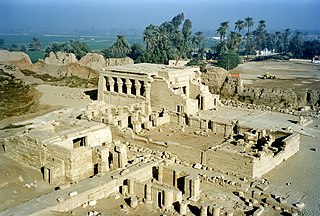

In ancient times - Tentira , the capital of the VI nome of Upper Egypt and the center of the cult of the goddess Hathor . Her , first explored by Mariet , has been well preserved since the last Ptolemaic ; It was completed by the Roman emperor Tiberius .
Content
- 1 History
- 2 Temple complex
- 2.1 Hathor Temple
- 2.2 Adjacent territory
- 3 See also
- 4 notes
- 5 Literature
- 6 References
History
An ancient cemetery near the walls of the Hathor Temple testifies to the population of the region in the pre-dynastic period . The mastabs of the Ancient Kingdom and the First Transition Period were richly decorated with hieroglyphic inscriptions and are an important source of information. Other burials date back to the Roman and Ptolemaic eras.
In ancient Egypt, the area was known as Yunet [5] . The modern Arab city is built on the site of Ta-ynt-netert , which translates as "Her divine support." In the Hellenistic period, Tentira [6] was the capital of the VI (Tentir) nom (septa) of Upper Egypt and was also called Nykentori or Nitentori , which means "willow tree" or "land of willow trees". The ancients believed that the name was given to the city by the goddess Hathor herself, revered in these parts. However, the crocodile was considered the official symbol of the city, as in many other Egyptian cities. This aspect often became the cause of zealous conflicts, such as with residents of the city of Ombo . In the era of Roman rule, the city of Tentiris became part of the province of Thebaid and the religious center of Ptolemaida . Little information has been preserved about the history of Christianity in the region, the names of two saints of that time are known - Pachomius the Great (beginning of the 4th century) and his associate Serapion, who founded the first hostel monastery in Tavenissi . The episcopal administration was reinstated under the name of Tentira in 1902, but the post has remained vacant since 1972.
The city received the modern name Dandara in the late period of Ottoman rule.
Temple complex
The length of 79 m the complex was built of sandstone, covers an area of approx. 40,000 square meters and is surrounded by a brick wall. The construction of the complex dates back to the Ptolemaic period and ended under the Roman emperor of Tiberius . However, under the foundation of the temples are buildings of previous eras, the oldest can be attributed to the reign of the builder of the Great Pyramid - Khufu (c. 2613 - c. 2494 BC). It is known about the restoration work under Pharaoh Piopi I.
Hathor Temple
Hathor Temple is one of the most famous in the complex and the best preserved in Upper Egypt. Its construction took 200 years. The building is distinguished by its uniqueness of architecture, accuracy and elegance of decorating walls and columns with hieroglyphs and images. Wall sculptures were granted at one time by the emperor Augustus , Tiberius , Claudius and Nero .
For a long time the temple was covered with sand, which did not save him from fanatics and vandals. The upper rooms were used as stables, where bonfires were made, which is why the ceilings are still covered with soot, and many paintings cannot be restored. For the first time, the excavation of the Hathor temple was undertaken in 1876 by the German Egyptologist Johannes Dumichen . Later, the complex was investigated by Mariet [7] .
Inside there is a huge hypostyle hall with 24 columns topped with images of Hathor. On the ceiling are astronomical scenes, on the walls - a description of the royal visit to the temple. On the roof there were several small shrines of Osiris , one of which depicts the solar disk and the zodiac ( Dendera zodiac ), exhibited today at the Louvre Museum . A copy of the image can be seen in the museum of Egypt.
The bas-reliefs in the Hathor temple with the " Lamps" of Dendera , depicting the conduct of the cult rite, cause a lot of controversy. Near-scientific theories based on the external similarity of the image speak out about the possibility of the use of lighting devices like modern ones by ancient people. Egyptologists associate the images with the symbolism of the Egyptians, designating "a god sprouting like a flower."
Adjacent Territory
To the west, behind the Hathor sanctuary, is a small temple of Isis , built and decorated during the reign of Augustus. To the north is a larger church than the Trajan period. Other buildings date back to Hadrian and Antoninus Pius .
In the west is a sacred lake planted with palm trees. The underground channels leading to the Nile still show the water level in the river. Nearby stood the gate of Mentuhotep II (moved to the Cairo Museum ). To the east of the lake, several early Christian buildings have survived, which may be associated with the monastic activity of the disciples of Pachomius the Great .
Excavations in front of the temple
Temple complex
Colorized photo
Exterior Wall of Hathor Temple
"Lamps" Dendera
Zodiac circle
Roman columns in front of the temple complex
Hieroglyphic inscriptions on granite
Sarcophagi
Colored relief of Hathor Temple
The capital of the columns of the temple
See also
- Kom Ombo
Notes
- ↑ archINFORM - 1994.
- ↑ http://www.geonames.org/358422
- ↑ http://www.webcitation.org/69vqYKrAW
- ↑ Egypt // Atlas of the World / comp. and preparation. to the ed. PKO "Cartography" in 1999; open Ed .: T.G. Novikova , T.M. Vorobyova . - 3rd ed., Eras., Fr. in 2002 with diaposes. 1999 - M .: Roskartografiya, 2002. - S. 186. - ISBN 5-85120-055-3 .
- ↑ Iunet (Dendera) . Philae-Data . Archived on May 17, 2008.
- ↑ Félix Teynard. Dendérah (Tentyris), Temple d'Athôr - Face Postérieure - Cléopatre et Cæsarion . The Metropolitan Museum of Art.
- ↑ Mariette Auguste. Dendérah: description générale du grand temple de cette ville. - 5 Bde .. - 1870-1874.
Literature
- Winter: A Reconsideration of the Newly Discovered Building Inscription on the Temple of Denderah , in: Göttinger Miszellen, Nr. 108, Göttingen 1989 ISSN 0344-385X
- Mariette Auguste: Dendérah: description générale du grand temple de cette ville , 5 Bde., 1870-1874 [1]
- Sylvie Cauville: Dendera. In: Kathryn A. Bard (Hrsg.): Encyclopedia of the Archeology of Ancient Egypt. Routledge, London 1999, ISBN 0-415-18589-0 , S. 252-54.
Links
- Dendera // Encyclopedic Dictionary of Brockhaus and Efron : in 86 volumes (82 volumes and 4 additional). - SPb. , 1890-1907.
- Hathor Temple Photo Tour
- Temple of the Goddess of Love with Cow Ears