
White clover

Sowing alfalfa
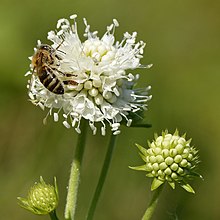
Sivets

Common bruise and forest bumblebee

Heart-shaped linden
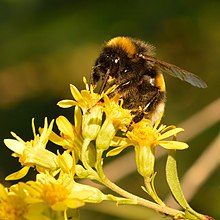
Common goldenrod

Rough Cornflower
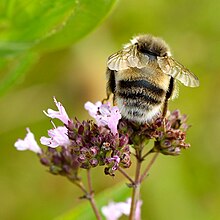
Origanum common
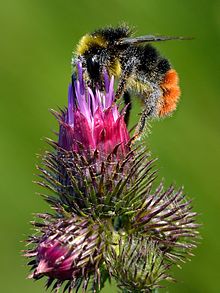
Curly thistle

Tatar maple

Blackberry gray

Meadow clover
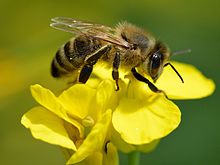
Rape
Medonos is a plant visited by bees to collect nectar , pollen [1] from flowers and adhesive from young leaves and shoots . In the hives, these products are processed, respectively, into honey , bee bread and propolis . The formation of paddy - sugar secretions of some insects also belongs to honey properties. Mortar honey of very low quality can cause disease and death of bee families.
List of some honey plants and properties of bee products:
- Amorpha shrubby . Mediocre honey plant, but it gives a lot of pollen; in a short time, bees can fill 2–5 frames with a dark-violet colored feather. Sometimes bees occupy so many hundreds of them that there is not enough space for laying eggs. The bees eat it reluctantly, and during the wintering, such a bee bread spoils, stony in the comb.
- Ankhuza officinalis . Spring-summer honey plant, according to the allocation of nectar, is close to an ordinary bruise.
- Ledum is swamp . Flowers secrete significant amounts of nectar and are readily visited by bees. Fresh honey has weak narcotic properties, it should be warmed up before use.
- Barberry In May - June it gives a lot of nectar, together with other forest honey plants, it helps to prepare the bee family for summer bribes. The honey tastes good, light yellow.
- Birch tree All species - highly productive spring pollen, provide the most valuable food for bees, with a high fat content. Bees collect raw materials for propolis from young leaves.
- Hawthorn . Late spring honey plant is readily visited by bees.
- Lingonberry . Gives a supportive bribe, medical productivity up to 50 kg / ha.
- The budra is ivy and the budra is hairy . Spring-summer long-flowering honey plant, in the spring gives supportive bribes. Honey is light yellow, aromatic.
- Elderberry is black . Spring-summer honey plant, gives supportive bribes. With continuous planting, honey productivity is up to 85 kg / ha.
- Valerian officinalis . Mediocre honey plant, gives only nectar. Honey productivity 87–137 kg / ha.
- Heather . A very good autumn honey plant, gives a productive bribe at a time when other honey plants have already bloomed. A bribe helps brood the bees for the winter. Honey productivity is 60-100 kg / ha, one family can collect 8-25 kg. The honey is dark yellow and red-brown in color, thick, aromatic, slightly tart. Compared with other varieties, it contains more mineral and protein substances, so when wintering on heather honey, diarrhea of bees can be observed.
- Veronica Species of this genus are spring-summer melliferous plants giving supporting bribes. Honey production up to 18 kg / ha.
- Daphne . Early spring honey plant, honey productivity 15 kg / ha. Freshly harvested honey is toxic, causing inflammation and acute pain in the mucous membranes of the mouth and intestines. It can be consumed after boiling. There are indications of toxicity to bees.
- The elm is smooth and the elm is bare . Good spring nectaronoses and dust-bearing plants also give propolis. In summer they can give off a paddy. Other types of elm are less important.
- Three-throated gledichia . Summer honey plant in the southern regions gives a productive bribe. It also releases nectar in dry weather. Honey production up to 200-250 kg / ha.
- Highlander pepper . Honey production is up to 180 kg / ha, other mountaineer species are less productive, but they produce nectar throughout the summer.
- Buckwheat sowing
- Pear Mediocre honey plant, gives supportive bribes. Honey productivity is 15-20 kg / ha.
- Loosestrife loosestrife and loosestriferacea rod . Summer-autumn nectaronos and dust-bearing plants, contributing to the autumn build-up of offspring, serve to replenish honey reserves for the winter. The honey productivity of 360-420 kg / ha provides a daily increase in the stock of one family by 5 kg. Honey is dirty yellow, aromatic, slightly tart.
- Ordinary oak and rock oak . Good spring pollen, in some years, bees collect nectar from female flowers. Oak is dangerous due to the possibility of a large number of paddy.
- Origanum ordinary . A good summer honey plant, eagerly visited by bees, especially in the first half of the flowering period. Honey productivity of 3-20 kg / ha in the presence of 50-400 stems.
- Angelica officinalis . In warm and humid weather, it releases a lot of nectar and is readily visited by bees. Honey production up to 90 kg / ha. Honey of pleasant taste, fragrant, easily crystallized.
- Blackberry Honey productivity is 20-25 kg / ha, honey is light, transparent, with a weak aroma.
- Joster is a laxative . Gives supportive bribes, medical productivity up to 25 kg / ha. Liquid honey, does not crystallize.
- Goldenrod common . Autumn honey plant is valuable in that it provides the necessary winter supply of honey and pollen. The honey is golden yellow, with a pleasant taste.
- Willow . Species of willow are of great value for beekeeping, since nectar and pollen are already given in early spring, these first bribes contribute to the growth of brood. Different species bloom at the same time, this stretches the overall flowering period.
- Hyssop officinalis . Bees collect nectar and a lot of pollen. Honey is very fragrant [2] .
- Viburnum vulgaris . Mediocre late spring nectar-pollen, honey production up to 30 kg / ha.
- Karagana is tree-like , or yellow acacia. Late spring honey plant, gives a supportive or productive bribe. Honey production up to 300 kg / ha. Honey is transparent, light yellow, without a pungent odor, with a delicate taste, does not crystallize for a long time. Many beekeepers value it above linden, it is also suitable for wintering bees.
- Chestnut
- Dogwood is ordinary . Very good early spring honey plant, gives nectar, pollen and propolis.
- Narrow leaf fireweed ( Ivan tea ). Very good summer honey plant with a honey productivity of 500-600 kg / ha. A family can bring up to 12 kg of honey to the hive per day. Pollen, its pollen with an adhesive coating gives propolis. The honey is transparent, greenish, with a delicate aroma, crystallizes into a white saline mass.
- Clover
- Maples Very good spring honey plants, in the presence of large arrays give a productive bribe. The highest honey productivity in field maple is up to 1000 kg / ha, in other species it is 100-120 ( Tatar maple, false-plane maple ), sometimes more than 200 kg / ha ( acutifolia ). Sometimes on the maples there is a pad.
- Coriander
- Buckthorn is brittle . A good honey plant, blooms throughout the summer, gives persistent bribes of nectar and pollen, in woodlands gives marketable honey. Honey production is up to 25 kg / ha, the bee family collects 2-4 kg of honey per day. Aromatic honey, darker than raspberry, coarse-grained.
- Common meadowsweet and meadowsweet . Good summer nectaronos and dust-bearing plants.
- Common hazel . One of the most important forest dusters, in early spring, bees take from it high-quality bee bread with a high content of proteins and vitamins. Often pollen is prepared for winter and early spring feeding of bees.
- Linden heart-shaped and linden European . An important summer honey plant, giving a productive bribe, can produce a type mixed with buckwheat. Honey productivity reaches 600-800 kg / ha, but it greatly depends on weather conditions and the age of plantings. Trees aged 20–25 years are most intensively secreted by nectar; the best weather conditions are daytime temperatures of about 25 ° C, variable cloud cover and high humidity. Collection of linden honey per family ranges from 7 to 20 kg. Bees take little pollen from linden. Honey is light yellow, sometimes with a greenish tint, with the smell of "linden", valued above many varieties. Sometimes, after flowering, bees collect a pad secreted by aphids , a linden pad is most dangerous to the health of bees.
- The goof is narrow-leaved . Valuable early summer honey plant, blooms 10 or more days, bees take nectar from it mainly. Gives supportive bribes necessary to prepare a family for the main summer bribe, especially in the steppe regions. Prepared bee colonies also collect marketed honey from sucker; during flowering, they can replenish supplies by 4–13 kg. Honey production up to 200 kg / ha.
- Raspberries . Excellent honey plant, honey productivity up to 50-100 kg / ha. It has a long flowering period, during which the bee family collects 3.5-5.5 kg of honey per day. Honey is light, often white, suitable for wintering bees.
- Coltsfoot common . One of the earliest melliferous plants, the honey productivity of up to 18 kg / ha, of bribes contributes to the development of brood.
- Lungwort medicinal and Lungwort soft . Early spring honey carriers, honey productivity up to 100 kg / ha. Honey can irritate the oral mucosa.
- Spurge
- Buckthorn buckthorn . Good summer pollen, gives a lot of highly nutritious pollen.
- Cucumber grass . Excellent honey plant, blooms from May to August, honey is light and aromatic, honey productivity up to 200 kg / ha.
- Medicinal dandelion . From early spring it gives a large amount of pollen, rich in protein. Strong families collect from dandelion up to 3 kg of honey per day. Honey productivity 4.3 kg / ha. The honey is thick, bright yellow or dark amber in color; it crystallizes quickly.
- Comfrey officinalis . Early summer honey plant, gives supportive bribes. Honey productivity 25 kg / ha.
- Sticky alder and gray alder . Early spring pollen gives propolis from young leaves and shoots. It is recommended to feed bee colonies before the alder blooms. To do this, the cut branches are kept in a warm room, after opening the anthers, pollen is separated using a sieve and mixed with honey or syrup.
- Stonecrop is caustic . Summer nectaronos and pollen, gives supportive bribes. It is valuable in that it secretes nectar during drought and is actively visited by bees. Honey production - up to 35 kg / ha. Golden yellow honey, belongs to the highest grades.
- Stonecrop ordinary . Good autumn honey plant, in two weeks of September each family can take 8-10 kg of honey. The honey is light yellow, of high quality, does not crystallize in the honeycombs in winter and is well consumed by bees.
- Plantain . Good pollen, especially medium plantain .
- Sunflower
- The two-leaved and the Siberian spells . Early spring nectar-dust-bearing plants, honey productivity is insignificant, but they are valuable in that they bloom immediately after snow melts.
- Motherwort is five-lobed . Good summer nectar-dusting plant with a long flowering period. Honey productivity is 240-300 kg / ha. Honey is light, transparent, with a specific, but not pungent odor.
- Russian broom and Zinger broom . Late spring nectaronos and dust-bearing plants are significant in places of mass distribution.
- Rape
- Robinia vulgaris , "white acacia". One of the best early summer honey plants that give productive bribes. Honey productivity is 100-300, in more southern areas it can reach 1000 kg / ha. A bribe per family can reach 5-8 kg per day and up to 80 kg per flowering period. Honey (usually called "acacia") is considered one of the best varieties, white, transparent. Due to the high content of fructose, it crystallizes slowly and forms a soft fine crystalline mass with a consistency of lard.
- Rhododendron is yellow , or Pontic azalea. It releases a large amount of nectar and is readily visited by bees, but honey is toxic to bees and to humans, it can cause the death of adult bees, queens and larvae. When you use two to three tablespoons of even pollen from azalea honey pollen, diarrhea, vomiting, chills, weakening of cardiac activity and loss of consciousness occur.
- Mountain ash . Medium-productive spring nectaronos, good pollen. They give supportive bribes, medical productivity up to 30-40 kg / ha.
- The bruise is ordinary . Valuable summer honey plant, recommended for sowing in accessory areas. Honey productivity 300-400 kg / ha. In a drought, the release of nectar decreases, but only slightly compared to other honey plants. Bees visit bruise flowers throughout the day, take nectar and pollen. The daily bribe is up to 6-8 kg per family. Honey of light amber color, with high taste, dense texture, slowly crystallizes and is well stored.
- Black currant . Spring nectaronos and pollen. Honey productivity 30-140 kg / ha.
- Common somnolence . A good honey plant, valued on a par with Ivan tea, sometimes replaces it if Ivan tea does not give a bribe. It is readily visited by bees, especially in the morning.
- The colza is ordinary . The honey productivity of continuous massifs reaches 40-50 kg / ha. The honey is greenish-yellow, has a pleasant but weak aroma.
- Turn . Spring honey plant, giving supportive bribes. Honey production up to 30 kg / ha.
- Common thyme and other types of thyme. Good summer melliferous plants secrete nectar all day long. During the season, one bee family can collect up to 15-20 kg of honey. Cultural honey production is 140 kg / ha with a plant density of 8300 per hectare.
- Poplar . Pollen, provides valuable nutritious food for bees. It is one of the most important sources of propolis.
- Yarrow . Summer honey plant, gives nectar and a large amount of pollen.
- Violet . Types of violets - honey plants that give only nectar.
- Coniferous trees . They are dusty, sometimes they intensively secrete a pad with which the bee family can take up to 4 kg of pade honey (from spruce ) per day, such honey has a tarry taste and smell, and is harmful to bee families. Bees collect pollen from pine trees reluctantly.
- Common bird cherry . Spring nectaronos and pollen, gives supportive bribes. Sometimes it gives off a pad.
- Blueberries Spring-summer honey plant, mainly gives supportive bribes. During the day, bees collect up to 2.5 kg of honey per hive, and honey productivity is 30-80 kg / ha. Honey is transparent, aromatic, has healing and dietary properties.
- Black root medicinal . Late spring and early summer nectaronos, taking bribes from it contributes to the growth of the bee family before a productive bribe. Allocates a lot of nectar, one bee is enough to visit 3-4 flowers. Honey is transparent, colorless.
- Chistyak spring . Early spring honey plant is readily visited by bees.
- Rosehip . Types of wild rose are mostly dust-bearing, very little is secreted by nectar. Recommended for planting in places where at the end of May - June there are few other dust-bearing plants.
- Cotton plant . Good summer-autumn honey plant, honey productivity up to 300 kg / ha. The honey is light and only after crystallization becomes white, has a peculiar aroma and delicate taste. It usually crystallizes quickly and then becomes almost white and fine-grained.
- Evening primrose is two years old . Gives a supportive bribe, one flower contains enough nectar to fill a bee’s honey goiter. Honey production up to 40 kg / ha. Evening primrose pollen is too sticky, and bees do not collect it.
- The apple tree . Valuable spring nectaronos and especially pollen, bees collect large stocks of bee bread from it. Honey productivity is 18-20 kg / ha.
- Lamb is white and blotchy spotted . Good summer nectaroses and dusters, honey production up to 540 kg / ha.
Notes
- ↑ As M. M. Glukhov notes, only those plants that give nectar to bees can be called honey plants, and plants that produce one pollen are called pollen cultivars.
- ↑ Abrikosov H.N. et al. Issop // Dictionary of the beekeeper / Comp. Fedosov N.F .. - M .: Selkhozgiz, 1955. - S. 131.
Literature
- Elin E. Ya., Zerova M. Ya. Et al. Gifts of forests. - Kiev: Harvest, 1979. - 392 p. (in Ukrainian )