
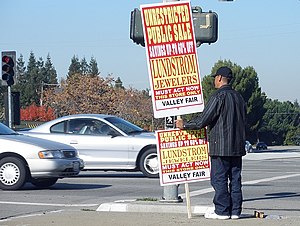
Live advertising , Walker [1] is a conditional name that is used to denote advertising in public .
Most often this consists of wearing posters , suits, clothes, accessories with advertising, advertising signs, and even in the application of advertising tattoos on the body.
Content
- 1 History
- 2 Types of "live advertising"
- 2.1 “Sandwich People”
- 2.2 "Interactive People Sandwiches"
- 2.3 "Pointers"
- 2.4 Advertising on clothes
- 2.5 Tattoos
- 2.6 Costume advertising
- 3 In culture
- 4 notes
- 5 Literature
- 6 References
History
Live advertising has been used for several centuries. It originated in London in the 19th century, when traditional advertising began to be taxed , and competition for “place on the wall” became too high. This led manufacturers to come up with various tricks. So, Prince Pückler-Muskau described the case when one person wore a cardboard hat three times higher than any other hat, on which it was written in large letters: "Boots of twelve shillings per pair is justified." [2] . In fact, this was one of the first examples of the use of "live advertising". Around the same time, “sandwich people” appeared in London . [2] As described by Charles Dickens , they were "a piece of human meat between two slices of glued cardboard." While in England "two-legged advertising" was already a common occurrence, in other countries it was a curiosity. Later, such an advertisement appeared in France and was called l 'Homme-affiche ( fr. "Poster man").
Types of Live Advertising
Conventionally, “live advertising” can be divided into the following categories:
- Sandwich People (Sandwich People)
- Interactive People Sandwiches
- "Pointers"
- Advertising on clothes
- Tattoos
- Costume
Sandwich People
This type of advertising is the wearing of a cardboard billboard with an advertising inscription. Such “sandwich people” can often be seen on the streets of big cities. Their work is often accompanied by the distribution of advertising booklets - the so-called flyers.
Interactive Sandwich People
Is a variation of "Sandwich People". The main difference is the interactive content that is played using the advertising monitor built into the sandwich. This device is powered by batteries. Can play videos and photos. To store files with content, external flash drives or the built-in memory of an advertising monitor are used. Creativity far surpasses Sandwich People. An example can be seen here or here .
Pointer People
Used in crowded places with pedestrians or motorists. In this case, people hold arrows pointing to specific advertised places. This species is more popular abroad than in Russia. Nevertheless, the use of such funds is often criticized by the city authorities, as it can be a distraction for drivers.
Clothing Advertising
This type of advertising is also very popular, largely due to the extreme popularity of T-shirts. At first, T-shirts were used exclusively as underwear, but already in the 1930s they were used for advertising. In 1939, the Wizard of Oz Promotional Shirt was released, which has now become a collector's rarity. [3] The latest trend is moving pictures on clothes. This was first done in 2003 at the Rugby World Cup, where Telstra girls wore T-shirts equipped with a small screen and a DVD player called TelePAKs.
Tattoos
In 1999, Vibe magazine predicted that in the next millennium, companies would pay people to get tattoo advertisements for their brands. [4] In March 2001, American professional basketball player Rashid Wallace rejected an offer from advertising company Fifty Rubies Marketing to wear tattoos advertising candy companies. In September 2001, a well-known online casino paid boxer Bernard Hopkins (USA) $ 100,000 to wear a temporary tattoo on his back during a fight with Felix Trinidad, making him the first athlete to use promotional tattoos in professional sports. [5] Six months later, the company did the same for members of the Celebrity boxing television show.
Costume advertising
She represents a specially hired person, dressed in an advertising suit , which should draw attention to the advertised place (company) in every possible way. Typically, a suit is a symbol of the advertised company or an object directly related to the company’s activities.
In Culture
- Blucher tablets - Masyani series
Notes
- ↑ Walk // Explanatory Dictionary of the Living Great Russian Language : in 4 volumes / auth. V.I. Dahl . - 2nd ed. - SPb. : Printing house of M.O. Wolf , 1880-1882.
- ↑ 1 2 "London placard carriers and 'sandwich men', 1820-1840."
- ↑ Dixon, Mark E .. “A T-Shirt History”
- ↑ O'Briant, Don. (August 10, 1999) The Atlanta Journal-Constitution
- ↑ Coates, Pete. (October 7, 2001) Milwaukee Journal Sentinel
Literature
- Walk // Explanatory Dictionary of the Living Great Russian Language : in 4 volumes / auth. V.I. Dahl . - 2nd ed. - SPb. : Printing house of M.O. Wolf , 1880-1882.