Mescal ( Spanish: mezcal ) - a drink obtained by distillation of fermented agave juice. The word mezcal has its roots in the Nahuatl language: melt , which means agave, and ixcalli , which means cooking. Thus, mexcalli literally translates as "cooked agave." This drink is a reflection of the difficult history and distinctive culture of Mexico, which is its homeland. In common parlance, mezcal is tequila without further processing.
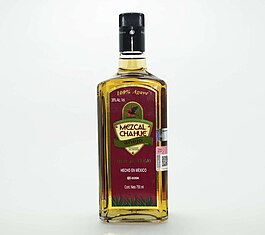
A drink can be called "mezcal" if it is made:
- by distillation of one of the 5 types of agave;
- in one of 9 states (Oaxaca, Durango, Guanajuato, Guerrero, San Luis Potosi, Tamaulipas, Zacatecas, Michoacan, Puebla);
Content
Origin History
Thanks to several studies, it has been proven that agave has been used by the inhabitants of Mesoamerica for more than nine thousand years.
This plant can be used as food, fibers for clothes and shoes, or as material for building houses. His thorns were used as nails and needles for rituals, and today they are used as alternative folk medicine.
Thanks to all these merits, agave was revered by the ancient inhabitants of Mesoamerica, who named the Mayauel, the goddess of fertility in honor of this plant.
Of course, agave was also used in the manufacture of alcohol. Even before colonial time, the inhabitants of Mesoamerica used it as a raw material in the preparation of fermented drinks.
They were an integral part of important religious rituals, therefore access to them was allowed only to sacred and noble people of that time.
One of the oldest distillation methods was the Philippine hearth. Filipino furnace technology used local materials such as clay and wood. Thanks to this, the production process is easily adapted for distillation in the conditions of artisanal production. Each district or village used what they had in abundance: local varieties of agave, tools for chopping, tree species growing on their territory, clay for their pots and metal used for their plates and fireplaces. Thus, each region created its own tools and methods for the production of its own distillate, receiving a huge variety of distillates in accordance with the regional characteristics of production.
Initially, this distilled beverage was known as “de vie” or “mescal wine”. But after some time the prefix “wine” or “o de vie” was omitted, and the drink took on the name known as “mezcal”.
In the eighteenth century, mezcal production was gaining momentum and becoming the leading industry in some regions.
The Spaniards during the colonization brought the copper still apparatus, which was inherited from the Arabs. They, in turn, used it to obtain essences.
During their studies of Mesoamerica, the conquerors discovered agave and products obtained by its fermentation. Therefore, they decided to start distilling these drinks to produce liquids with a high percentage of alcohol.
However, during the Spanish colonial activity in Mexico, the crown banned the consumption and production of mezcal, arguing this was a "pernicious abuse of public health and royal interests." But, of course, this had personal economic interests underneath. The ban was created to preserve the import of alcoholic beverages from Europe,
Despite this, mezcal continued its existence and production among small producers in artisanal conditions, preserving the teachings of its ancestors.
Towards the end of the nineteenth century, when Mexico gained independence, some entrepreneurs introduced modernized agave distillation methods to Jalisco.
The main distribution and popularity received mezcal made in the city of Tequila. Its production was distinguished by some changes in the process of preparation and processing of agave. It began to be called as "mezcal from the city of Tequila", but, over time, the name was reduced, and the drink received the name Tequila. During the twentieth century, capitalist influence led to an increase in the production of the alcohol industry and Tequila, as a better-known product, gained prestige and made mass production possible.
Manufacturing Technology
Of course, it all starts with agave. In fact, several species of agave have been domesticated and cultivated. However, wild agave has traditionally been appreciated by producers an order of magnitude higher. To reach maturity, the plant needs about 7-8 years. However, there are also champions - aged 40-50 years. These wild agaves are mainly found in the most inaccessible places.
Collection
It consists in cutting agave leaves and cutting off the central trunk from the root that feeds it, with a special tool sharpened at one end, which is called “koa”. Agave pickers are called "chemical workers." Agave must be harvested before the beginning of the inflorescence, which precedes the propagation of agave. This is important because all the sugars accumulated during the entire growth of agave (and this is at least 7-8 years) will go into the growth of inflorescences, which cannot be allowed in the process of making mescal. After all, the more sugars left in pinha, the more alcohol can be obtained.
Already at this stage there is a creation of the taste of the future drink. Here, partly determined flavoring properties, namely astringent herb. The closer the leaves are cut off to the pinha, the sweeter the agave mash will be.
Roasting
With baking, the agave cooking process begins. There are three most common ways:
- The Earth pit is the most authentic method. A pit in the form of a crater is excavated in the ground, which is lined with stones from the inside. At the bottom is placed wood, which when heated heats the stones. The type of wood burned also affects the taste of the future drink. Agave is located on the stones (up to 10 tons are usually placed in such a pit). The baking process lasts from 5 to 7 days.
- stone stoves - rooms with walls of blocks or stones. The agave inside is exposed to hot steam. Such furnaces hold up to 20 tons and the cooking process takes up to 3 days.
- Autoclave is a modern method. It can be considered as a big pressure cooker. Some autoclaves can hold up to 30 tons, and cooking time up to 18 hours.
Thermal action contributes to the decomposition of complex sugars into simple ones, which will participate in the subsequent fermentation process.
Shredding Process
It aims to extract juices that enter the fermentation process. There are 4 most common methods:
- manual - an ax or machete is used to grind agave into small fragments. Then they are crushed with wooden mortars.
- tachon is a circular millstone, often made of volcanic stone, which weighs 200-1000 kg and is driven by a donkey, horse or tractor around an axis on a concrete base.
- mechanical shredders (shredder ) -: in the past few decades, some of the artisanal manufacturers have facilitated the grinding process. The motor is strong enough to grind agave, which saves time and efforts of producers.
- conveyor - these machines are the most efficient in an industrial production line using a number of mechanical crushers and presses. Agave passes through them several times until a complete extraction of its sweet juice is achieved.
Fermentation
This is the process by which microorganisms convert sugar to alcohol. The speed and activity of the process is characterized by the appearance of bubbles in agave juice. Its characteristic sound is an indicator of the development of the process. In handicraft production, agave, the fibers and juices obtained from it, are poured into containers and fermentation takes 3-10 days in total. The most common are tanks made of wood from each region. However, there are also tanks made of stone, tanks and even animal skins. Modern stainless steel tanks are also used. Only agave juice is fermented in them. Since they allow manufacturers to control the temperature and the result is achieved in just 18 hours or even less.
Distillation
It involves heating the liquid to a boil, and then capturing the generated vapor through a cooling system, which lowers its temperature and condenses it. Depending on the scale of production, the following are used: Philippine horn, Alambique, continuous-type columns, combined methods.
Exposure
This stage is extremely rare for mezcal producers. After all, exposure usually smooths out flaws. Therefore, master mescal distillers say: "there is no need to improve what is already perfect." According to the degree of aging, mezcal is divided into three main types: Joven (without aging in wood barrels), Reposado (literally: “rested”, aged in barrels for several months) and Anejo (aged in barrels for up to several years). Tequila, unlike mezcal, is aged in barrels and longer, up to 14 years - Extra Aneja.
Spill
Mescal styles
According to the scale, raw materials and production technologies, the following styles are distinguished:
-Ancestral-
Indicates that hand tools have been used for centuries: clay, wood, reeds and agave leaves. And hands. The distillation takes place in a clay vessel, on top of which is a bowl of water to collect condensate on the back side. To do this, you can use a reed tube and a sheet of agave placed inside the vessel. Heating is carried out by fire from a fire.
-Artisanal-
It is the most common. The distillation is carried out in a copper distillation cube. Some manufacturers have their own characteristics, for example, that the use of wood, which adds other flavors during evaporation. Distillation is carried out in batches. This implies that distillers are loaded and unloaded after each distillation. (??)
-Modern-
They include both continuous and fractional distillation columns of continuous operation, which allow you to increase the efficiency of separation of alcohols and flavors that we just studied, and you have some idea about the production processes of mezcal, which give the spirit its diversity and complexity.
Mescal flavor and aroma
The specificity of a particular production process affects the aroma, which mezcal will subsequently possess. They can be divided into 4 groups according to origin:
- Smokiness - acquired during baking in cone-shaped earth furnaces due to the release of certain molecules during combustion. Characteristic notes are chili peppers, chocolate, wood, smoke. The higher the alcohol content in mezcal, the less intense these aromatic profiles will be. Factors of influence are also the type of wood, its quantity and the size of the land furnace.
- Green agave - is a consequence of the presence in raw agave of a large number of extraordinary essential oils, which include the following notes: anise, citrus, green and floral notes, as well as characteristic grassy notes of bitterness.
- Baked agave - a flavor that occurs as a result of chemical reactions that occur during the baking of “piny”. Proteins combine with sugars, releasing compounds that characterize the profile aroma of mescal. In the process of prolonged baking in the underground ovens, sweet, fried notes are formed, as well as aromas of peanuts, almonds, baked pumpkin, brown sugar, honey and caramel.
- Bacterial fermentation - acquired during the fermentation during the conversion of sugar to ethanol. In the production of mezcal, this stage is started using wild yeast. They are in the environment, namely in the air, wood and any objects in contact with the liquid during production processes. The aromas characteristic of bacterial fermentation are pineapple, dried fruits, hair spray, gas, paint, leather, animal notes. Sometimes they prevail so much that they are perceived as defective notes.
The variety of mezcal is a consequence of many factors that create a wide range of tastes and aromas. In general, we can talk about the influence of 3 main ones, namely:
Agave variety used
The type of agave or their combination, the method of cultivation (cultivated or wild-growing variety), the use or absence of chemical fertilizers and pesticides - all this affects the result and taste of mescal.
Variety of manufacturing processes
Collection, baking, grinding, fermentation, distillation, aging, infusion - all these processes are different in different regions due to cultural heritage and family traditions. For example, two identical varieties of agave were harvested the same way, the same time passed under the same conditions when baking, after the same grinding, the fermentation process went differently. The first instance underwent fermentation with the addition of fiber (agave fibers), and the second without addition. As a result, the mescal from the first case will receive characteristic grassy-astringent notes in taste and aroma, while the second will have a less pronounced character.
Terroir
This concept includes the sum of geological and climatic factors. Different temperatures, humidity, soil affect, firstly, the growth of agave, the amount of sugar and water in it, as well as other trace elements, and, secondly, these factors affect the populations of yeast and active microorganisms that participate in the subsequent fermentation process .
Literature
- Lyubov Sergacheva; Alexander Kotlyarov ;. Exotic II. Mescal. About Mescal // Mescal = Alcoholic Beverages Electronic Library. - M .: Creative group "Good Weather", 2007.
- Ray Foley. Chapter 15. Tequila and Mezcal // Cocktail Recipes for Dummies = Bartending For Dummies. - M .: "Dialectics" , 2007. - S. 416. - ISBN 0-7645-5051-9 .