Hydrazine (diamine) H 2 N — NH 2 is a colorless, extremely toxic, highly hygroscopic liquid with an unpleasant odor.
| Hydrazine | |
|---|---|
 | |
 | |
 | |
| Are common | |
| Systematic name | Hydrazine |
| Chem. formula | N 2 H 4 |
| Physical properties | |
| condition | colorless liquid |
| Molar mass | 32.05 g / mol |
| Density | 1.01 g / cm³ |
| Ionization energy | |
| Thermal properties | |
| T. melt. | +2 ° C |
| T. bale. | 114 ° C |
| T. aux. | |
| Etc. blast | |
| Steam pressure | |
| Chemical properties | |
| pK a | |
| Solubility in water | mixes up |
| Classification | |
| Reg. CAS number | [302-01-2] |
| PubChem | |
| Reg. EINECS number | |
| Smiles | |
| Inchi | |
| RTECS | |
| Chebi | |
| UN number | |
| ChemSpider | |
| Security | |
| GHS icons |      |
| NFPA 704 |  3 3 2 |
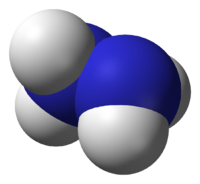
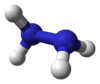
The N 2 H 4 molecule consists of two NH 2 groups rotated relative to each other, which determines the polarity of the hydrazine molecule, μ = 0.62⋅10 −29 C · m. Miscible in any ratio with water , liquid ammonia , ethanol ; in nonpolar solvents it is poorly soluble. Forms organic derivatives: alkyl hydrazines and aryl hydrazines .
It was discovered in 1887 by Theodore Curcius [3] .
Properties
Thermodynamically, hydrazine is much less stable than ammonia, since the N – N bond is not very strong: decomposition of hydrazine is an exothermic reaction that proceeds in the absence of catalysts at 200–300 ° C:

Transition metals ( Co , Ni , Cu , Ag ) catalyze the decomposition of hydrazine. During catalysis with platinum , rhodium and palladium, the main decomposition products are nitrogen and hydrogen:

Due to the presence of two lone pairs of electrons from nitrogen atoms, hydrazine is capable of joining one or two hydrogen ions. When one proton is attached, hydrazinium compounds with a charge of 1+ are obtained, two protons - hydrazonium with a charge of 2+, containing respectively N 2 H 5 + and N 2 H 6 2+ ions . Aqueous solutions of hydrazine have basic properties, but its basicity is much less than that of ammonia:
(for ammonia K b = 1.78⋅10 −5 )
Protonation of the second lone pair of electrons is even more difficult:
Hydrazine salts are known - hydrazinium chloride N 2 H 5 Cl, hydrazinium sulfate N 2 H 6 SO 4 , etc. Sometimes their formulas are written N 2 H 4 · HCl, N 2 H 4 · H 2 SO 4 , etc. and called hydrazine hydrochloride, hydrazine sulfate, etc. Most of these salts are soluble in water.
Hydrazine salts are colorless; almost all are readily soluble in water. Among the most important are hydrazine sulfate N 2 H 4 · H 2 SO 4 .
Hydrazine as a reducing agent
Hydrazine is an energetic reducing agent . In solutions, hydrazine is usually also oxidized to nitrogen:
Hydrazine can be reduced to ammonia only with strong reducing agents, such as Sn 2+ , Ti 3+ , with hydrogen at the time of isolation (Zn + HCl):
It is oxidized by atmospheric oxygen to nitrogen, ammonia and water. Many organic hydrazine derivatives are known. Hydrazine, as well as hydrazine hydrate, hydrazine sulfate, hydrazine chloride, are widely used as reducing agents for gold , silver , platinum metals from dilute solutions of their salts. Copper under similar conditions is reduced to nitrous.
In organic synthesis, hydrazine is used to reduce the carbonyl group of aldehydes and ketones to methylene according to Kizhner-Wolf ( Kizhner-Wolf reaction), the reaction proceeds through the formation of hydrazones , which are then split under the action of strong bases.
Discovery
A qualitative reaction to hydrazine is the formation of colored hydrazone with certain aldehydes , in particular with p- dimethylaminobenzaldehyde.
Getting
Hydrazine is obtained by oxidation of ammonia NH 3 or urea CO (NH 2 ) 2 with sodium hypochlorite NaClO [4] (Rashig method):
the reaction is carried out at a temperature of 160 ° C and a pressure of 2.5-3.0 MPa.
The synthesis of hydrazine by the oxidation of urea with hypochlorite is similar in mechanism to the synthesis of amines from amides according to Hoffmann:
the reaction is carried out at a temperature of ~ 100 ° C and atmospheric pressure.
The Bayer method is also used:
Application
Hydrazine is used in organic synthesis , in the production of plastics , rubber , insecticides , explosives , as a component of rocket fuel , as a reducing agent in the recovery of gold from solutions.
Hydrazine sulfate is used in the case of diseases such as inoperable progressive common forms, relapses and metastases of malignant tumors - lung cancer (especially non-small cell), mammary glands , stomach , pancreas , larynx , endometrium , cervix , desmoid cancer , soft tissue sarcoma , fibrosarcoma , neuroblastoma , lymphogranulomatosis , lymphosarcoma (monotherapy or as part of polychemotherapy ).
Hydrazine is also used as a fuel in hydrazine-air low temperature fuel cells.
A liquid mixture of hydrazine and ammonium nitrate is used as a powerful explosive with zero oxygen balance - astrolite , which, however, is currently not practical.
Hydrazine is widely used in the chemical industry as a reducing agent for oxygen contained in demineralized water used to power boilers (boiler plants, production of ammonia, weak nitric acid, and others). The following chemical reaction proceeds: N 2 H 4 + O 2 = N 2 + 2H 2 O.
Propellants
During World War II, hydrazine was used in Germany as one of the components of the Messerschmitt Me-163 fighter jet fuel ( C-Stoff , containing up to 30% hydrazine hydrate).
Hydrazine and its derivatives ( methylhydrazine , asymmetric dimethylhydrazine and mixtures thereof ( aerosin )) are widely used as rocket fuel. They can be used in tandem with a wide variety of oxidizing agents, and some can be used as a single-component fuel , in which case the decomposition products on the catalyst are the working medium of the engine. The latter is convenient for low-power engines.
| Oxidizing agent | Specific thrust (P1, s *) | Combustion Temperature ° C | Fuel density g / cm³ | The increase in speed, ΔVid, 25, m / s | Fuel weight% |
|---|---|---|---|---|---|
| Fluorine | 364.4 s | ° C | 1,314 | 5197 m / s | 31% |
| Tetrafluorohydrazine | 334.7 s | ° C | 1.105 | 4346 m / s | 23.5% |
| Clf 3 | 294.6 s | ° C | 1,507 | 4509 m / s | 27% |
| Clf 5 | 312.0 s | ° C | 1,458 | 4697 m / s | 26.93% |
| Perchloryl fluoride | 295.3 s | ° C | 1,327 | 4233 m / s | 40% |
| Oxygen fluoride | 345.9 s | ° C | 1,263 | 4830 m / s | 40% |
| Oxygen | 312.9 s | ° C | 1,065 | 3980 m / s | 52% |
| Hydrogen peroxide | 286.9 s | ° C | 1,261 | 4003 m / s | 33% |
| N 2 O 4 | 291.1 s | ° C | 1,217 | 3985 m / s | 43% |
| Nitric acid | 279.1 s | ° C | 1,254 | 3883 m / s | 40% |
- The specific thrust is equal to the ratio of thrust to weighted fuel consumption; in this case, it is measured in seconds (s = N · s / N = kgf · s / kgf). To translate the weight specific gravity to mass it must be multiplied by the acceleration of gravity (approximately equal to 9.81 m / s²). In the space and rocket sphere, the term “specific impulse of thrust” (expressed in m / s) or simply “specific impulse” (in seconds) is more often used for designation. Expressed in m / s, this value characterizes the velocity of the jet stream (approximately, taking into account the additional term in the thrust formula of the rocket engine). Specific impulse is the most important characteristic of the perfection of rocket engines. Depends on the type of fuel pair used, engine design and construction, and other parameters.
Toxicity
Hydrazine and most of its derivatives are very toxic. Small concentrations of hydrazine cause eye and respiratory tract irritation. With increasing concentration, dizziness, headache and nausea begin. This is followed by convulsions, toxic pulmonary edema, followed by coma and death. MPC in the air of the working area = 0.1 mg / m 3 . Belongs to the first class of danger [5] .
Notes
- ↑ 1 2 3 4 http://www.cdc.gov/niosh/npg/npgd0329.html
- ↑ Hall H. K. Correlation of the Base Strengths of Amines 1 // J. Am. Chem. Soc. / P. J. Stang - American Chemical Society , 1957. - Vol. 79, Iss. 20. - P. 5441-5444. - ISSN 0002-7863 ; 1520-5126 ; 1943-2984 - doi: 10.1021 / JA01577A030
- ↑ Volkov V.A., Vonsky E.V., Kuznetsova G.I. Outstanding chemists of the world. - M .: VSh, 1991 .-- S. 656.
- ↑ Tretyakov et al., 2001 .
- ↑ Technical hydrazine hydrate
Literature
- Akhmetov N.S. General and inorganic chemistry. - 4th ed., Rev. - M .: High School, 2003 .-- 743 p. - ISBN 5-06-003363-5 .
- Karapetyants M. Kh. , Drakin S. I. General and inorganic chemistry. Textbook for universities. - 4th ed., Erased. - M .: Chemistry, 2000 .-- 592 p., Ill. - ISBN 5-7245-1130-4 ; BBK 540 K 21; UDC 546 (075.8).
- Tretyakov, Yu.D., et al. 15.3.3.1. Hydrogen nitrogen compounds and their derivatives. Hydrazine. Hydroxylamine. // Inorganic chemistry. Chemistry of elements: Textbook for high schools. In 2 books. Prince II / Yu. D. Tretyakov, L.I. Martynenko, A.N. Grigoriev, A. Yu. Tsivadze. - M .: Chemistry, 2001 .-- S. 869-872. - 583 p., Ill. - ISBN 5-7245-1214-9 ; BBK 24.1 (I 7); UDC 546 T 66.
- Audrit L., Ogg B. Hydrazine Chemistry = The Chemistry of Hydrazine. - M .: IIL , 1954.- 238 p., Ill.