Saida [1] ( Arabic. صيدا , Saida - lit. “fishing”), in ancient times Sidon ( dates. 𐤑𐤃𐤍 , other Greek. Σιδών ) - the third largest city of Lebanon . Located on the Mediterranean coast , 25 miles north of Thira and 30 miles south of Beirut , the capital of Lebanon.
| City | |
| Pollock | |
|---|---|
| صيدا | |
| A country |  Lebanon Lebanon |
| Governorate | South lebanon |
| Area | Pollock |
| History and Geography | |
| Area | 7.86 km² |
| Timezone | UTC + 2 , in summer UTC + 3 |
| Population | |
| Population | 200,000 people |
| Density | 8 767 people / km² |
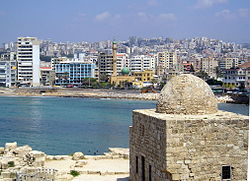

Also - one of the most ancient cities of Phenicia . The largest shopping center of the ancient world in the X - IX centuries BC. e. The Bible refers to “the firstborn of Canaan ” ( Genesis 10:15 ), the brother of Amorite and the Hittite .
In his honor , the gyrus of Sayd on the satellite of Jupiter to Europe was named .
Content
- 1 History
- 2 Paleogenetics
- 3 Famous residents
- 4 Twin Cities
- 5 See also
- 6 notes
- 7 Literature
History
Sidon has been inhabited since prehistoric times. During archaeological excavations at the site of Sidon II, stone artifacts belonging to the Acheulian culture were found , while finds at the site of Sidon III include macrolithic finds from the Neolithic era, presumably preceding the invention of pottery .
It was one of the most important Phoenician cities and perhaps the most ancient. In the XII century BC e. Sidon was plundered by the Philistines , but quickly recovered. Here and in other ports of Phenicia, the great Mediterranean trading empire was founded. Homer praised the art of the local craftsmen producing glass, purple, as well as the skill of female embroidery. For him, all the Phoenicians are Sidonians. It was the natives of Sidon who founded the city of Tire . Tire also grew into a great city, and in subsequent years there was competition between these cities, each claiming to be the mother country ("Mother of the cities") of Phenicia. Finally, the hegemony in Phenicia passed to Tire after the destruction of Sidon in 676 BC. e. the Assyrian king Asarhaddon , who crushed the rebellion of Abdmilkat . Glass production, the most important craft of Sidon of the Phoenician era, was of great importance; purple paint production was almost as important. Small pigments of Murex trunculus were used to extract the pigment.
In 1855, the sarcophagus of King Ashmunazor II was discovered. From the Phoenician inscription on the lid it becomes clear that he was the “king of Sidon”, probably in the 5th century BC , and that his mother was a priestess of Astarte , the Sidon goddess. In this inscription, the gods Eshmun and Baal Sidon (“Lord of Sidon”) are mentioned as the main gods of Sidon.
In the years preceding Christianity, Sidon had many conquerors: Assyrians , Babylonians , Egyptians , Greeks , and finally the Romans . Herod the Great visited Sidon. It is reported that Jesus Christ and St. Paul also visited him. The city was eventually conquered by the Arabs , and then the Ottoman Turks .
Like other Phoenician city-states, Sidon suffered from a succession of conquerors. At the end of the Persian era in 351 BC, it was captured by Tsar Artaxerxes III , and then Alexander the Great in 333 BC. e. Under the successors of Alexander, he enjoyed relative autonomy, sports competitions were held in which the greatest athletes of the region participated. Important finds were made in the Sidon Necropolis, such as Alexander’s Sarcophagus , Lycian Tomb and Weeping Sarcophagus , which are currently on display at the Archaeological Museum of Istanbul .
In June 2013, in the city of Saida, the rebellion of supporters of Sheikh Ahmed al-Asir was suppressed [2] .
Paleogenetics
Y-chromosome haplogroups R1b-M269, R1b-P312, R1b-P311, R1b-DF27, R1b-CTS300, E-L677, T-M70, J-M304, Q were found in Crusaders from Sidon who lived in the 11th – 13th centuries M346 and mitochondrial haplogroups HV0a, HV1b, H2a5, H5'36, U5a1g, J1b1a1, J1b4a1, J1d1a1 T2 [3] . Three people from the “crusader pit” were Europeans of various origins, including from Spain and Sardinia, four were close to the local population of the Eastern Mediterranean, two combined elements of European and Middle Eastern DNA and, possibly, were descendants of the crusaders and local residents [4 ] [5] . Crusaders of European descent had a Y-chromosome haplogroup R1b and mitochondrial haplogroups H or U5, Crusaders of Middle Eastern origin had Y-chromosome haplogroups E, T, J and Q and mitochondrial haplogroups J1 or HV, crusaders of mixed origin had a European Y-chromosome haplog R -P312 and mitochondrial haplogroups HV0 and T2, common both in the Middle East and in Europe [6] .
Famous residents
- Dorofei Sidonsky - astrologer and poet ( I century ).
- Boet of Sidon is a philosopher.
Twin Cities
- Sochi , Russia (since 2005 )
- Constanta , Romania
- Lyon , France
- Sofia , Bulgaria
- Odessa , Ukraine
See also
- Kings of Sidon
- Ashmoon Temple
- Sidon Sea Castle
- Sidon (Eylet)
- Sidon synagogue
Notes
- ↑ Geographic Encyclopedic Dictionary: Geographic Names / Ed. A.F. Treshnikov . - 2nd ed., Ext. - M .: Soviet Encyclopedia , 1989. - S. 407. - 210 000 copies. - ISBN 5-85270-057-6 .
- ↑ Lebanon: Sheikh Asir escaped, his supporters crave blood , euronews (June 25, 2013). Date of treatment December 31, 2013.
- ↑ Marc Haber et al. A Transient Pulse of Genetic Admixture from the Crusaders in the Near East Identified from Ancient Genome Sequences , 2019
- ↑ Fighters in Crusades had families with locals and recruited offspring to cause, study shows
- ↑ Genetics first deciphered the DNA of medieval crusaders , April 18, 2019
- ↑ Crusaders in the Middle East recruited the local population
Literature
- Pollock (a city in Lebanon) - an article from the Great Soviet Encyclopedia .