The Progressive Party of the United States (1912) is the “third” political party of the United States at the beginning of the 20th century , which arose as a result of a split within the Republican Party during the 1912 presidential campaign .
| Progressive party | |
|---|---|
| Progressive party | |
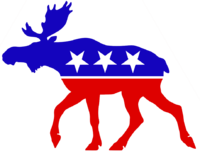 Moose - Party Symbol | |
| Leader | Theodore Roosevelt |
| Established | 1912 |
| Dissolution date | 1916 |
| Headquarters | |
| Ideology | progressivism See Program |
| Allies and Blocks | Socialist Party of America |
| Motto | “We must be strong as an elk!” |
The party symbol was an elk . The appearance of the symbolism is connected with the nickname “moose party” ( “ moose party” , English “Bull Moose Party” ), which appeared after the attempt on the party leader Theodore Roosevelt in 1912. In response to a question whether injury to his election campaign would hurt, Roosevelt said: "I am healthy as an elk . "
Creation History
In 1911-1912, the former US President of the Republican Party, Theodore Roosevelt , dissatisfied with the policies of his successor to the presidency of William Taft , began an active election campaign for the presidency. Roosevelt intends to become the Republican Party presidential candidate in place of Taft, who was about to run for a second term.
Roosevelt managed to win a landslide victory among the Republican presidential candidates. He scored 278 votes of delegates, while President Taft received only 48 votes, and Senator Lafolet - 36.
However, Roosevelt did not receive support in nominating his candidacy for the presidency of the United States from the Republican Party at the Republican Party Convention (Congress) in Chicago on June 7, 1912 (the convention pushed Taft's nomination). The outraged Roosevelt accused Taft of “stealing goals” (violations in the counting of votes), saying “if you have voted for the present and legitimate majority, it must be organized.” This marked the beginning of the formation of a new political party in the United States, the asset of which was Roosevelt's supporters from the progressive wing of the Republican Party.
After the results of the vote were announced on the night of June 22, 343 Roosevelt supporters, calling themselves red bandanas , left the convention. According to Roosevelt’s biographer A. I. Utkin, “many congress delegates had the feeling that almost a national revolution had taken place” [1] .
On August 5, 1912, the US Progressive Party Convention was held in Chicago, at which Theodore Roosevelt was nominated as a presidential candidate.
Program
The party’s ideological platform was officially called the “Contract with the People” and included the following points:
- workers' right to unionize;
- limitation of funds for election campaigns;
- voting right for women;
- an eight-hour work day and a six-day work week;
- compensation for the costs of treatment, health insurance in industrial enterprises;
- right to retirement;
- unemployment insurance;
- facilitating the adoption of constitutional amendments;
- inheritance tax;
- income tax;
- social security for children and women;
- labor compensation to workers;
- a decrease in the power of courts in the event of work conflicts
- creating a network of river channels within the United States;
- the right for immigrants to "get their share of opportunities."
Presidential Election
In the 1912 election, Roosevelt received the highest result among the “third candidates” since that time and even took second place, defeating the incumbent US president, Republican candidate William Taft (27% and 88 electoral votes were Roosevelt versus 23% and 8 were Taffeta). However, he was so behind the campaign winner, Democratic candidate Woodrow Wilson (Wilson scored 42% and 435 electoral votes) that it was clear that he could not return to the White House . This, together with poor results in the local elections, led to a drop in party prestige and the departure of many leaders.
In the next presidential election of 1916, the Progressive Party again nominated Roosevelt, but he refused in favor of Republican candidate Charles Hughes , who lost the election to Woodrow Wilson. After that, the party broke up at the national level, although in some states (for example, in Washington ) its branches still remained for some time.
See also
- Third parties (USA)
- Theodore Roosevelt
- US Presidential Election (1912)
- Progressive Party (USA, 1924)
- Progressive Party (USA, 1948)
Notes
- ↑ Utkin A.I. Theodore Roosevelt. - M .: Eksmo Publishing House, 2003 .-- S. 457.
Links
- TeddyRoosevelt.com: Bull Moose Information
- 1912 platform of the Progressive Party