Caroline (gray) protein [1] ( lat. Sciurus carolinensis ) is a mammal from the squirrel family of rodents .
| Caroline Squirrel |
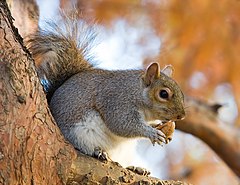 | 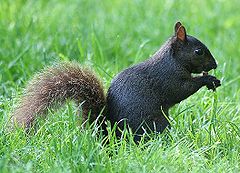
Carolina Gray Squirrel in St James's Park ( London (above), melanist (below) |
|
| Scientific classification |
|---|
| No rank : | Bilateral symmetrical |
| Squadron : | Euarchontoglires |
|
| International scientific name |
|---|
Sciurus carolinensis gmelin , 1788 |
| Security status |
|---|
Least ConcernedIUCN 3.1 Least Concern : 42462 |
|
Color is black or gray; black specimens are especially common in urban areas in eastern Canada, since this color increases the survival of the species in urban environments.
Content
The natural habitat of the gray squirrel before its
introduction into Europe
Carolina squirrel lives in eastern North America, west of the Mississippi River to the northern borders of Canada, but recently the species began to penetrate into Scotland, Ireland, England and Italy, displacing ordinary squirrels from there. The crowding out is due to the fact that the gray protein is a carrier, and also has some tolerance to the paraospa virus, a protein that kills ordinary proteins. In addition, gray squirrels in winter are more likely to find their stocks, and also use the stocks of ordinary (European) squirrels.
Caroline squirrel prefers mature coniferous forests with an area of at least 40 hectares, but can also settle in areas where oaks and walnuts grow, the fruits of which are an important source of winter nutrition for these animals.
The length of the body is 380–525 mm, the tail is 150–250 mm, the ears are 25–33 mm, and the back foot is 54–76 mm. The color of the fur is gray, with tan marks of brown or red color.
The breeding season is in December - February, in the northern regions - a little later - in May - June. The second brood is in the middle of summer. The squirrel run lasts five days: all this time the male pursues the female, moving away from the mink to a distance of 500 m. Five days later, the female is ready for conception, as evidenced by the edematous pink vulva , this condition lasts 8 hours. Mating lasts less than 30 seconds. After mating, a female forms a vaginal gelatin plug, which prevents re-mating. Pregnancy lasts 44 days.
Security status
Least Concerned
IUCN 3.1 Least Concern : 42462 |
Most females enter reproduction at the age of 1.25 years, but are capable of birth at the age of 5.5 months. Females bring two offspring a year, for 8 years. Males become sexually mature at the age of 11 months. In the event that they live together with a dominant male, puberty is delayed until the age of two. The testicles of males usually weigh 1 gram, but during the rut period their weight increases to 6-7 g, this happens twice a year.
Newborns are born naked, with the exception of vibrissae , their birth weight is 13-18 g. Mother feeds them 7-10 weeks. In the seventh week after birth, molting occurs, and young squirrels acquire the coloring of adults. By 9 months, they have the weight of an adult animal. In the litter of 2-4 cubs, possibly up to 8.
In the years of growth of this species or in a lean year, these proteins gather in large "flocks" and migrate in search of suitable places, overcoming long distances and water barriers.
The record life expectancy among the genus of protein was recorded specifically for the species of gray squirrel - one individual in captivity survived to the age of 23 years and 6 months.
- In 1968, the gray squirrel was recognized as a symbol of Kentucky [2] .