Louis (Ludwig) [1] Spur ( German: Louis (Ludwig) Spohr , April 5, 1784 , Braunschweig - October 22, 1859 , Kassel ) - German violinist , composer , conductor and teacher , one of the first representatives of the romantic style in music.
| Louis Spur Louis Spohr | |
|---|---|
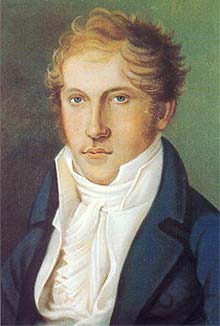 Self portrait | |
| basic information | |
| Full name | Ludwig Spur |
| Date of Birth | April 5, 1784 |
| Place of Birth | Braunschweig |
| Date of death | October 22, 1859 (75 years old) |
| Place of death | Kassel |
| Buried | |
| A country |  Germany Germany |
| Professions | composer , conductor , violinist , teacher |
| Instruments | Violin |
| Genres | and |
| Awards | |
Content
Biography
Spur was born into a family of a doctor who was also an amateur musician and tried to give his son a good education. Having shown his musical abilities early, Spur, at the age of six, began to study music theory from the organist Hartung, then - on the violin from the famous musician Mokur. Having achieved sufficient success, Spur attracted the attention of the Duke of Braunschweig, who in 1799 appointed him court musician. The last teacher of Spur was the violinist of the Mannheim School Franz Ekck (son of the trumpeter Georg Ekk, who collaborated with Mozart ); Ekk significantly influenced Spur, completely rebuilding his performing technique, and took him with him on a long tour and study trip, the final point of which was St. Petersburg in 1802 , where Spur, in particular, was delighted with the play of Muzio Clementi and John Field (from this trip there was a detailed, colorful and naive diary of an 18-year-old musician, later on included by him in extensive fragments in his later memoirs) [2] [3] .
Then Spur began touring on his own, with great success everywhere. Spur embarked on his first concert tour as soloist in 1804 . In 1812, the musician went to Vienna , where he received the position of bandmaster of the local opera, and then traveled to Italy, where he competed with Niccolo Paganini himself .
In 1816, the premiere of the most important Spur opera, Faust, based on the novel by Friedrich Klinger , took place. Having comprehended Mozart’s opera discoveries (Don Giovanni), Spur was one of the first to combine the infernal and religious spheres in the opera, created a demonic image, applied the leitmotif technique and, ultimately, discovered (along with other composers) the history of German romantic opera. [4] The Spur could not be staged in Vienna ; its premiere took place at the Estates Theater in Prague under the direction of Karl Maria von Weber .
Since 1817, Spur worked as the musical director of the Frankfurt City Theater, in 1820, together with his wife, harpist Doretta Spur (1778-1834), performed in London . Two years later, the musician gets the place of the court bandmaster in Kassel, where he works until his death.
Creativity
The legacy of the Spurs composer includes a large number of works in various genres: he owns nine operas, oratorios, symphonies, masses, cantatas, chamber compositions. The most popular are 15 of his concerts for violin and orchestra, as well as four concerts for clarinet , dedicated to Johann Simon Hermstedt . Spur was also considered one of the best violinists of its time, its performance was distinguished by great technical virtuosity and deep expressiveness.
Major works
Opera
- The Test (Die Prüfung, 1806)
- Alruna, Queen of Owls (Alruna, die Eulenkönigin, 1808)
- A duel with a lover (Der Zweikampf mit der Geliebten, 1811)
- Faust (1816; new edition 1852)
- Zemira and Azor (1819)
- Yessonda (Jessonda, 1823)
- Mountain spirit (Der Berggeist, 1825)
- Pietro from Albano (1827)
- The Alchemist (Der Alchimist, 1830)
- Crusaders (Die Kreuzfahrer, 1845)
Works for Voices, Choir and Orchestra
Oratorios
- The Last Judgment (Das jüngste Gericht, 1812)
- The Last Acts (Die letzen Dinge, 1826)
- The Last Hours of the Savior (Des Heilands letze Stunden, 1835)
- The Fall of Babylon (Des Fall Babylons, 1842)
- Our Father (Vater unser) - Mass to the words of F. G. Klopstock
- Liberated Germany (Das befreite Deutschland) - stage cantata (1814)
For orchestra
10 symphonies, of which:
- 4th - The Holiness of Sounds (Die Weihe der Töne, 1832)
- 6th - Historical (Historische, 1839)
- 7th - The earthly and divine in human life (Irdisches und Göttliches im Menschenleben, for 2 orchestras, 1841)
- 9th - Seasons (Die Jahreszeiten, 1850)
3 overtures, including an overture to the Shakespeare Macbeth tragedy
Tool Concerts
- 18 concerts for violin , including three unpublished during the life of the composer (1799-1844) [5]
- 4 concerts for clarinet (1808-44)
- Concert for String Quartet and Orchestra (1845)
- Concert for harp and orchestra
Chamber-instrumental ensembles
- 3 sonatas for violin and piano
- 15 duets for 2 violins
- 5 piano trios (1841-47)
- 36 string quartets
- 4 double quartets (1823-47)
- 3 piano quintets (1820, 1845, 1853)
- 7 string quintets
- Piano Sextet (1848)
- String Sextet (1848)
- Septet (for flute, clarinet, horn, bassoon, violin, cello and piano)
- Octet (for violin, 2 violas, cello, clarinet, 2 horns and double bass)
- Nonet (for violin, viola, cello, flute, oboe, clarinet, horn, bassoon and double bass, 1813)
Pieces for piano, 2 fantasies for harp
For the choir - cantatas, psalms, choirs.
For voice and piano - about 100 songs, including songs on the texts of I.V. Goethe : Gretchen behind the spinning wheel (Gretchen am Spinnrade, 1809), Mignon (1815), etc.
In astronomy
In honor of the main heroine of the opera Louis Spur "Yessonda" named an asteroid (549) Jessonda , discovered in 1904.
Literature
- Solovyov N.F. , -. Spur, Ludwig // Brockhaus and Efron Encyclopedic Dictionary : 86 volumes (82 volumes and 4 additional). - SPb. , 1890-1907.
- C. Brown. Louis Spohr: a Critical Biography. - Cambridge, 1984
Notes
- ↑ Under the name “Ludwig”, the composer is known only in Germany, in all other countries he is called in the French manner “Louis”
- ↑ Clive Brown. Louis Spohr: A Critical Biography - Cambridge University Press, 2006 .-- P. 13-14.
- ↑ [R. Ruditsa. M. Saponov. Russian diaries and memoirs of Richard Wagner, Ludwig Spur, Robert Schumann. - M .: Deka-VS, 2004.] // “ Critical Mass ”, 2005, No. 2.
- ↑ Antipova N. Discovery of romantic demonism in Ludwig Spur's “Faust” (Inaccessible link) Date of treatment July 12, 2016. Archived April 1, 2016.
- ↑ Liner notes to Spohr: Violin Concertos Nos. 2 & 9
Links
- Louis Spur on the Allmusic website
- Spur Biography
- Spur, Louis: sheet music at International Music Score Library Project