Aponogeton ( Latin: Aponogeton ) is a genus of monocotyledonous plants of the Old World , distinguished into the Aponogetonaceae family of the order Chastochotsvetnye ( Alismatales ).
| Aponogetone | |||||||||||||||||||
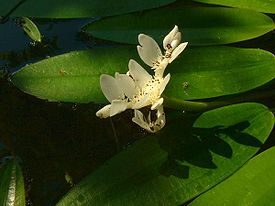 Aponogeton two-banded ( Aponogeton distachyos ) | |||||||||||||||||||
| Scientific classification | |||||||||||||||||||
|---|---|---|---|---|---|---|---|---|---|---|---|---|---|---|---|---|---|---|---|
| |||||||||||||||||||
| International scientific name | |||||||||||||||||||
Aponogeton Lf (1782), nom. cons. | |||||||||||||||||||
| Synonyms | |||||||||||||||||||
| |||||||||||||||||||
| Type view | |||||||||||||||||||
Aponogeton natans ( L. ) Engl. & K.Krause [2] | |||||||||||||||||||
According to the database of The Plant List (2013), the family includes 2 genera [3] :
- Aponogeton - 57 species
- Ouvirandra - 1 species, Ouvirandra bernieriana Hook. .
Content
Botanical Description
There are about 57 [4] species in the genus aponogetone. Especially many species of this genus in Madagascar - there are 11 species endemic to this island and the nearby Comoros . In the fossil state ( Oligocene - about 25 million years ago), leaf prints of one of the species of this genus were found far beyond the tropics - in Western Kazakhstan .
The appearance of aponoheton species resembles the usual rhodet ( Potamogeton ) in our reservoirs, however, there are significant differences regarding the life form: all types of aponoheton are rosette-forming plants with leafless peduncles emerging from the sinuses of the rosette and tuberiform thickened sympodial rhizome , from which numerous thin the roots.
The leaves of the apogonetone are usually distinctly divided into a short vagina, petiole and whole-marginal plate, the shape of which varies from linear to ovate, most often elliptical or lanceolate. Fully sessile, linear-lanceolate leaves has the African aponoheton valisnerioid ( A. vallisnerioides ), and in the African aponoheton calico ( A. junceus ), the leaf blade is reduced to the middle vein, into which the petiole directly passes. Many species have either only submerged or only floating leaves (the latter usually with wider and less transparent plates), but it is not so rare that both of them are within the same species and on the same plant. Typically, leaf blades have a thickened middle vein and several additional arcuate veins connected to each other and to the middle vein by a network of transverse anastomoses. The leaves of the Madagascar aponogeton ( A. madagascariensis ), better known as perforated aponogeton ( A. fenestralis ), as well as “mesh plants” or “lace plants”, are remarkable for leaves. At the very beginning of its development, its leaf blades lose their tissue between the veins, really becoming like a wire mesh or lace. This feature to some extent protects the leaf blade from damage when living in fast flowing streams and rivers.
Generative organs
Spike- shaped apopogetone inflorescences are located on long legs that carry them above the surface of the water. Many types of inflorescences have simple ears with flowers spirally spaced on a rather thick axis; in others, they divide from the base into 2, less often 3-10 branches, and in this case the flowers are often located only on one side of each of the branches. At the base of the inflorescence there is a blanket enveloping it, usually quickly falling off after the inflorescence leaves the water.
Aponogetone flowers are usually bisexual, less often unisexual, zygomorphic or actinomorphic, primarily 3-membered, without bracts. Perianth segments are all of the same structure, most often there are 2, less often 3 (then the third is less than the other two), 1 or they are completely absent. In many species, the perianth segments are petal-shaped and painted in white, pink or yellow, but remaining fruit and green, in others they are more like bracts from the very beginning. In diclinous aponogetone ( A. distachyon ) and some other species, the only perianth segment is greatly enlarged. Stamens are usually 6, arranged in 2 circles, with rather long filaments and small two-nested anthers, less often (sometimes within the same plant) the number of stamens reaches 12, and then they are located in 3-4 circles. Pollen grains are single-furrowed. The gynoecium usually consists of 3, less often 2–9, almost free sessile carpels, with 2–8 ovules in each carpel. Each carpel at the apex is drawn into a short column, in the downward stigma in the form of a longitudinal groove on the inside.
A fetus formed from gynoecium is a metaholic, immersed in water, where the pericarp is gradually destroyed, releasing endosperm-free seeds that immediately fall to the bottom or float on the surface for some time (up to several hours). Germination of seeds occurs rather quickly: from one day to several weeks.
From an environmental point of view, some types of apogoneton do not have a narrow confinement; others, on the contrary, live either only in fast flowing rivers and streams, or only in standing water bodies. There are species, for example, the Australian six-leaf aponetone ( A. hexapetalus ) that grows in reservoirs that exist only 3-4 months a year, and then dry out very much. When living in relatively deep bodies of water, inflorescences may not reach the surface of the water and remain enclosed in a veil. In this case, some species, for example, the Australian bubbly aponoheton ( A. bullosus ), do not form fruits, others, for example, the Madagascar aponohetopon, are pollinated cleistogamous, forming smaller fruits with a small amount of seeds.
The method of cross-pollination in aponogetone species is still not well understood. The presence of septal nectaries between carpels and often quite bright colors of flowers collected in inflorescences., Favor entomophilia, although the possibility of pollination of flowers by the wind cannot be considered excluded. It is also possible pollination of inflorescences semi-immersed in water with pollen that has precipitated on the surface of the water. Self-pollination is usually eliminated due to protandria (stigmas become susceptible to pollen only after spilling it from the anthers of the same flower), and in apono-hetons of Trupin ( A. troupinii ) and dioecious ( A. dioeens ) - due to the transition to dioeciousness. In some species, same-sex flowers are also found within the same inflorescence. So, in Loria aponoheton ( A. loriae ), the lower flowers in the inflorescence are bisexual, and the upper male ones with rudiments of carpels, in the aponogeton of the holoflorum ( A. nudiflorus ), the lower flowers of the inflorescence are female, without perianth. Reman's South African aponogetone ( A. rehmannii ) is an apomictic species, its female inflorescences have only female flowers, while the undulating aponoheton ( A. undulatus ) from India has the usual viviparium: inflorescences change into young plants that sink to the bottom and take root.
Distribution
The natural habitat includes sub- Saharan Africa , South Asia, and Northern Australia .
Usage
In all tropical countries where the species of the apogonetone family are found, the locals eat their baked or boiled tuber-rich rhizomes rich in starch . In addition, many species of apogonetone are cultivated as aquarium plants . Among them, the South African two-banded aponetone, introduced into the culture from 1780 and naturalizing in many reservoirs of Western Europe, Australia and South America, is especially popular. Slightly less common in culture are undiluted aponogeton, bubbly aponogeton from Australia, Madagascar ulvoid aponogeton ( A. ulvaceus ) and Madagascar aponogeton. The latter species, remarkable for its mesh leaves, has been cultivated for more than 100 years, however, it does not live long in aquariums and is very demanding on temperature conditions.
Taxonomy
The genus Aponogeton includes 57 species [4] :
- Aponogeton abyssinicus Hochst. ex A.Rich.
- Aponogeton afroviolaceus lye
- Aponogeton angustifolius aiton
- Aponogeton appendiculatus H. Bruggen
- Aponogeton azureus H. Bruggen
- Aponogeton bernierianus ( Decne. ) Hook.f.
- Aponogeton bogneri H. Bruggen
- Aponogeton boivinianus Baill. ex jum.
- Aponogeton bruggenii SRYadav & Govekar
- Aponogeton bullosus H. Bruggen - Aponogeton vesicular , or Aponogeton vesicular
- Aponogeton capuronii H. Bruggen
- Aponogeton cordatus jum.
- Aponogeton crispus Thunb. - Curly ApoNogetone
- Aponogeton cuneatus SWLJacobs
- Aponogeton decaryi jum. ex humbert
- Aponogeton desertorum Zeyh. ex spreng.
- Aponogeton dioecus Bosser - Aponogeton dioecious
- Aponogeton distachyos Lf - Aponogeton two-haired
- Aponogeton eggersii Bogner & H. Bruggen
- Aponogeton elongatus F. Muell. ex benth. - Aponogeton elongated
- Aponogeton euryspermus Hellq. & SWLJacobs
- Aponogeton fotianus J. Raynal
- Aponogeton fugax JCManning & Goldblatt
- Aponogeton hexatepalus H. Bruggen - Six- leaf aponogeton
- Aponogeton jacobsenii H. Bruggen in de Wit
- Aponogeton junceus Lehm. ex Schltdl. - Aponogeton chitnikovy
- Aponogeton kimberleyensis Hellq. & SWLJacobs
- Aponogeton lakhonensis A. camus
- Aponogeton lancesmithii Hellq. & SWLJacobs
- Aponogeton longiplumulosus H. Bruggen
- Aponogeton loriae Martelli - Lonia Aponogeton
- Aponogeton madagascariensis ( Mirb. ) H. Bruggen - Aponogeton Madagascar , or Aponogeton perforated
- Aponogeton masoalaensis bogner
- Aponogeton natalensis Oliv.
- Aponogeton natans ( L. ) Engl. & K.Krause typus [2]
- Aponogeton nudiflorus Peter - Holoflower Aponogeton
- Aponogeton proliferus Hellq. & SWLJacobs
- Aponogeton queenslandicus H. Bruggen - Aponogeton Queensland
- Aponogeton ranunculiflorus Jacot Guill. & Marais
- Aponogeton rehmannii Oliv. - Remon Aponogetone
- Aponogeton rigidifolius H. Bruggen - Rigid aponogeton
- Aponogeton robinsonii A.Camus
- Aponogeton satarensis Sundararagh. , ARKulk. & SRYadav
- Aponogeton schatzianus Bogner & H. Bruggen
- Aponogeton stuhlmannii Engl. - Aponogeton graceful
- Aponogeton subconjugatus Schumach. & Thonn.
- Aponogeton tenuispicatus H. Bruggen
- Aponogeton tofus SWLJacobs
- Aponogeton troupinii J. Raynal - Aponogeton Trupina
- Aponogeton ulvaceus Baker - Aponogeton ulvovidny , or curly- leaved Aponogeton
- Aponogeton undulatus roxb. - Aponogeton wavy
- Aponogeton vallisnerioides Baker - Aponogeton vallisnerioid
- Aponogeton vanbruggenii Hellq. & SWLJacobs
- Aponogeton viridis Jum.
- Aponogeton womersleyi H. Bruggen
Notes
- ↑ For the conventionality of indicating the class of monocotyledons as a superior taxon for the plant group described in this article, see the APG Systems section of the Monocotyledonous article .
- ↑ 1 2 NCU-3e. Names in current use for extant plant genera. Electronic version 1.0. Entry for Aponogeton Lf (English) (Retrieved April 20, 2012)
- ↑ Aponogetonaceae (English) . The Plant List . Version 1.1. (2013). Date of appeal September 20, 2016.
- ↑ 1 2 List of species of the genus Aponogeton on The Plant List (English) (Retrieved September 20, 2016)
Literature
- Tsvelev N.N. Aponogetonaceae family // Plant Life : in 6 tons / ch. ed. A. L. Takhtadzhyan . - M .: Enlightenment , 1982. - T. 6: Flowering plants / ed. A. L. Takhtadzhyana. - S. 24-26. - 543 p. - 300,000 copies.