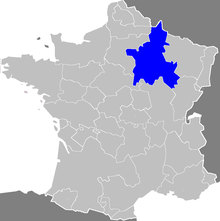
Champagne ( French Champagne , Lat. Campania ) is a historical region in France , famous for its wine-making traditions .
Content
Geography
In the north, Champagne bordered on the region of Liège and Hainaut , in the northeast - with Luxembourg , in the east - with Bar, Tula and Lorraine , in the southeast - with Franche-Comté , in the south - with Burgundy , in the south-west - Gatineau , in the west - with Brie , in the northwest - with Laonne and Soissons . After 1790, the Champagne lands became part of the departments of Ob , Marne , Upper Marne , Ardennes and partly Aene and Yonne . The area is characterized by a flat character, from where the Latin name Campania came from, which is found among writers from the VI century. n e.
Champagne is currently part of the Grand Est region .
History
Archaeological excavations have discovered the existence of man in Champagne in the Quaternary era [1] . Along with the monuments of the Paleolithic period, even more monuments of the Neolithic and Bronze periods were found, and the Greek influence is clearly seen in the latter.
Before the Romans conquered Gaul, Champagne was inhabited by three Gallic tribes - Lingons , Senons and Remas . A significant part of the lingons and senons, in search of new lands, from the VI century. BC e. undertook devastating raids on northern Italy . When Caesar arrived in Gaul as a proconsul , first the Lingons and Remas, and then the Senons entered into an alliance with him and surrendered under his protection. Nevertheless, they took an active part in the uprising of Vercingetorig . August joined the Remus region to the province of Belgium , and the lands of Lingons and Cenons to Gaul of Lugdun. The country underwent rapid romanization. Beautiful roads were held; on the site of military camps, large cities began to appear, built up with magnificent buildings; only in the names of some cities there are traces of the tribes that once inhabited Champagne: Reims ( Remus ), Langres ( Lingons ), Sans ( Senons ), Troyes ( trikasses ). In 69, the Druids , taking advantage of the unrest that occurred at that time because of the imperial throne, tried to raise an uprising among the Gallic tribes, led by Lingon Julius Sabin , but the attempt ended in complete failure, and Sabin was executed.
Christianity began to spread in Champagne from the II century . According to legend, the first bishops of Champagne - St. Sixtus Reims, Memmy of Shalons, and Savinian Sansky were direct disciples of the Apostle Peter. In fact, their activities and martyrdom date back to the end of the 3rd century .
In the middle of the III century, Champagne was attacked by alemanns and vandals . In the IV century, the emperors Constantius Chlorus , Julian and Valentinian managed to repel the attacks of the German hordes and hold Langr, Reims and San. The weakening of the empire in the first half of the fifth century. entailed new invasions of the Germans. Champagne was especially devastated during the invasion of Attila , defeated by Aetius in 451 near Chalon.
After the fall of the Western Roman Empire, Champagne, which was part of the possessions of Siagria , was conquered by Clovis . Under the divisions between the children and grandchildren of Clovis, Champagne was divided into two parts: Reims and Chadon moved to Australia , Langre, Troyes and San - to Burgundy . By the end of the VI century. refers to the first known Duke of Champagne - Loop . He was at first an adherent of Hildebert II and Brünnhilde , but court intrigues forced him to flee to Guntramn Burgundy . His successor Vintrion commanded the Australians in the war against the Lombards , then unsuccessfully tried to conquer Neustria for Hildebert II and was executed by Brünnhilde in 598 .
At the end of the 7th century , Weimer was known, who first took the side of the mighty Mayordom Ebroin in his struggle with the Bishop Leodegar of отtena , but then quarreled with his patron and paid his life for it - and Drogon , son of Pipin of Geristalsky . In the Carolingian era , the city of Troyes, which used to belong to Burgundy, again moved to Champagne and became its capital. The first Earl of Troyes to receive this city in beneficiaries is Aldramn, a contemporary of Charlemagne and Louis the Pious . After Aldramn, Champagne passed into the hands of Ed , the son of Robert the Strong , who was her first hereditary count ( 854 ). Ed, elected to the kings of France, handed Champagne to his brother Robert , who was also proclaimed king after the death of his brother and fought over the throne with Karl Prostovaty .
In 923, Robert was killed in the Battle of Soissons and, dying, bequeathed Champagne to his son-in-law Herbert, Count of Vermandois . Herbert II (923–943) supported the candidacy of Raul of Burgundy on the French throne. Pretending to enter into negotiations on an alliance with Charles the Simple, he captured him and kept him in the Chateau Thierry fortress for four years. In an effort to expand his possessions, he captured Reims and Lahn, but met resistance from Raul. Herbert then freed Karl and recognized him as king, but Raoul took from Herbert most of his possessions, and only after Raoul’s death did Herbert manage to return Reims.
Herbert's successor, Robert (943–968), waged a continuous war with the Dukes of Burgundy over border regions. His son Herbert II (968–993) was a loyal follower of King Lothar in his struggle with Germany and the Lorraine barons and was not sympathetic to the election of Hugo Capet as king. With the son of Herbert II, Stephen I (993-1019), the male line ceased and Champagne passed to the relative of the reigning dynasty on the female line, Count Blois Ed I (1019-37). Ed managed to defend Champagne from the claims of King Robert the Pious and annexed San. After Robert's death, he forced King Henry I to flee to Normandy , but then the latter, with the help of the Norman Duke Robert the Devil , defeated Ed and robbed him of San.
When the male line ceased in the Kingdom of Arelat , Ed began to dispute the inheritance with the German emperor Conrad II and conquered part of Burgundy , but was killed under Bar-le-Duke. His two sons, Stephen II and Thibault , shared his possessions. They refused to take a vassal oath to King Henry I. Because of this, a war broke out during which Stefan died. His uncle, Earl of Blois Thibault I took away from his successor Ed II .
Ed II accompanied William the Conqueror on his campaign to England , where he settled, becoming the ancestor of the counts Albemarle and Holderness. Thibault I divided his possessions among his sons; Champagne went to Ed III ( 1089 - 1093 ), who was succeeded by his brother Hugo ( 1093 - 1125 ), who added Bar-le-Duc and Vitry to Champagne. In 1104 - 1108, Hugo made a trip to the Holy Land, and upon returning from there he intended to join the Order of the Johannites . Thanks to his assistance, sv. Bernard founded the famous Abbey of Clairvaux . Suspecting his wife in infidelity, Hugo again went to Palestine in 1125 and died there as a knight of the Knights Templar . He ceded his lands to his nephew, Count Blois of Thibault the Great .
Thibault was succeeded by his eldest son Henry I the Generous (1152-81), so nicknamed for his generosity towards the church. During the life of his father, Henry I took part in the second crusade , together with King Louis VII . When he returned, he remained faithful to his vassal all his life and helped him in the war with Henry Plantagenet over Aquitaine and Poitou . When, after the death of Pope Adrian IV, Frederick Barbarossa did not recognize Pope Alexander III , Henry I acted as a mediator between the emperor and Louis VII, who supported the pope. In 1178, Henry again went on a crusade, with a significant number of vassals. On the return trip, he was captured by the Turks , but was released thanks to the request of the Byzantine emperor.
XII and XIII centuries were a time of special prosperity of the famous fairs in Champagne , enjoyed special patronage of the Counts of Champagne. The counts generally willingly supported the urban population and gave it privileges in the form of self-government, since as a result of the growth of industry and trade, their incomes increased.
Henry I was succeeded by his son Henry II Young , brother of Henry II - Thibault III , the son of the last Thibault IV , who became the king of the Navarra, and son of Thibault IV, Thibault V. Thibault V was succeeded by his brother Henry III Tolstoy (1270-74), married to Louis IX's niece, Blanca . After the premature death of Henry III, Champagne and Navarre were succeeded by his two-year-old daughter Jeanne , under the regency of his mother. Since Navarre was threatened by the King of Aragon Pedro III , Blanche entered into an agreement with the French king Philip III , according to whom Philip III took control of Joan of adulthood, and after adulthood, Jeanne had to marry the son of the king Philip the Beautiful . Blanche entered a second marriage with Edmund Lancaster , the brother of the English king Edward I , who ruled Champagne until Jeanne came of age. In 1284, Jeanne married Philippe the Beautiful, and Champagne lost its independent significance, becoming a province of the French kingdom.
During the Hundred Years War, Champagne was one of the main theaters of operations and almost entirely at the beginning of the 15th century passed into the hands of the British. With the help of Jeanne d'Arc, Charles VII traveled to Reims , and then he soon regained all Champagne. The Hundred Years War, then the wars of Francis I with Charles V (Champagne was also one of the theaters of war) and, finally, the religious wars of the second half of the 16th century (there were especially many Protestants in Champagne, thanks to the proximity of Germany and Switzerland ), greatly undermined the economic welfare of Champagne, and she was never able to achieve such prosperity, as in the XII and XIII centuries.
Champagne was the theater of the first Allied campaign against revolutionary France at the end of the 18th century . To meet the approaching Austrians and Prussians, the French marched in Champagne and occupied the Argon gorges, these Thermopylae of France, as Dumurier called them; the latter first thought in response to the Allied invasion to rush into the Austrian Netherlands , hoping that his untrained troops were more suitable for this than for a defensive war, but he had to give in to the insistence of the Minister of War Cervan and took a position in the gorge near Granpre. Prussian troops undoubtedly exceeded the French in bearing and in knowledge of military craft, and they were commanded by one of the best generals of the time, the Duke of Karl-Wilhelm-Ferdinand of Braunschweig . The Prussians were 42 thousand, and the Austrians in the amount of 70 thousand were moving behind them.
The Duke's manifesto aroused in France terrible bitterness and rage. The Allies, having taken Longwy and Verdun , took a position on the Meuse , which made it seemed impossible to connect Dumourier with Kellerman ; but the Duke of Braunschweig missed a good moment to take the passages in the Argon forest , which Dumourier noticed and immediately took Granpre's pass, and Dillon - Illett defile (September 5), which made it possible to calmly wait for Kellerman's arrival.
On September 11, the Duke of Braunschweig stepped out of Verdun to go around the Argon Gorges; a day later, Calcreit and Clerfe successfully connected. With a skillful movement, Clerfe easily took up a position at Croix-au-Bois, which prompted Dumurier to leave the Grand Pres; but the Duke of Braunschweig missed the opportunity to defeat the French and sent them after 1,200 hussars, who defeated the 12,000-strong detachment of the retreating enemy. Dumurier, Kellerman, Dillon and Bernonville became between Saint-Menegu and the Argons, opening the way for the Allies to Chalon and Reims. Kellerman stood on the heights of Valmy . On September 20, the Prussian army fell upon him, but after an indecisive battle, he retreated, having suffered a moral defeat, as his faith in the invincibility of the troops of Frederick the Great shook. On October 24, the Allies left for Luxembourg .
See also
- Counts of Champagne
- Champagne (wine region)
- Vallage
Notes
Literature
- Pithou, “Le premier livre des comtes héréditaires de Champagne et de Brie” (P., 1572);
- Lefèvre de Comartin, “Recherche de la noblesse de Champagne” (Chalon, 1673);
- Baugier, “Mémoires historiques de la province de Champagne” (Chalon and P., 1725);
- D'Arbois de Jubainville, Histoire des comtes de Champagne (P., 1859-67);
- Lex, "Le comte Eudes II de Blois, Ier de Champagne" ("Positions des thèses de l'Ecole des Chartes", P., 1883);
- D'Arbois de Jubainville, “Documents inédits concernant quelques-uns des premiers intendants de Champagne” (P., 1879);
- Longnon, “Livres de vassaux du comté de Champagne et Brie, 1172-1222” (P., 1869);
- him, "Rôles des fiefs du comté de Champagne sous Thibaut le Chansonnier, 1249-52" (P., 1877);
- Gaussen, “Portefeuille archéologique de la Champagne” (Bar-on-Ob, 1862);
- Taylor, “Voyage pittoresque en Champagne” (Paris, 1857);
- Vallet de Viriville, “Archives historiques de l'Aube et de l'ancien diocèse de Troyes” (Tpya, 1841);
- Boutiot, “Histoire de Troyes et de la Champagne meridionale” (Tpya, 1870-80);
- Poinsignon, "Histoire de la Champagne et de la Brie" (Chalon-Paris, 1885);
- Longnon, “Géographie de la Gaule au VI siècle” (P., 1878);
- him, Etudes sur les pagi de la Gaule (P., 1869-72);
- him, Les pagi du diocèse de Reims (P., 18 72);
- Morel, “La Champagne souterraine” (Chalon, 1876);
- Nicaise, “l'Epoque gauloise dans le département de la Marne” (P., 1884);
- him, “L'Epoque du bronze dans le département de la Marne” (Chalon, 1881);
- De Baye, “L'art étrusque en Champagne” (Tours, 1875);
- Henri, La Réforme et la Ligue en Champagne et à Reims (Saint-Nicolas, 1867);
- Herelle, La Réforme et la Ligue en Champagne (Chalon, 1888);
- Letillois de Mezières, “Biographie générale des Champenois célèbres” (P., 1836);
- Denis, “Recherches bibliographiques sur les auteurs qui ont écrit sur la province de Champagne” (Chalon, 1870).
Links
- Butenko V.A. Champagne // Encyclopedic Dictionary of Brockhaus and Efron : 86 volumes (82 volumes and 4 additional). - SPb. , 1890-1907.