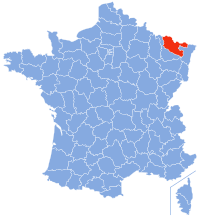
Moselle ( fr. Moselle ) is a department in the north-east of France , one of the departments of the Grand Est region [1] (former Alsace-Champagne-Ardennes-Lorraine , and before that Lorraine ). The sequence number is 57. Administrative Center ( Prefecture ) - Metz . The population is 1,066,667 people (20th place among the departments, data of 2010 ).
| Department | |||||
| Moselle | |||||
|---|---|---|---|---|---|
| fr Moselle | |||||
| |||||
| A country |  France France | ||||
| Enters into | Grand Est | ||||
| Includes | 9 counties, 51 cantons and 730 communes | ||||
| Adm Centre | Metz | ||||
| Chairman of the General Council | Philip Leroy | ||||
| History and geography | |||||
| Date of education | |||||
| Square | 6216 km² (35th place ) | ||||
| Timezone | UTC +1 | ||||
| Population | |||||
| Population | 1,066,667 people ( 2010 ) ( 20th place ) | ||||
| Density | 171.6 persons / km² (27th place) | ||||
| official languages | french german | ||||
| Digital identifiers | |||||
| ISO 3166-2 code | FR-57 | ||||
 | |||||

Content
Geography
The area of the territory is 6216 km². Through the department flow the Moselle , Saar , Sale .
The Department included 9 districts ( Bule-Mosel , Metz-Ville , Metz-Campagne , Sarbur , Sargemin , Thionville-West , Thionville-Est , Chateau-Salen , Forbach ), 51 cantons and 730 communes. As a result of the administrative reform, from March 2015 the number of districts decreased to 5 [2] :
- Metz - 143 communes;
- Sarbur - Chateau-Salen - 230 communes;
- Sarhemin - 83 communes;
- Thionville - 105 communes;
- Forbach - Bule-Moselle - 169 communes
History
The Moselle is one of the first 83 departments formed during the Great French Revolution in March 1790. It originated in the territory of the former province of Lorraine . The name comes from the Moselle River. In 1793, France annexed to its territory a number of regions that were formerly part of the Holy Roman Empire, but in 1814, after the defeat of Napoleon, almost all the conquered lands were ceded to the German state.
1790-1793
Ethnography
Until the middle of the 20th century, the Moselle split into two distinct cultural-language zones, the Germanic and the Romanesque. The Moselle language boundary has become the object of study for many linguists and ethnographers. Currently almost disappeared.
List of archaeological sites
- Metz - the ancient Divodur
See also
- District of Moselle
- Mozel Cantons
- Malbrook Castle
Notes
- ↑ Décret n ° 2016-1262 du 28 septembre 2016 portant fixation du région Grand Est (Fr.) . Decree of September 28, 2016 . legifrance.gouv.fr. The date of circulation is December 22, 2016. Archived on October 2, 2016.
- ↑ Décret n ° 2014-1721 du 29 décembre 2014 portant suppression of the arrondissements de Boulay-Moselle, de Château-Salins, de Thionville-Ouest et de Metz-Campagne (département de la Moselle) (Fr.) . Decree No. 2014-1721 of December 29, 2014 . legifrance.gouv.fr. The date of circulation is December 22, 2016. Archived January 1, 2015.
Links
- Prefecture website (in French)
- Conseil Website website (in French)
- Plattweb (in French and Platt)
- Hughes, S. "Bilingualism in North-East of France, French spoken by Moselle Cross-border (or frontier) workers"