Prosauropods [1] , or prozavropods [2] ( lat. Prosauropoda ) - a treasure trove of dinosaurs from the suborder Sauropodomorpha, to which various taxonomists rank from the superfamily to the suborder inclusive [3] . Possessed a long tail and barrel-shaped body. Some prosauropods moved on four legs, others only on two. They ate plants and were the first large dinosaurs to appear on Earth. They lived with the Middle Triassic in the Lower Jurassic era ( 247.2-174.1 million years ago [3] ).
| † Prosauropods |
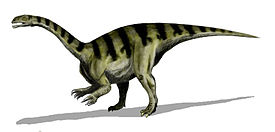
Reconstruction of Sellosaurus |
| Scientific classification |
|---|
| No rank : | Bilateral symmetrical |
| Infraclass : | Archosauromorphs |
| No rank : | Archosauriformes |
| Suborder : | † Sauropodomorphs |
| Infrastructure : | † Prosauropods |
|
| International scientific name |
|---|
Prosauropoda Huene , 1920 |
| Families |
|---|
- † Anchisauridae
- † Euskelesauridae
- † Otozoidae
|
Geochronology247.2-174.1 Ma | million years | Period | Era | Aeon |
|---|
| 2,588 | Even | | | Ka | F
but
n
e
R
about
s
about
th | | 23.03 | Neogene | | 66.0 | Paleogen | | 145.5 | a piece of chalk | M
e
s
about
s
about
th | | 199.6 | Yura | | 251 | Triassic | | 299 | Permian | P
but
l
e
about
s
about
th | | 359.2 | Carbon | | 416 | Devonian | | 443.7 | Silur | | 488.3 | Ordovician | | 542 | Cambrian | | 4570 | Precambrian |
◄ Nowadays◄ Cretaceous-Paleogene extinction◄ Triassic extinction◄ Mass Permian Extinction◄ Devonian extinction◄ Ordovician-Silurian extinction◄ Cambrian explosion |
|---|
|
Content
During the Triassic period, the prosauropods lived throughout Pangea , that is, over the entire surface of the planet. Despite their name and a number of common features that related them to sauropods , these dinosaurs were not their progenitors at all. They probably represented a side branch of the sauropodomorph group.
The small size allowed the prozauropods to walk on two legs. But they did not always do this, because they could safely move around on all four. Climbing to their hind legs, they ate foliage from the upper branches. In addition to plant foods, prosauropods also fed on animals. The remains of prosauropod are known since the 19th century. For example, the skeleton of an ankhisavr was found in 1818, but only in 1885 it became clear that the bones belong to a reptile .
It remains debatable whether this group should be considered paraphyletic (i.e., including only a part of the descendants of a hypothetical common ancestor) among basal sauropodomorphs, or prozauropod can be distinguished as a monophyletic group, and in the latter case sauropods can hardly be included in this group. Galton and Apurch ( 2004 ) defines the clade of the prosauropod as a group including the plateosaurus and all taxa more closely related to it, as well as all types of basal sauropodomorphs that do not belong to sauropods. Other researchers (e.g., Paul Sereno , 2005 ) believe, however, that the prosauropods encompassing all of these species will be a paraphyletic group, which will include the ancestors of sauropods, but not themselves. In recent years, some scholars have attempted to revise the prosauropod in such a way as to exclude them as ancestors of the sauropod. For example, Yeats and Kitching ( 2003 ) excluded the basal proseuropod thecodontosaurus and the Saturnalia , and they also consider them as the basal sauropod anchisaurus and melanorosaurus . Yeats ( 2007 ) went even further by saying that prosauropods such as Massospondylus and Riojasaurus are actually more closely related to sauropods.
Classification
According to the Fossilworks website, as of September 2017, the following extinct taxa up to and including genus are included in the infraorder [4] :
- Infraorder Prosauropoda Huene, 1920 - Prosauropods
- Childbirth incertae sedis
- Genus Barrancapus Hunt et al. 1993 (1 view)
- Genus Evazoum Nicosia & Loi, 2003 (1 species)
- Genus Pengxianpus Yang & Yang, 1987 (1 species)
- Genus Pseudotetrasauropus Ellenberger, 1965 (4 species)
- Genus Saurischichnus Huene, 1941 (1 species)
- Genus Tetrasauropus Ellenberger, 1970 (1 species)
- Genus Yimenosaurus Bai et al. , 1990 (1 view)
- Family Anchisauridae Marsh, 1885 [ syn. Amphisauridae Marsh, 1882 , Gryponichidae Huene, 1932 , Palaeosauridae Huene, 1932 , Palaeosauriscidae Kuhn, 1959 , Sellosauridae Huene, 1908 ]
- Genus Ammosaurus Marsh, 1891
- Genus Gyposaurus Broom, 1911
- Genus Kainomoyenisauropus Ellenberger, 1970 (1 species)
- Genus Qomoqomosauropus Ellenberger, 1970 (1 species)
- Genus Senqutrisauropus Ellenberger, 1970 (1 species)
- Genus Tritotrisauropus Ellenberger, 1970 (1 species)
- Euskelesauridae Ellenberger Family , 1970
- Genus Thotobolosaurus Ellenberger, 1970 (1 species)
- Otozoidae Lull Family , 1904
- Genus Pengxianpus Yang & Yang, 1987 (1 species)
Many taxa are included in the treasure in the nomen dubium status, for example: Aetonyx , Agrosaurus .
