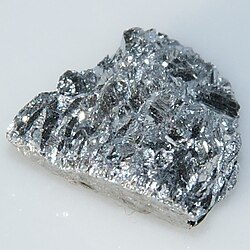
Antimony ( chemical symbol - Sb ; lat. S ti b ium ) - a chemical element of the 15th group (according to an outdated classification - the main subgroup of the fifth group) of the fifth period of the periodic system of chemical elements D. I. Mendeleev ; has an atomic number 51. The simple substance is antimony - a semimetal of silver-white color with a bluish tint, coarse-grained structure. Four metallic allotropic modifications of antimony are known that exist at various pressures, and three amorphous modifications (explosive, black, and yellow antimony) [3] .
| Antimony | ||||
|---|---|---|---|---|
| ← Tin | Tellurium → | ||||
| ||||
| The appearance of a simple substance | ||||
| Silver White Metalloid | ||||
 | ||||
| Atom properties | ||||
| Name, symbol, number | Antimony / Stibium (Sb), 51 | |||
| Atomic mass ( molar mass ) | 121,760 (1) [1] a. E. m. ( g / mol ) | |||
| Electronic configuration | [Kr] 4d 10 5s 2 5p 3 | |||
| Atom radius | 159 pm | |||
| Chemical properties | ||||
| Covalent radius | 140 pm | |||
| Ion radius | (+ 5e) 62 (−3e) 245 pm | |||
| Electronegativity | 2.05 [2] (Pauling scale) | |||
| Electrode potential | 0 | |||
| Oxidation state | 5, 3, −3 | |||
| Ionization energy (first electron) | 833.3 (8.64) kJ / mol ( eV ) | |||
| Thermodynamic properties of a simple substance | ||||
| Density (at N. at. ) | 6.691 g / cm³ | |||
| Melting temperature | 903.9 K | |||
| Boiling temperature | 1908 K | |||
| Beats heat of fusion | 20.08 kJ / mol | |||
| Beats heat of vaporization | 195.2 kJ / mol | |||
| Molar heat capacity | 25.2 [3] J / (K · mol) | |||
| Molar volume | 18.4 cm³ / mol | |||
| The crystal lattice of a simple substance | ||||
| Lattice structure | trigonal | |||
| Lattice options | a hex = 4,307; c hex = 11,27 [4] | |||
| C / a ratio | 2.62 | |||
| Debye temperature | 200 K | |||
| Other characteristics | ||||
| Thermal conductivity | (300 K) 24.43 W / (mK) | |||
| CAS Number | ||||


| 51 | Antimony |
Sb 121,760 | |
| 4d 10 5s 2 5p 3 | |
Content
History
Antimony has been known since antiquity. In the countries of the East, it was used around 3000 BC. e. for the manufacture of vessels. In ancient Egypt already in the XIX century. BC e. antimony shine powder (natural Sb 2 S 3 ) called mesten or stem was used to blacken eyebrows. In ancient Greece, it was known as στίμμι and στίβι , hence Lat. stibium [5] . Around the XII-XIV centuries. n e. the name antimonium appeared. A detailed description of the properties and methods of producing antimony and its compounds was first given by the alchemist Vasily Valentin (Germany) in 1604. In 1789, A. Lavoisier included antimony in a list of chemical elements called antimoine [6] (modern English antimony , Spanish and Italian antimonio , German Antimon ). The Russian word "antimony" came from the Turkish and Crimean Tatar sürmä [7] ; he designated the powder of lead gloss PbS, which also served to blacken eyebrows (according to other sources, "antimony" - from the Persian "surrogate" - metal).
Being in nature
Clark antimony - 500 mg / t. Its content in igneous rocks is generally lower than in sedimentary rocks. Of sedimentary rocks, the highest concentrations of antimony are observed in shales (1.2 g / t), bauxite and phosphorite (2 g / t) and the lowest in limestone and sandstone (0.3 g / t). Elevated amounts of antimony are installed in coal ash. Antimony, on the one hand, in natural compounds has the properties of a metal and is a typical chalcophilic element , forming antimonite . On the other hand, it has the properties of a metalloid, manifested in the formation of various sulfosalts - bournonite, boulangerite, tetrahedrite, jamsonite, pyrargyrite, etc. With such metals as copper , arsenic and palladium , antimony can produce intermetallic compounds. The ionic radius of antimony Sb 3+ is closest to the ionic radii of arsenic and bismuth , due to which there is an isomorphic substitution of antimony and arsenic in faded ores and geocronite Pb 5 (Sb, As) 2 S 8 and antimony and bismuth in cobalt Pb 6 FeBi 4 Sb 2 S 16 et al. Antimony in small amounts (grams, tens, rarely hundreds g / t) is noted in galena, sphalerite , bismuthins, realgar and other sulfides . The volatility of antimony in some of its compounds is relatively low. Antimony halides SbCl 3 have the highest volatility. Under hypergenic conditions (in the surface layers and on the surface), antimonite undergoes oxidation according to the following scheme: Sb 2 S 3 + 6O 2 = Sb 2 (SO 4 ) 3 . The resulting antimony oxide sulfate is very unstable and quickly hydrolyzes, turning into antimony ocher - servantite Sb 2 O 4 , stibioconite Sb 2 O 4 • nH 2 O, valentine Sb 2 O 3 , etc. The solubility in water is quite low (1.3 mg / l), but it increases significantly in solutions of alkalis and sulphurous metals with the formation of thioacids such as Na 3 SbS 3 . The content in sea water is 0.5 μg / L [8] . Antimonite Sb 2 S 3 (71.7% Sb) is of major industrial importance. Sulfosalts tetrahedrite Cu 12 Sb 4 S 13 , bournonite PbCuSbS 3 , boulangerite Pb 5 Sb 4 S 11 and jamsonite Pb 4 FeSb 6 S 14 are of little importance.
Genetic groups and industrial types of deposits
In low- and medium-temperature hydrothermal veins with ores of silver, cobalt and nickel, as well as in sulfide ores of complex composition.
Deposits
Antimony deposits are known in South Africa , Algeria , Azerbaijan , Tajikistan , Bulgaria , Russia , Finland , Kazakhstan , Serbia , China , Kyrgyzstan [9] [10] .
Production
According to research company Roskill, in 2010, 76.75% of the global primary production of antimony was accounted for by China (120,462 tons, including official and unofficial production), Russia took the second place in terms of production (4.14%; 6500 tons), third - Myanmar (3.76%; 5897 t). Other major manufacturers include Canada (3.61%; 5660 tons), Tajikistan (3.42%; 5370 tons) and Bolivia (3.17%; 4980 tons). In 2010, a total of 196,484 tons of antimony were produced in the world (of which secondary production amounted to 39,540 tons) [11] .
In 2010, the official production of antimony in China decreased compared to 2006-2009 and is unlikely to increase in the near future, the Roskill report says [11] .
In Russia, the largest producer of antimony is the GeoProMining holding (6500 tons in 2010), which is engaged in the extraction and processing of antimony at its Sarylakh-Antimony and Zvezda production complexes in the Republic of Sakha (Yakutia) [12] .
Reserves
According to statistics from the US Geological Survey :
| A country | Reserves | % |
|---|---|---|
| China | 950,000 | 51.88 |
| Russia | 350,000 | 19.12 |
| Bolivia | 310,000 | 16.93 |
| Tajikistan | 50,000 | 2.73 |
| South Africa | 21,000 | 1.15 |
| Others (Canada / Australia) | 150,000 | 8.19 |
| Total in the world | 1 831 000 | 100.0 |
Isotopes
Natural antimony is a mixture of two isotopes : 121 Sb ( isotopic abundance 57.36%) and 123 Sb (42.64%). The only long-lived radionuclide is 125 Sb with a half-life of 2.76 years, all other antimony isotopes and isomers have a half-life of no more than two months.
Threshold energy for reactions with the release of a neutron (first):
- 121 Sb - 9.248 MeV,
- 123 Sb - 8.977 MeV,
- 125 Sb - 8.730 MeV.
Physical Properties
Antimony in its free state forms silver-white crystals with a metallic luster, density - 6.68 g / cm³. Recalling the appearance of a metal, crystalline antimony has greater fragility and less heat and electrical conductivity [ clarify ] [14] . Unlike most other metals, it hardens upon solidification [15] . An admixture of antimony lowers the melting and crystallization points of lead, and the alloy itself somewhat expands in the course of hardening. Compared with its homologues in the group - arsenic and bismuth, which are also characterized by the presence of both metallic and non-metallic properties, the metallic properties of antimony slightly prevail over non-metallic, in arsenic the properties of metal, in bismuth - on the contrary, non-metal - are weakly expressed.
Getting
The main production method is sulphide ore roasting followed by reduction of coal oxide [16] :
Chemical Properties
With many metals it forms intermetallic compounds - antimonides . The main valence states in compounds: III and V.
Oxidizing concentrated acids actively interact with antimony.
- sulfuric acid converts antimony to antimony (III) sulfate with the release of sulfur dioxide:
- nitric acid converts antimony to antimony acid (conditional formula ):
Antimony is soluble in Tsarskaya Vodka :
Antimony readily reacts with halogens:
- with iodine in an inert atmosphere with slight heating:
- reacts differently with chlorine, depending on temperature:
Application
Antimony is increasingly used in the semiconductor industry in the production of diodes, infrared detectors, devices with Hall effect . It is a component of lead alloys that increase their hardness and mechanical strength. Scope includes:
- batteries
- antifriction alloys;
- printing alloys;
- small arms and tracer bullets;
- cable sheaths;
- matches;
- medicines, antiprotozoal drugs;
- soldering - some lead-free solders contain 5% Sb;
- use in linotypic printing machines.
Together with tin and copper, antimony forms a metal alloy - babbitt , which has antifriction properties and is used in sliding bearings. Sb is also added to metals for thin castings.
Antimony compounds in the form of oxides, sulfides, sodium antimonate and antimony trichloride are used in the manufacture of refractory compounds, ceramic enamels, glass, paints and ceramic products. Antimony trioxide is the most important of antimony compounds and is mainly used in flame retardant compositions. Antimony sulfide is one of the ingredients in match heads.
Natural antimony sulfide, stibnite, used in biblical times in medicine and cosmetics. Stibnite is still used as a medicine in some developing countries.
Antimony compounds, such as meglumine antimoniate (glucanthim) and sodium stibogluconate (pentostam), are used in the treatment of leishmaniasis .
Electronics
Included in some solders . It can also be used as a dopant for semiconductors (electron donor for silicon and germanium).
Thermoelectric materials
Antimony telluride is used as a component of thermoelectric alloys (thermo-emf of 150–220 μV / K) with bismuth telluride.
Biological role and effects on the body
Antimony is toxic. Refers to trace elements. Its content in the human body is 10 −6 % by weight. It is constantly present in living organisms, the physiological and biochemical role is not clarified. Antimony is irritating and cumulative. Accumulates in the thyroid gland , inhibits its function and causes endemic goiter . However, getting into the gastrointestinal tract , antimony compounds do not cause poisoning, since the Sb (III) salts hydrolyze there with the formation of sparingly soluble products. Moreover, antimony (III) compounds are more toxic than antimony (V). Dust and Sb vapors cause nosebleeds, antimony casting fever , pneumosclerosis , affect the skin, and disrupt sexual function. The threshold for the perception of taste in water is 0.5 mg / L. The lethal dose for an adult is 100 mg, for children - 49 mg. For antimony aerosols, the maximum permissible concentration in the air of the working zone is 0.5 mg / m³, in atmospheric air 0.01 mg / m³. MAC in the soil of 4.5 mg / kg. In drinking water, antimony belongs to hazard class 2, has a MPC of 0.005 mg / l [17] , established by the sanitary-toxicological limiting sign of harmfulness . In natural waters, the standard content is 0.05 mg / L. In industrial wastewater discharged to treatment plants having biofilters, the antimony content should not exceed 0.2 mg / l [18] .
Notes
- ↑ Michael E. Wieser, Norman Holden, Tyler B. Coplen, John K. Böhlke, Michael Berglund, Willi A. Brand, Paul De Bièvre, Manfred Gröning, Robert D. Loss, Juris Meija, Takafumi Hirata, Thomas Prohaska, Ronny Schoenberg , Glenda O'Connor, Thomas Walczyk, Shige Yoneda, Xiang ‑ Kun Zhu. Atomic weights of the elements 2011 (IUPAC Technical Report ) // Pure and Applied Chemistry . - 2013 .-- Vol. 85 , no. 5 . - P. 1047-1078 . - DOI : 10.1351 / PAC-REP-13-03-02 .
- ↑ Antimony: electronegativities . WebElements. Date of treatment July 15, 2010.
- ↑ 1 2 Editorial.: Zefirov N.S. (Ch. Ed.). Chemical encyclopedia: in 5 volumes. - Moscow: Soviet Encyclopedia, 1995. - T. 4. - P. 475. - 639 p. - 20,000 copies. - ISBN 5-85270-039-8.
- ↑ WebElements Periodic Table of the Elements | Antimony | crystal structures
- ↑ Walde A., Hofmann JB Lateinisches etymologisches Wörterbuch. - Heidelberg: Carl Winter's Universitätsbuchhandlung, 1938 .-- T. 2 .-- S. 591.
- ↑ Lavoisier, Antoine. Traité Élémentaire de Chimie, présenté dans un ordre nouveau, et d'après des découvertes modernes . - Paris: Cuchet, Libraire, 1789 .-- P. 192.
- ↑ Fasmer M. Etymological Dictionary of the Russian Language . - Progress. - M. , 1964-1973. - T. 3. - S. 809.
- ↑ JP Riley and Skirrow G. Chemical Oceanography V. I, 1965
- ↑ Antimony deposit
- ↑ Category: Antimony deposits - wiki.web.ru
- ↑ 1 2 Study of the Antimony market by Roskill Consulting Group (Link not available) . Date of treatment April 9, 2012. Archived October 18, 2012.
- ↑ GeoProMining: Sarylakh-Surma, Zvezda . Archived on May 28, 2012.
- ↑ Antimony Uses, Production and Prices Primer (link not available) . Date of treatment April 9, 2012. Archived October 25, 2012.
- ↑ Glinka N. L. “General chemistry”, - L. Chemistry, 1983
- ↑ Antimony // Encyclopedic dictionary of a young chemist. 2nd ed. / Comp. V.A. Kritsman, V.V. Stanzo. - M .: Pedagogy , 1990 .-- S. 235 . - ISBN 5-7155-0292-6 .
- ↑ Inorganic chemistry: B 3t. / ed. Yu. D. Tretyakov. T. 2: Chemistry of intransitive elements: a textbook for students. institutions of higher prof. Education / A. A. Drozdov, V. P. Zlomanov, G. N. Mazo, F. M. Spiridonov - 2nd ed., Rev. - M.: Publishing Center "Academy", 2011. - 368 p.
- ↑ GN 2.1.5.1315-03 MPC of chemicals in the water of water bodies of drinking, cultural and domestic water use
- ↑ Alekseev A.I. et al. “Criteria for the quality of water systems”, - St. Petersburg. CHEMISTRY, 2002