


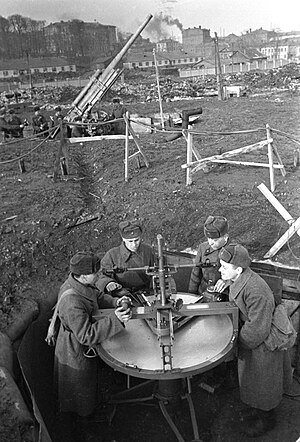


An anti-aircraft gun (also a jargon anti-aircraft gun , an outdated anti- aircraft gun , an anti-aircraft gun) is a specialized artillery gun on a carriage , as a more modern version mounted on a unified self-propelled wheeled or tracked chassis , with circular firing and a high elevation angle (shooting in the “ zenith ” , from here comes the name - "anti-aircraft gun"), designed to combat enemy aircraft .
First of all, it is characterized by a high initial velocity of the projectile and accuracy of aiming, in this regard, anti-aircraft guns were often used as anti-tank .
The main methods of firing are obstructive fire at predetermined lines and fire along the lines of the likely use of airborne weapons (dropping bombs) by enemy aircraft.
The most effective use of anti-aircraft guns is achieved by controlling their fire using radar and automatic fire control devices . After the Second World War, the role of anti-aircraft guns in air defense gradually decreases, their role is taken by anti-aircraft missile systems , which have a greater firing range and high accuracy at long distances.
If necessary, quick-fire anti-aircraft guns can be used as super-heavy anti-personnel (and anti-easy-technical too) weapons due to the high rate of fire, high striking (infantry, due to the explosive action of the projectile, dies from a shell near it, heavy infantry and light armored vehicles, from the first direct hit) and psychological (a direct hit breaks the infantryman completely, lowering the morale of nearby units). In other words, they can be more effective than a regular machine-gun point.
Content
History
In 1891, the first experimental firing at aerial targets took place in Krasnoye Selo . Tied balloons and horse-drawn balloons were used as air targets. Experienced firing at aerial targets with four-inch bullet shrapnel cannons, carried out at the Ust-Izhora training ground in 1890 and near Krasnoye Selo in 1891 , showed the high effectiveness of the use of artillery . Nevertheless, it was determined that a successful anti-aircraft gun was needed to successfully combat the enemy’s air targets. As a result, Russian engineers developed the 76-mm anti-aircraft gun of the 1914/15 model . So the Russian air defense was created.
... Improvements in artillery . In order to comprehensively improve artillery in the reporting year, following the example of past years, various issues were resolved, related mainly to the technical part, and the necessary tests were carried out.
The most important of the executed in this respect was the following: ....7. The experiments performed on shelling freely flying air balloons led to the conviction that in order to obtain any reliable results with such shooting special guns and special rangefinders are needed; requirements for such guns and rangefinders have been developed and communicated to the best Russian and foreign factories and companies with a proposal to develop projects of guns and submit samples of rangefinders. ...
- From the most comprehensive report on the Ministry of War on the activities and condition of all branches of military command for 1909.
[one]
Types
Caliber
According to caliber anti-aircraft guns are divided into:
- small caliber (20 - 60 millimeters );
- medium caliber (60 - 100 millimeters);
- large caliber (over 100 millimeters).
Separately, anti-aircraft machine guns of a caliber of 12.7 - 14.5 mm are taken into account.
Placement
- Stationary
- Serfs
- Ship
- Armored trains
- Self-propelled ( chassis )
- wheeled
- half tracked
- tracked
- Trailed
Formations
As a rule, they are used as part of a formation — a division ( regiment , brigade ), and the smallest firing unit — a battery (consisting of 4-8 guns).
See also
- Anti-aircraft machine gun
- Self-propelled anti-aircraft gun
- 88 mm FlaK 18/36/37/41 anti-aircraft gun
- Air defense
- Missile defense
- Radio fuse