Silver ( Ag from Lat. Argentum ) - an element of the 11th group (according to the outdated classification - a secondary subgroup of the first group), the fifth period of the periodic table of chemical elements DI Mendeleev , with atomic number 47.
| Silver | ||||
|---|---|---|---|---|
| ← Palladium | Cadmium → | ||||
| ||||
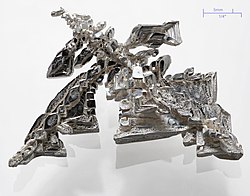
| The appearance of a simple substance | ||||
| silvery-white soft metal | ||||
 | ||||
| Atom properties | ||||
| Name, symbol, number | Silver / Argentum (Ag), 47 | |||
| Atomic mass ( molar mass ) | 107.8682 (2) [2] a. e. m. ( g / mol ) | |||
| Electronic configuration | [Kr] 4d 10 5s 1 | |||
| Atomic radius | 144 pm | |||
| Chemical properties | ||||
| Covalent radius | 134 pm | |||
| Ion radius | (+ 2e) 89 (+ 1e) 126 pm | |||
| Electronegativity | 1.93 (Pauling scale) | |||
| Electrode potential | +0.799 | |||
| Oxidation states | 2, 1 | |||
| Ionization energy | 1st: 730.5 kJ / mol ( eV ) 3rd: 3361 kJ / mol ( eV ) | |||
| Thermodynamic properties of a simple substance | ||||
| Density (at n. In. ) | 10.5 g / cm³ | |||
| Melting temperature | 1235.1 K; 962 ° C | |||
| Boiling temperature | 2485 K; 2162 ° C | |||
| Ud. heat of fusion | 11.95 kJ / mol | |||
| Ud. heat of evaporation | 254.1 kJ / mol | |||
| Molar heat capacity | 25.36 [3] J / (K · mol) | |||
| Molar volume | 10.3 cm ³ / mol | |||
| Crystal lattice of simple matter | ||||
| Grid structure | cubic face centered | |||
| Grid parameters | 4.086 Å | |||
| Debye temperature | 225 K | |||
| Other features | ||||
| Thermal conductivity | (300 K) 429 W / (m · K) | |||
| CAS number | ||||


| 47 | Silver |
Ag 107.8682 | |
| 4d 10 5s 1 | |
Simple substance silver is a malleable, ductile noble metal of silver-white color . The crystal lattice is face-centered cubic . Melting point - 962 ° C, density - 10.5 g / cm³.
History
Silver is known to mankind since ancient times. This is due to the fact that at one time silver, as well as gold , was often found in its native form - it did not have to be smelted from ores . This predetermined the rather significant role of silver in the cultural traditions of various nations . One of the oldest centers for the extraction and processing of silver was prehistoric Sardinia , where it was known from the early Chalcolithic [4] .
In Assyria and Babylon, silver was considered a sacred metal and was a symbol of the moon . In the Middle Ages, silver and its compounds were very popular among alchemists. From the middle of the 13th century, silver became the traditional material for making dishes. In addition, silver is still used for minting commemorative coins (the exit from the turnover of the last silver coins in the 1960s and 1970s roughly coincided with the crisis of the Bretton Woods monetary system ).
Origin of title
Slavic metal names - rus. silver , polish. srebro , bolg. silver , art. Srebro - back to the Proto-Slavic * sérebro , which has correspondences in the Baltic ( lit. sidabras , old prussian . sirablan ) and Germanic ( gots. silubr , German Silber , English silver ) languages. Further etymology outside the German-Balto-Slavic circle of languages is unclear, suggest either the origin of the same basis as the Anatolian subau-ro "brilliant", or early borrowing from the languages of the Middle East: cf. akkad sarpu "purified silver", from Akkad. sarapu “clean, fuse ”, or from pre-Indo-European languages of ancient Europe: cf. Basque. zilar [5] .
The Greek name for silver ἄργυρος, árgyros comes from the Indo-European root * H₂erǵó-, * H₂erǵí- , meaning "white, shining". From the same root is its Latin name - argentum .
Being in nature
The average silver content in the crust (according to Vinogradov ) is 70 mg / ton. Its maximum concentrations are set in shale , where they reach 1 g / t. Silver is characterized by a relatively low energy index of ions , which causes a slight manifestation of the isomorphism of this element and its relatively difficult entry into the lattice of other minerals. There is only a constant isomorphism of silver and lead ions. Silver ions enter the lattice of native gold , the amount of which sometimes reaches almost 50% by mass in the electrum . In a small amount, silver ion is included in the lattice of copper sulphides and sulfosalts, as well as in the composition of tellurides developed in some polymetallic and especially in gold-sulphide and gold- quartz deposits.
A certain part of precious and non-ferrous metals is found in nature in the native form. The facts of finding not just big, but huge nuggets of silver are known and documented. So, for example, in 1477, a silver nugget weighing 20 tons was discovered at the mine mine “Saint George” (Schneeberg deposit in the Ore Mountains 40–45 km from the town of Freiberg). Silver was loosened in size from 1 working out, staged her holiday dinner, and then split and weighed. In Denmark , in the Copenhagen Museum, there is a nugget weighing 254 kg, discovered in 1666 at the Norwegian mine Kongsberg. Large nuggets were found on other continents. Currently, the Canadian parliament houses one of the native silver plates from the Cobalt deposit in Canada , which weighs 612 kg. Another plate, found on the same deposit and given the name “silver pavement” for its dimensions, had a length of about 30 m and contained 20 tons of silver. However, with all the impressiveness of ever-discovered finds, it should be noted that silver is more chemically more active than gold, and for this reason it is less often found in nature in its native form. For the same reason, the solubility of silver is higher and its concentration in seawater is an order of magnitude greater than that of gold (about 0.04 μg / l and 0.004 μg / l, respectively [6] ).
More than 50 natural minerals of silver are known, of which only 15–20 are of important industrial importance, including:
- native silver;
- electrum (gold-silver);
- Kustelit (silver-gold);
- Argentite (silver-sulfur);
- proustit (silver-arsenic-sulfur);
- bromargerit (silver-bromine);
- kerargrite (silver-chlorine);
- pyrargyrite (silver-antimony-sulfur);
- stefanite (silver-antimony-sulfur);
- polibazit (silver-copper-antimony-sulfur);
- Freybergite (copper-sulfur-silver);
- argentoyarosite (silver-iron-sulfur);
- diskrazit (silver-antimony);
- agvilarite (silver-selenium-sulfur)
Like other noble metals, silver has two types of manifestations:
- actually silver deposits, where it makes up more than 50% of the value of all useful components;
- complex silver-containing deposits (in which silver is a part of non-ferrous ores, alloying and noble metals as an associated component).
Actually, silver deposits play a rather significant role in world silver mining, however, it should be noted that the main proven reserves of silver (75%) fall to the share of complex deposits.
Silver content in non-ferrous metal ores is 10-100 g / t, in gold-silver ores 200-1000 g / t, and in silver ore deposits 900-2000 g / t, sometimes tens of kilograms per ton.
Silver is also found in caustobolites: peat, oil, coal, bituminous shale.
Deposits
Significant silver deposits are located in the territories of the following countries:
- Armenia ,
- Germany ,
- Spain ,
- Peru ,
- Chile
- Mexico ,
- Of China ,
- Canada
- USA ,
- Australia ,
- Poland ,
- Russia ,
- Kazakhstan ,
- Romania ,
- Sweden ,
- Czech Republic
- Slovakia ,
- Austria
- Of Hungary
- Norway [7] .
There are also silver deposits in Cyprus and Sardinia [8] .
Physical Properties
Pure silver is rather heavy (lighter than lead , but heavier than copper , density is 10.5 g / cm ³), an unusually ductile silvery-white metal (light reflectance is close to 100%). Thin silver foil in transmitted light has a purple color. Over time, the metal fades, reacting with traces of hydrogen sulphide contained in the air and forming a sulphide deposit , whose thin film then gives the metal a characteristic pinkish color. It has the highest thermal conductivity among metals. At room temperature, it has the highest electrical conductivity among all known metals (electrical resistivity 1.59⋅10 −8 Ohm · m at 20 ° C). Relatively refractory metal, melting point 962 ° C.
Chemical Properties
Silver, being a noble metal, has a relatively low reactivity, it does not dissolve in hydrochloric and dilute sulfuric acids. However, in an oxidizing environment (in nitric , hot concentrated sulfuric acid, and also in hydrochloric acid in the presence of free oxygen) silver dissolves:
It dissolves in ferric chloride , which is used for etching :
Silver is also easily dissolved in mercury , forming amalgam (a liquid alloy of mercury and silver).
Silver is not oxidized by oxygen even at high temperatures, but in the form of thin films it can be oxidized by oxygen plasma or ozone when irradiated with ultraviolet light. In the humid air in the presence of even the slightest traces of divalent sulfur ( hydrogen sulfide , thiosulfates , rubber ) a raid of slightly soluble silver sulfide is formed , causing darkening of silver products:
In the absence of oxygen:
Free halogens easily oxidize silver to halides:
However, in the light of this reaction is drawn, and silver halides (except fluoride) gradually decompose. The principle of black and white photography is based on this phenomenon.
When heated with sulfur, silver gives sulfide:
- .
The most stable degree of oxidation of silver in compounds is +1. In the presence of ammonia , the silver (I) compounds give an easily soluble [Ag (NH 3 ) 2 ] + complex in water. Silver also forms complexes with cyanides and thiosulfates . Complexation is used to dissolve poorly soluble silver compounds, to extract silver from ores. Silver exhibits higher oxidation states (+2, +3) only in combination with oxygen (AgO, Ag 2 O 3 ) and fluorine (AgF 2 , AgF 3 ), such compounds are much less stable than silver (I) compounds.
Silver (I) salts, with rare exceptions (nitrate, perchlorate, fluoride), are insoluble in water, which is often used to determine halogen ions (chlorine, bromine, iodine) in aqueous solution.
Application
- Since it has the highest electrical conductivity , thermal conductivity and resistance to oxidation by oxygen under normal conditions, it is used for contacts of electrical products (for example, contacts of relays, lamellae), as well as multilayer ceramic capacitors .
- The composition of solders : copper-silver solders PSR-72, PSR-45 and others, is used for soldering a variety of important compounds, including dissimilar metals, solders with high silver content are used in jewelry, and with medium - in a variety of techniques, from high-current switches before liquid rocket engines, sometimes also as an additive to lead in the amount of 3% (PSr-3), they are replaced by tin solder .
- In the composition of the alloys: for the manufacture of cathodes of galvanic elements .
- It is used as a precious metal in jewelry (usually in an alloy with copper , sometimes with nickel and other metals).
- Used when minting coins (negotiable - until the early 1970s, now - only jubilee), as well as awards - orders and medals.
- Silver halides and silver nitrate are used in photography, as they are highly sensitive to light .
- Silver iodide is used to change the weather ("dispersal of clouds").
- Due to the high electrical conductivity and oxidation resistance, the following is used:
- in electrical engineering and electronics as covering responsible contacts and conductors in high-frequency circuits;
- in microwave technology as a coating of the inner surface of the waveguides .
- It is used as a coating for highly reflective mirrors ( aluminum is used in ordinary mirrors).
- Often used as a catalyst in oxidation reactions, for example, in the production of formaldehyde from methanol , as well as epoxide from ethylene .
- Used as a disinfectant, mainly for disinfecting water. Limited use in the form of salts ( silver nitrate ) and colloidal solutions ( protargol and collargol ) as an astringent. In the past, the use of silver preparations was much wider.
The fields of application of silver are constantly expanding, and its use is not only alloys, but also chemical compounds. A certain amount of silver is constantly consumed for the production of silver-zinc and silver-cadmium batteries, which have a very high energy density and mass energy consumption and are capable of delivering very large currents to a load with low internal resistance .
Silver is used as an additive (0.1–0.4%) to lead for the casting of current leads of positive lead plates of special lead batteries, which have a very long service life (up to 10–12 years) and low internal resistance.
Silver chloride is used in chlorine silver-zinc batteries, as well as for coating some radar surfaces. In addition, silver chloride, which is transparent in the infrared region of the spectrum, is used in infrared optics.
Silver fluoride single crystals are used to generate laser radiation with a wavelength of 0.193 μm ( ultraviolet radiation ). [ clear ]
Silver is used as a catalyst in gas mask filters.
Silver acetylide (carbide) is rarely used as a powerful initiating explosive ( detonators ).
Silver phosphate is used to melt special glass used for radiation dosimetry. The approximate composition of this glass: aluminum phosphate - 42%, barium phosphate - 25%, potassium phosphate - 25%, silver phosphate - 8%.
Silver permanganate , a crystalline dark purple powder, soluble in water; used in gas masks. In some special cases, silver is also used in dry galvanic cells of the following systems: chlorine-silver element , bromine-silver element , iodine-silver element .
Silver is registered as a food additive E174 .
In medicine
Until the mid-twentieth century, silver nitrate was used as an external antiseptic called lapis . In the light, it decomposes into free silver, nitrogen dioxide and molecular oxygen. However, at present in all spheres a lot of significantly more effective antiseptics are used.
Since 1990, in alternative medicine, there has been a revival of the use of colloidal silver as a treatment for numerous diseases. In laboratory studies, different results were obtained: in some studies it was shown that the antimicrobial effect of silver is very insignificant, while others showed that a solution of 5-30 ppm is effective against staphylococcus and E. coli. This contradiction is associated with the size of colloidal silver nanoparticles - the smaller their size, the more pronounced the antimicrobial effect [9] . It should be noted that similar properties of nanoparticles are characteristic of most transition metals and are associated with the destruction of the bacterial cell membrane during sorption of nanoparticles. This, however, manifests itself only in very pure solutions.
Silver is a heavy metal, the content of which in drinking water is regulated by SanPiN 2.1.4.1074-01 “Drinking water” - silver has been assigned hazard class 2, “highly hazardous substance”. Gossanepidemnadzor officially approved the hygienic standards for the content of harmful substances in drinking water, in these standards the silver content in drinking water is limited to a concentration of 0.05 mg / l [10] .
Colloidal silver preparations are not recognized as drugs in the USA and Australia and are offered in food stores. Also in abundance they can be found in online stores around the world as dietary supplements (dietary supplements) , a simpler name - food additives. The law of the USA and Australia prohibited marketers from attributing medical efficacy to colloidal silver. But some sites, including in their territory, still indicate the beneficial effects of the drug in the prevention of colds and flu, as well as the therapeutic effects in more serious diseases, such as diabetes, cancer, chronic fatigue syndrome, HIV / AIDS, tuberculosis, and other diseases. There are no medical studies showing that colloidal silver is effective for any of these reported symptoms.
Before the era of evidence-based medicine, silver salt solutions were widely used as antiseptic and astringent agents. The action of such drugs as protargol , collargol , etc., which are colloidal forms of silver, is based on this property of silver. Currently, silver preparations are used less and less often due to low efficiency.
Physiological action
Traces of silver (about 0.02 mg / kg) are contained in the organisms of all mammals , but its biological role is not well understood. The human brain is characterized by an increased silver content (0.03 mg per 1000 g of fresh tissue, or 0.002% by weight in ash). Interestingly, in isolated nuclei of nerve cells - neurons - silver is much more (0.08% by weight in ash) [11] .
With a diet, a person receives an average of about 0.1 mg Ag per day. It contains a lot of egg yolk (0.2 mg per 100 g). Silver is removed from the body mainly with feces [11] .
Silver ions have bacteriostatic properties. However, to achieve a bacteriostatic effect, the concentration of silver ions in water must be increased so that it becomes unsuitable for drinking. The bacteriostatic properties of silver have been known since antiquity. In the VI century BC. er The Persian king Cyrus II the Great used silver vessels for storing water in his military campaigns. The coating of surface wounds with silver plates was practiced in ancient Egypt. Purification of large quantities of water, based on the bactericidal action of silver, is particularly convenient to produce electrochemically [11] .
In the early 1970s, the lower limit of the bacteriostatic action of silver was estimated to be about 1 μg / l in water [11] . According to the data of 2009, the lower limit of action is at a level of 50–300 µg / l [9] , which is already dangerous for humans.
Like all heavy metals, silver with an excessive supply to the body is toxic [11] .
According to US sanitary standards, the silver content in drinking water should not exceed 0.05 mg / l. Согласно действующим российским санитарным нормам серебро относится к высокоопасным веществам (класс опасности 2 по санитарно-токсикологическому признаку вредности), и предельно допустимая концентрация серебра в питьевой воде составляет те же 0,05 мг/л [10] .
При длительном поступлении в организм избыточных доз серебра развивается аргирия , внешне выражающаяся серой окраской слизистых оболочек и кожи [12] , причём преимущественно на освещённых участках тела, что обусловлено отложением частичек восстановленного серебра. Какие-либо расстройства самочувствия заболевших аргирией наблюдаются далеко не всегда. Вместе с тем, немедицинскими источниками отмечалось, что они не подвержены инфекционным заболеваниям [11] .
Ионы серебра оказывают генотоксичный эффект, разрушая целостность молекул ДНК в клетках, в том числе вызывая перестройки в хромосомах и фрагментацию последних. Кроме того, исследователи выявили повреждения генов в сперматозоидах [13] .
Добыча
Серебро было известно с глубокой древности (4-е тысячелетие до н. э.) в Египте, Персии, Китае [14] .
Значительным источником извлечённого серебра (не в виде самородков) считается территория Анатолии (современная Турция). Добываемое серебро поступало в основном на Ближний Восток, на Крит и в Грецию [15] .
Более или менее значительные данные о добыче серебра относятся к периоду после III тысячелетия до н. э., например, известно, что халдеи в 2500 году до н. er извлекали металл из свинцово-серебряных руд [15] .
После 1200-х годов до н. er центр производства металла сместился в Грецию, в Лаврион, недалеко от Афин. Шахты были весьма богаты: их добыча с 600 до 300 года до н. er составляла около 1 млн тройских унций (30 т ) в год. В течение почти тысячи лет они оставались самым крупным источником серебра в мире [15] .
С IV по середину I века до н. er лидером по производству серебра были Испания и Карфаген [15] .
Во II—XIII веках действовало множество рудников по всей Европе , которые постепенно истощались.
По мере расширения торговых связей, требующих денежного обращения, в XII—XIII веках выросла добыча серебра в Гарце , Тироле (главный центр добычи — Швац ), Рудных горах , позднее в Силезии , Трансильвании , Карпатах и Швеции . С середины XIII до середины XV веков ежегодная добыча серебра в Европе составляла 25—30 т; во 2-й половине XV века она достигала 45—50 т в год. На германских серебряных рудниках в это время работало около 100 тысяч человек. [sixteen] Крупнейшим из старых месторождений самородного серебра является открытое в 1623 году месторождение Конгсберг в Норвегии [17] .
Освоение Америки привело к открытию богатейших месторождений серебра в Кордильерах . Главным источником становится Мексика , где в 1521 — 1945 годах было добыто около 205 тыс. т металла — около трети всей добычи за этот период. В крупнейшем месторождении Южной Америки — Потоси — за период с 1556 по 1783 год добыто серебра на 820 513 893 песо [ прояснить ] и 6 « прочных реалов » (последний в 1732 году равнялся 85 мараведи ) [18] .
В России первое серебро было выплавлено в июле 1687 года российским рудознатцем Лаврентием Нейгартом из руд Аргунского месторождения ( Нерчинский горный округ ) [19] . В 1701 году в Забайкалье был построен первый сереброплавильный завод, который на постоянной основе стал выплавлять серебро 3 года спустя. Некоторое количество серебра добывалось на Алтае . Лишь в середине XX века освоены многочисленные месторождения на Дальнем Востоке [17] .
В 2008 году [20] всего добыто 20 900 т серебра. Лидером добычи является Перу (3600 т), далее следуют Мексика (3000 т), Китай (2600 т), Чили (2000 т), Австралия (1800 т), Польша (1300 т), США (1120 т), Канада (800 т).
На 2008 год лидером добычи серебра в России является компания « Полиметалл », добывшая в 2008 году 535 т [21] . В 2009 и 2010 годах «Полиметалл» добыл по 538 т серебра, в 2011 году — 619 т.
Мировая добыча серебра (1990-2017) (1990-2007 - данные US Geological Survey [22] , 2008-2017 - данные The Silver Institute [23] ) :

Мировые запасы серебра оцениваются в 505 тыс. т (на 1986 год), подтверждённые — 360 тыс. т [24] .
In mythology
В мифологии многих народов серебру приписываются магические свойства, способность отгонять всяческую нечисть — оборотней, вампиров, злых духов и так далее .
See also
- Благородные металлы
- Пираргирит
- Серебро (геральдика)
- Список серебряных инвестиционных монет
Notes
- ↑ 1 2 Wieser M. E. , Coplen T. B. Atomic weights of the elements 2009 (IUPAC Technical Report) // Pure and Applied Chemistry — International Union of Pure and Applied Chemistry , 2010. — Vol. 83, Iss. 2. — P. 359–396. — ISSN 0033-4545 ; 1365-3075 ; 0074-3925 — doi:10.1351/PAC-REP-10-09-14
- ↑ Michael E. Wieser, Norman Holden, Tyler B. Coplen, John K. Böhlke, Michael Berglund, Willi A. Brand, Paul De Bièvre, Manfred Gröning, Robert D. Loss, Juris Meija, Takafumi Hirata, Thomas Prohaska, Ronny Schoenberg , Glenda O'Connor, Thomas Walczyk, Shige Yoneda, Xiang-Kun Zhu. Atomic weights of the elements 2011 (IUPAC Technical Report) (Eng.) // Pure and Applied Chemistry . - 2013. - Vol. 85 , no. 5 — P. 1047–1078 . - DOI : 10.1351 / PAC-REP-13-03-02 .
- ↑ Чукуров П. М. Серебро // Химическая энциклопедия: в 5 т / Зефиров Н. С. (гл. ред.) . — М. : Большая Российская энциклопедия , 1995. — Т. 4: Полимерные—Трипсин. — С. 323. — 639 с. - 40 000 copies — ISBN 5-85270-039-8 .
- ↑ Silver in Neolithic and Eneolithic Sardinia , in H. Meller, R. Risch, E. Pernicka (eds.), Metalle der Macht — Frühes Gold und Silber. 6. Mitteldeutscher Archäologentag vom 17. bis 19. Oktober 2013 in Halle (Saale), Tagungen des Landesmuseums für Vorgeschichte Halle 11 (Halle (Saale), 2014.
- ↑ В. В. Иванов . Целесообразность человека. Часть пятая. , « Новая газета » (3 сентября 2012). Дата обращения 5 сентября 2012.
- ↑ JP Riley and Skirrow G. Chemical Oceanography V. 1, 1965.
- ↑ Про серебро " месторождения Архивировано 7 сентября 2010 года. .
- ↑ Про серебро " История серебра Архивировано 13 февраля 2010 года. .
- ↑ 1 2 Khaydarov R. A, Khaydarov RR, Estrin Y., Cho S., Scheper T, and Endres C, «Silver nanoparticles: Environmental and human health impacts» , Nanomaterials: Risk and Benefits, Series: NATO Science for Peace and Security Series C: Environmental Security, 2009, Springer, Netherlands, pp. 287—299. ISSN 1874-6519.
- ↑ 1 2 СанПиН 2.1.4.1074-01. Питьевая вода. Hygienic requirements for water quality of centralized drinking water supply systems. Контроль качества .
- ↑ 1 2 3 4 5 6 Некрасов Б. В. Основы общей химии. — 1973. — Т. 3. — С. 44, 52.
- ↑ Интернет-знаменитость «Папа Смурф» скончался в США на 63 году жизни .
- ↑ Найдена опасность обеззараживания воды серебром: Наука: Наука и техника: Lenta.ru
- ↑ Шейпак А. А. История науки и техники. Материалы и технологии: Учебное пособие. — МГИУ, 2010. — Т. Ч. II. — С. 35. — 343 с. — ISBN 9785276018485 .
- ↑ 1 2 3 4 Алексеев И. С. Металлы драгоценные. — М. : Газоил пресс, 2002. — ISBN 5-87719-038-5 .
- ↑ http://www.mining-enc.ru/s/serebro-/ — Серебро — Горная энциклопедия. Проверено 17 ноября 2016.
- ↑ 1 2 Михаил Максимов «Очерк о серебре» (недоступная ссылка)
- ↑ Письмо казначея Потоси дона Ламберто де Сьерра императору Карлу III от 16 июня 1784 года. // Colleccion de documentos ineditos para la historia de Espana. Tomo V. — Madrid, 1844.
- ↑ Трухин В. И. О «бедном» Нейдгарте замолвите слово // Российский исторический иллюстрированный журнал «РОДИНА» 2012 г., № 12 .
- ↑ MINERAL COMMODITY SUMMARIES 2009 .
- ↑ ПРАЙМ-ТАСС: «Полиметалл» в январе—июне получил 19 млн долл чистой прибыли (недоступная ссылка) .
- ↑ US Department of the Interior. US Geological Survey. Silver. Statistics and Information (англ.) . Официальный сайт US Geological Survey (minerals.usgs.gov) (1996-2011). The appeal date is September 4, 2018.
- ↑ The Silver Institute and Thomson Reuters. World Silver Survey 2018 (англ.) . The Silver Institute. Официальный сайт (www.silverinstitute.org) (04.2018). Дата обращения 4 сентября 2018. )
- ↑ Химическая энциклопедия / Редкол.: Кнунянц И. Л. и др.. — М. : Советская энциклопедия, 1995. — Т. 4. — 639 с. — ISBN 5-85270-092-4 .
Links
- Серебро на Webelements
- Серебро в Популярной библиотеке химических элементов
- Энциклопедия Кругосвет
- Термодинамические свойства серебра (Mathcad Calculation Server)
- Colloidal silver not approved ( Коллоидное серебро не одобрено ) (англ.)
- Учебник «Неорганическая химия» под редакцией Ю. Д. Третьякова
- Вторичное серебро
- Чукуров П. М. Серебро // Химическая энциклопедия: в 5 т / Зефиров Н. С. (гл. ред.) . — М. : Большая Российская энциклопедия , 1995. — Т. 4: Полимерные—Трипсин. — С. 323. — 639 с. - 40 000 copies - ISBN 5-85270-039-8 .
- Соединения серебра (токсикологическая химия)
- Серебро в Большой советской энциклопедии
- Физико-химические свойства серебра (справочник)
- Термодинамические свойства серебра (online расчёт)