The 1900 presidential election took place on November 6 and turned out to be a replay of the previous election : the Republican candidate, now as president, William McKinley again beat Democrat William Jennings Brian again. The return of the United States to economic prosperity and the especially victory in the 1898 Spanish-American War greatly strengthened McKinley's position.
← 1896  1904 → 1904 → | |||
| US Presidential Election (1900) | |||
|---|---|---|---|
| 1900 | |||
| November 6th | |||
| Voter turnout | 73.2% [1] | ||
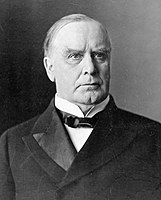 | 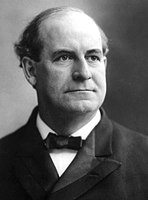 | ||
| Candidate | William McKinley | William Jennings Brian | |
| The consignment | Republican Party | Democratic Party | |
| From | Ohio | Nebraska | |
| vice president | Theodore Roosevelt | Adlai stevenson | |
| The number of votes of electors | 292 | 155 | |
| states | 28 | 17 | |
| Votes | 7,228,864 (51.6%) | 6,370,932 (45.5%) | |
 | |||
Content
Elections
Republican Party
The 926 Republican Convention delegates meeting in Philadelphia June 19-21 were re-nominated by William McKinley. Thomas K. Platt, the “boss” of the New York State Republican Party, did not like the popular governor, Theodore Roosevelt, although he was also a Republican. Roosevelt’s efforts to reform New York’s policies, including republican politics, led Platt and other government leaders to pressure President McKinley to accept Roosevelt as his new vice presidential candidate, filling out a place left open when vice president Garrett Hobart died in 1899. Roosevelt unexpectedly became president after the assassination of McKinley .
Democratic Party
After Admiral George Dewey returned from the Spanish-American War, he ran for president. But Dewey angered the Protestants since his wife was Catholic , never voted on the election and said that the presidency would be easy because the president only enforces the laws passed by Congress . " [2] He realized that he could not be put forward, and stopped the campaign. [3] At a democratic national convention, William Jennings Brian was disagreeingly nominated for president, and former vice president Adlai Stevenson was nominated for vice presidency.
Others
The populist party nominated Wharton Baker and Ignatius Donnelly . Part of the party supported Brian. The Social Democratic Party nominated Eugene Debs .
Campaign
With a thriving economy, Republicans campaigned under the slogan " Four More Years of Full Dining Bowlers ." Together with the victory in the Spanish-American War, won in 1898, their campaign was of great appeal to voters. Teddy Roosevelt , who participated in the Cuban war, became a national hero and a popular republican speaker. In his speeches, he constantly maintained that the war was fair and freed Cubans and Filipinos from Spanish tyranny. [four]
Four years ago, the nation was in tension, because at our very door the American island was moaning in hidden agony from despotism, worse than medieval. We had our own Armenia on the doorstep. The situation in Cuba became so unbearable that we could no longer remain calm in order to preserve the last vestige of self-esteem ... We drew a sword and fought in the fairest and most brilliantly successful foreign war that this generation has ever seen.
The campaign of William Bryan was basically a repetition of the previous one with the main appeal for "free silver". However, this time it was less successful, as the economy was booming, and gold production increased significantly thanks to Alaska and South Africa , which allowed to issue more money (secured by gold). In addition, Brian criticized McKinley's imperialism . He believed that instead of liberating Cuba and the Philippines, the administration simply changed the brutal Spanish dictatorship to the American one. Brian especially criticized the bloody suppression of the uprising of the Philippine partisans. This topic was successful in certain circles, for example, among the former Golden Democrats (the so-called “solid currency” Germans) or anti-imperialists ( Andrew Carnegie ).
Like in the previous election, McKinley spoke from the front porch of his own house in Canton ( Ohio ) in front of brought delegations of voters. One day he received in this way 16 delegations and 30 thousand people. Brian, like four years ago, traveled around the country by train and participated in hundreds of meetings in the Midwest and East of the country. Interestingly, Theodore Roosevelt , a Republican vice presidential candidate, repeated the tactics of the Democrats and also spoke a lot in the country.
Results
| Candidate | The consignment | Voters | Electors | |
|---|---|---|---|---|
| amount | % | |||
| William McKinley | Republican Party | 7,228,864 | 51.6% | 292 |
| William Jennings Brian | Democratic Party | 6 370 932 | 45.5% | 155 |
| John Granville Walley | Prohibition | 210 864 | 1.5% | 0 |
| Eugene Victor Debs | Social Democratic Party | 87 945 | 0.6% | 0 |
| Wharton Baker | Populist party | 50 989 | 0.4% | 0 |
| Joseph Francis Maloney | Socialist Labor Party | 40 943 | 0.3% | 0 |
| other | - | 6,889 | 0,0% | 0 |
| Total | 13,997,426 | 100 % | 447 | |
Notes
- ↑ Voter Turnout in Presidential Elections . The American Presidency Project . UC Santa Barbara .
- ↑ Convention Diary: NRO Total Convention at www.nationalreview.com
- ↑ ADMIRAL DEWEY LOSES HOPE. - Says Now He Doesn't Know What Prompted Him to Aspire to the Presidency. - View Article - NYTimes.com . query.nytimes.com. Date of treatment May 24, 2014.
- ↑ [Brands 1997: 400]
Links
- 1900 popular vote by counties
- 1900 State-by-state Popular vote
- How close was the 1900 election? - Michael Sheppard, Michigan State University