Palladium is a chemical element with atomic number 46 [3] . It belongs to the 10th group of the periodic table of chemical elements (according to the outdated short form of the periodic system, it belongs to the side subgroup of group VIII, or to group VIIIB), is in the fifth period of the table. The atomic mass of an element is 106.42 (1) a. e. m . It is indicated by the symbol Pd (from lat. Palladium ).
| Palladium | ||||
|---|---|---|---|---|
| ← Rhodium | Silver → | ||||
| ||||
| The appearance of a simple substance | ||||
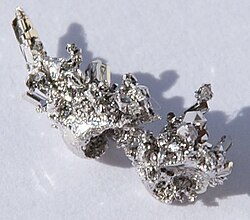
| Silver white soft viscous malleable metal | ||||
 | ||||
| Atom properties | ||||
| Name, symbol, number | Palladium / Palladium (Pd), 46 | |||
| Atomic mass ( molar mass ) | 106.42 (1) [1] a. E. m. ( g / mol ) | |||
| Electronic configuration | [Kr] 4d 10 | |||
| Atom radius | 137 pm | |||
| Chemical properties | ||||
| Covalent radius | 128 pm | |||
| Ion radius | (+ 4e) 65 (+ 2e) 80 pm | |||
| Electronegativity | 2.20 (Pauling scale) | |||
| Electrode potential | +0.987 | |||
| Oxidation state | 0, +1, +2 (most often), +3, +4 (often), +5, +6 (very rare) | |||
| Ionization energy (first electron) | 803.5 (8.33) kJ / mol ( eV ) | |||
| Thermodynamic properties of a simple substance | ||||
| Density (at N. at. ) | 12.02 g / cm³ | |||
| Melting temperature | 1554 ° C | |||
| Boiling temperature | 2940 K | |||
| Beats heat of fusion | 17.24 kJ / mol | |||
| Beats heat of vaporization | 372.4 kJ / mol | |||
| Molar heat capacity | 25.8 [2] J / (K · mol) | |||
| Molar volume | 8.9 cm³ / mol | |||
| The crystal lattice of a simple substance | ||||
| Lattice structure | cubic face-centered | |||
| Lattice options | 3.890 Å | |||
| Debye temperature | 274 K | |||
| Other characteristics | ||||
| Thermal conductivity | (300 K) 71.8 W / (mK) | |||
| CAS Number | ||||


| 46 | Palladium |
Pd 106.42 | |
| 4d 10 | |
The element belongs to transition metals and to noble metals of the platinum group (light platinoids). The simple substance palladium under normal conditions is a silver-white ductile metal .
Content
History
In 1803, the famous London mineral merchant Forster received an anonymous letter asking him to try to sell a small amount of a new chemical element - “palladium”, an ingot of which was attached to the letter [4] . The mysterious metal was put up for sale and attracted everyone's attention [4] . There is a debate among British chemists about whether this metal is really a new chemical element or is it just an alloy of previously known metals. Chemist Richard Cenevix , wanting to expose the "fraudulent fake", bought a bar of "palladium" [4] . Soon, Cenevix made a presentation to members of the Royal Society of London , where he announced that this metal is just an alloy of platinum with mercury . However, the secretary of the Royal Society, chemist William Hyde Wollaston, publicly doubted the conclusions of Chenevix. Other chemists failed to isolate either platinum or mercury in this “alloy”. The debate again escalated and continued for some time. When they began to subside, an anonymous announcement appeared in the scientific journal Nicholson's Journal that anyone who could make artificial palladium within a year would be paid a reward of £ 20 [4] . Interest in metal jumped again, but no one was able to manufacture it [4] .
In 1804, William Wollaston reported to the Royal Society that in platinum ore from South America, he discovered new previously unknown metals - palladium and rhodium [4] . In an effort to purify the “raw” platinum extracted from the ore from impurities of gold and mercury , he dissolved it in aqua regia , and then precipitated it from the solution with ammonia [4] . The remaining solution had a pink hue, which could not be explained by the presence of gold and mercury [4] . Then zinc was added to this solution, which led to the precipitation of a black precipitate [4] . Wollaston found that if you try to dissolve this dried precipitate with aqua regia, part of it dissolves, and part does not [4] . After diluting the solution with water, Wollaston added potassium cyanide to it, which led to an abundant precipitation of an already orange color, which, upon heating, first turned gray and then melted into a drop of metal - palladium, which was less than mercury in specific gravity. From the remaining undissolved part of the black precipitate, he isolated another metal - rhodium [4] .
Only in February 1805 did the Nicholson's Journal publish an open letter from Wollaston, in which he admitted that the scandalous hype surrounding palladium was the work of his hands [4] . It was he who launched the new metal on sale, and he also gave an anonymous announcement with a promise of a prize for its artificial manufacture, already having proof that palladium is a new metal [4] .
Name Origin
It is named after the asteroid Pallas , discovered by the German astronomer Olbers in 1802, that is, shortly before the discovery of palladium. In turn, the asteroid is named after Athena Pallas from ancient Greek mythology . Palladium , or Palladium, - the legendary wooden image of Athena Pallas falling from the sky; according to the prophecy of Helen ( Priam's son), Troy will remain indestructible while this talisman is stored in its walls. According to legend, only after the goddess's favorites - Odysseus and Diomedes - during the night outings, Palladium was stolen, this stronghold fell.
Being in nature
One of the rarest elements in the earth's crust; its clarke number is 1 · 10 −6 %. It occurs in a native form ( allopalladium ), in the form of intermetallic minerals (palladium platinum , stannopalladinite Pd 3 Sn 2 , etc.) and other compounds ( palladium PdO, braggite (Pd, Pt, Ni) S, etc.). About 30 palladium minerals are known. It accompanies other platinum metals, its content in a mixture of platinoids in various deposits varies from 25 to 60% [2] . According to the Golshmidtovsky geochemical classification of elements , like all platinoids, it belongs to siderophiles, that is, it has an affinity for iron and is concentrated in the Earth’s core [5] . Currently, the largest (not developed) palladium deposit in Russia is located in the Murmansk region (Fedorovo-Pansky intrusive massif).
Getting
Palladium is obtained mainly in the processing of sulfide ores of nickel , silver and copper . Some part of world production (about 10%) is recovery from secondary raw materials [2] .
After precipitating gold and platinum from a mixture of precious metals in aqua regia, dichlorodiammine palladium Pd (NH 3 ) 2 Cl 2 is precipitated, it is purified by recrystallization from an ammonia solution of HCl, decomposed to powdered palladium by calcination in a reducing atmosphere, the palladium powder is melted [2] .
When restoring solutions of palladium salts, palladium black is obtained - a fine crystalline powder of palladium [2] .
Compact metal palladium is also obtained by electrodeposition from nitrite and phosphate acidic electrolytes, for example, using Na 2 [Pd (NO 2 ) 4 ] [2] .
Production Indicators
The largest palladium deposit is located in Russia (Norilsk, Talnakh). Also known deposits in Transvaal (Africa), Canada, Alaska, Australia, Colombia [6] .
World palladium shipments in 2007 amounted to 267 tons (including Russia - 141 tons, South Africa - 86 tons, USA and Canada - 31 tons, other countries - 9 tons). Palladium consumption in 2007 amounted to 107 tons in the automotive industry, 40 tons in the electronics industry, and 12 tons in the chemical industry [7] .
According to the London research company GFMS, in 2009 the Russian Federation sold approximately 1.1 million ounces of palladium, in 2010–800 thousand ounces, in 2011 the export volume will be similar [8] .
Physical Properties
Palladium is a transition metal . Under normal conditions, forms silver-white crystals of cubic syngony , space group Fm 3 m , cell parameters a = 0.38902 nm , Z = 4 , structural type of copper .
Palladium is plastic; microadditives of nickel , cobalt , rhodium or ruthenium improve the mechanical properties of Pd and increase hardness .
It is insoluble in water. Density - 12.02 (20 ° C, g / cm³); under special conditions forms colloidal palladium and palladium black . Melting point - 1554 ° C (in some sources 1552 ° C); boiling point about 2940 ° C. The heat of fusion is 16.7 kJ / mol, the heat of vaporization is 353 kJ / mol. Specific heat at 20 ° C - 25.8 J / (mol · K); electrical resistivity at 25 ° C - 9.96 microns Ohm / cm; thermal conductivity - 75.3 W / (m · K). Vickers hardness is 37 ... 39 [2] . Brinell hardness is 52 kgf / mm 2 .
The linear expansion temperature coefficient is 1.17 · 10 −5 K −1 (in the range 0 ... 100 ° С) [2] .
The surface tension coefficient of liquid palladium at a melting point is 0.015 N / cm [2] .
Palladium is a paramagnet ; its magnetic susceptibility is + 5.231 · 10 −6 (at +20 ° C) [2] .
It actively absorbs hydrogen , forming solid solutions (up to 900 volumes of H 2 per volume of Pd), while the lattice constant increases. Hydrogen is removed from palladium by heating to 100 ° C in vacuum [2] .
Isotopes
Natural palladium consists of six stable isotopes : 102 Pd (1.00%), 104 Pd (11.14%), 105 Pd (22.33%), 106 Pd (27.33%), 108 Pd (26.46 %) and 110 Pd (11.72%).
The most long-lived artificial radioactive isotope 107 Pd ( T 1/2 7 · 10 6 years). Some palladium isotopes are actively formed as fragments of fission of uranium and plutonium; Thus, in the irradiated fuel of modern reactors with a degree of burnup of 3%, 0.15% of palladium is contained [2] .
Chemical Properties
Palladium is the most chemically active of platinum metals. Does not react with water, diluted acids, alkalis, ammonia solution. Reacts with hot concentrated sulfuric and nitric acids, unlike other platinum metals. It can be translated into solution by anodic dissolution in hydrochloric acid [2] :
At room temperature it reacts with aqua regia , with moist chlorine and bromine . When heated, reacts with fluorine , sulfur , selenium , tellurium , arsenic and silicon . It is oxidized during fusion with potassium hydrosulfate KHSO 4 , and also interacts with a melt of sodium peroxide [2] .
When heated in air, it is stable up to ~ 300 ° C and above 850 ° C; in the range 300 ... 850 ° C tarnishes due to the formation of a film of palladium oxide PdO, which decomposes at a higher temperature [2] .
Application
Catalysts
Palladium is often used as a catalyst , mainly in the process of hydrogenation of fats , oil cracking , organic synthesis (see Lindlar's catalyst , Palladium-catalyzed coupling reactions ).
Palladium chloride PdCl 2 is also used as a catalyst for the detection of trace amounts of carbon monoxide in air or gas mixtures.
Hydrogen Technology
Since hydrogen diffuses very well through palladium, palladium membranes are used for the deep purification of hydrogen. To save expensive palladium in the manufacture of membranes for hydrogen purification and separation of hydrogen isotopes, alloys with other metals have been developed (the most effective and economical alloy of palladium with yttrium ).
Palladium is also capable of extremely effectively reversibly accumulating hydrogen. See Palladium hydride .
Electronics
Palladium chloride is used in electroplating as an activating substance in the galvanic metallization of dielectrics - in particular, the deposition of copper on the surface of laminated plastics in the manufacture of printed circuit boards .
The use of palladium in contact nodes is due to the high wear and corrosion resistance of palladium. Palladium and palladium alloys are used to coat sulfide resistant contacts. Palladium is used to produce rheochords of high- precision precision resistances, including in the form of an alloy with tungsten (for example, ПДВ-20М).
Palladium is also part of ceramic capacitors (type KM), with high temperature stability of the capacitance in high-frequency equipment for broadcasting, radio communications, and television [9] .
In jewelry and coinage
- In alloys used in jewelry (for example, to obtain an alloy of gold- palladium - the so-called "white gold" ). Palladium, even in a small concentration in the alloy (about 1%), changes the color of the alloy based on gold from yellow to silver-white. The main alloys of palladium with silver used in jewelry have 500 and 850 silver samples (since they are the most technologically advanced during machining and are decorative).
- Limited-edition commemorative coins are sometimes minted from palladium [10] .
In medicine
- Medical instruments, parts of pacemakers , dentures are made from palladium and its alloys;
- In some countries, a small amount of palladium is used to produce cytostatic drugs - in the form of complex compounds, similar to cis-platinum .
- Beta-active palladium-103 is used for brachytherapy in the treatment of cancer.
Other Palladium Applications
- For the manufacture of special chemical glassware, parts resistant to corrosion of precision measuring instruments, precision mechanical tools.
- A certain amount of palladium is spent on the manufacture of chemical equipment for the production of hydrofluoric acid (vessels, distillation cubes, pump parts, retorts ).
- Palladium is a precious metal and is traded on exchange and over-the-counter markets. In some countries, including Russia, legislation allows individuals and legal entities to open “metal accounts” in palladium at banks. In the Russian Federation for the illegal acquisition, storage, transportation, transfer and sale of palladium (as well as other precious metals of gold , silver , platinum , iridium , rhodium , ruthenium and osmium [11] ) in large quantities (that is, worth more than 2.5 million rubles [12] .) with the exception of jewelry and household products and scrap of such products, criminal liability is provided in the form of imprisonment for up to 5 years [13] .
See also
- Platinum Group Metals
- White gold
Notes
- ↑ Michael E. Wieser, Norman Holden, Tyler B. Coplen, John K. Böhlke, Michael Berglund, Willi A. Brand, Paul De Bièvre, Manfred Gröning, Robert D. Loss, Juris Meija, Takafumi Hirata, Thomas Prohaska, Ronny Schoenberg , Glenda O'Connor, Thomas Walczyk, Shige Yoneda, Xiang ‑ Kun Zhu. Atomic weights of the elements 2011 (IUPAC Technical Report ) // Pure and Applied Chemistry . - 2013 .-- Vol. 85 , no. 5 . - P. 1047-1078 . - DOI : 10.1351 / PAC-REP-13-03-02 .
- ↑ 1 2 3 4 5 6 7 8 9 10 11 12 13 14 15 Palladium // Chemical Encyclopedia: 5 t / Knunyants I. L. - M .: Big Russian Encyclopedia , 1992. - T. 3: Copper — Polymer. - S. 440-441. - 639 p. - 48,000 copies. - ISBN 5-85270-039-8 .
- ↑ Mendeleev's table on the IUPAC website.
- ↑ 1 2 3 4 5 6 7 8 9 10 11 12 13 A popular library of chemical elements. Book One "Hydrogen - Palladium." Ed. 3rd - M.: Science, 1983.
- ↑ Voitkevich V. G. Origin and chemical evolution of the Earth / ed. L.I. Prikhodko. - M .: Nauka, 1973. - 168 p.
- ↑ Norilsk metal - And what do we know about palladium?
- ↑ Bulletin of Foreign Commercial Information, No. 95, 08/23/08, p. 12.
- ↑ Thomson Reuters GFMS | Analytics and content for metals professionals | Thomson reuters eikon
- ↑ “Methodology for the comprehensive utilization of secondary precious metals from waste computer technology” (UTV. GOSTELECOM RF 10/19/1999)
- ↑ Sberbank website Archived copy of December 31, 2014 on Wayback Machine .
- ↑ According to Article 1 of the Federal Law of March 26, 1998 No. 41-FZ “On Precious Metals and Precious Stones” .
- ↑ According to article 170.2 of the Criminal Code of the Russian Federation .
- ↑ According to article 191 of the Criminal Code of the Russian Federation .
Literature
- Palladium: chemistry, technology and application // Russian Chemical Journal . - 2006. - T. L , No. 4 . The thematic issue of the journal covers numerous problems of production and use of palladium
Links
- Mark Winter. Palladium: the essentials . WebElements . Date of treatment April 4, 2019 .
- A popular library of chemical elements . Palladium . Digital Library "Science and Technology" (July 10, 2002) . Date of treatment April 4, 2019 .