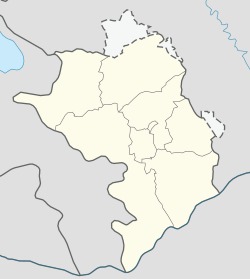
Tigranakert ( Armenian Տիգրանակերտ , lat. Tigranocerta ) is an ancient city in the Artsakh province of Great Armenia [1] [2] [3] , one of four ancient Armenian cities with this name, presumably founded by Tigran II in the 1st century BC. e. and bearer of his name. A direct mention of this city is contained in the work of the 7th century Armenian historian Sebeos ; There is an opinion that Movses Kagankatvatsi also pointed to this city [4] [5] . Located in the Artsakh province of Great Armenia [1] [2] [3] . Armenian archaeologists identify it with the city of the ancient and medieval era, the ruins of which were discovered in 2005 in the village of Shakhbulag in Plain Karabakh , northwest of Agdam (north-east of the Askeran region of the unrecognized Nagorno-Karabakh Republic , which controls this part of Plain Karabakh , or north West of the Agdam region of Azerbaijan ) [2] [6] [7] [8] . In the place of the ancient city, burial mounds, stone sculptures, religious buildings, churches, hollowed out in the rocks, have been preserved. The report on the find was published in the academic journal of the International Association of Armenian Studies [2] .
| Ancient city | |
| Tigranakert | |
|---|---|
| arm Տիգրանակերտ , lat. Tigranocerta | |
 | |
| Region | Artsakh |
| Founded | I century BC e. |
| Founder | Tigran II |
| First mention | VII century |
| Ruined | XIV century |
| The name of the settlement | Shahbulag |


Excavations of the city are carried out by the Artsakh archaeological expedition of the Institute of Archeology and Ethnography of the National Academy of Sciences of Armenia under the leadership of Hamlet Petrosyan, a doctor of historical sciences [9] . In December 2008, at a meeting of the government of the Nagorno-Karabakh Republic, it was decided to declare Tigranakert a state reserve.
Content
- 1 Written Mention
- 2 City searches
- 3 Excavations
- 4 History of the ruins of the city
- 5 Background on the localization of Tigranakert
- 6 International Resonance
- 7 Archeology and politics
- 8 Sources
- 9 See also
- 10 Links
- 11 Notes
Written Mention
According to historians K. Galachyan, L. R. Baghdasaryan and R. G. Ananikyan, “Tigranakert is the most ancient city of Artsakh-Karabakh, which has existed for a long time and played a role in the history of the region” [10] . Tigranakert is mentioned by Sebeos , an Armenian historian of the 7th century , and, judging by the name, is supposed to have been founded at the beginning of the 1st century. BC e. Tigran the Great - is believed to be the first of four cities bearing such a name (including the capital of Great Armenia), built in the 80s of the 1st century. BC e.
Sebeos mentions Tigranakert in connection with the campaign of the Byzantine emperor Heraclius the Great to Armenia, then owned by the Persians, and his victory over the army of the Persian king Khosrov and the defeat of Tbilisi in 627. According to the text, Heraclius, having invaded Atropatena and defeated its ancient capital Gandzak , moved through Albania to Iberia . Having received news of this, the Persian king Khosrov Nushirvan detached his commander, who crossed across Irakli through the Ararat valley towards Gardaman (the area on the right bank of the Kura River, at that time Albanian) and became a camp in the “friend” Tigranakert (and not in the one mentioned here the “Avan”, that is, the fortified village, Tigranakert), while the Persians became a camp near the “Avan” Tigranakert in the rear of Heraclius. In the ensuing battle, they were defeated:
It came to Khozroi’s hearing that Irakle returned, reached Paytarakan and wanted to go through Ivania to Iveria. Khozroy ordered his commander, Shahr-Varaz, to cut off his path. He hastened to Ararat and went to Gardman, to meet him, and camped in another Tigranakert, opposite him. Shagen with 30,000 troops arrived in time and set up camp in the rear of Herakl, in the town of Tigranakert. Thus, his troops were located on this, and the army of Shahr-Varaz - on the other side. Irakle's camp between the two of them. [eleven]
The historian Movses Kagankatvatsi also mentions among the representatives of the Albanian clergy - fighters against the Chalcedonian "heresy" - a certain Petros, a monk from the monastery of Tkrakert, identified with the Artsakh Tigranakert [12] .
City Search
The approximate location of Tigranakert of Artsakh near Mardakert was established long ago due to silver coins, marble bowls, tombs, etc. found in these places, which testified to the presence of a large and rich ancient settlement in the region [13] . The locals called these places “Trakert” or “Tarnakert” (the local sound of the name “Tigranakert”) [14]
According to the story of the head of the excavations, Dr. Hamlet Petrosyan, on the basis of written sources, topographic and archaeological information, he concluded that the remains of the city should be sought on the hills near the Khachinchay River , where the chain of the Artsakh Mountains passes into the lowlands, on lands that were borderline between the provinces of Artsakh and Utik , so the city of Tigranakert was part of Utik , and the Avan of Tigranakert was Artsakh [15] . Data in favor of this area was obtained as a result of a detailed study of reports on the route of the Herakli campaign to Tbilisi. So, Movses Kagankatvatsi reports that Irakli spent the night at a ravine near the bank of the Terter river near the village of Kagankatuyk (Kalankatuyk), then - in the village of Dyutakan. It is also natural to assume that the army of Heraclius was moving along a road paved from north to south. All this again, according to Petrosyan, pointed to the area south of the Terter River, that is, the border of the present Nagorno-Plain Karabakh, an area not far from the then capital of Albania - Partava (near modern Barda ). Finally, the priest Petros from Tigranakert was mentioned immediately after the priest David from Kalankatuyk, which implies that Tigranakert was apparently not far from this village. Later excavated basilica gave Petrosyan reason to believe that Petros served in it as rector in it [16] .
Choosing the Khachinchaya valley as a conditional center, archaeologists examined the monuments within a radius of about 10 km. As a result, two groups of ruins were found, on the right and left banks of the river. The ruins in the area of the source near the fortress of Shahbulag, which in the XIX century, were examined in detail. were known from descriptions of travelers under the names Tngrnagert, Taranyurt, Tarnagut [2] .
Excavations
As a result of a brief 15-day excavation in 2006, ruins with numerous ceramics of the 1st century were found. BC e., two cemeteries, a basilica built in the Hellenistic technique of dry masonry from powerful hewn stones, walls with semicircular towers, the remains of an early Christian basilica, etc. Of particular importance to archaeologists was the large amount of ceramics characteristic of the first half of the 1st century. BC e., that is, for the era of Tigranes the Great. As a result, Armenian archaeologists considered it established that this settlement existed between the beginning of the 1st century. BC e. and XIII — XIV centuries. n e. and was one of the cities built by Tsar Tigran the Great [2] [6] [17] .
According to reports of Armenian archaeologists, among the finds is a unique cruciform early Christian basilica of the 5th – 6th centuries, defined as one of the oldest in the Transcaucasus. Among the ruins of the basilica, in particular, an inscription in Armenian was discovered, which is a small disk with a diameter of about 8 cm, located on a paved floor. The inscription reads: “ I am Vach (e) servant G (ospoda) B (og) a ” [18] . The disk belongs to the category of gift stones and, apparently, belonged to one of several famous historical persons of this name [19] . According to Armenian archaeologists, this is one of the rare churches that has an entrance from the northern, southern and western sides. The church acted until the 9th century , when “due to damage caused by Gentiles or as a result of earthquakes, it ceased to function” [18] .
The city was built on the slopes of Mount Vankasar (Chobandag), and due to the steepness of the mountain, terraces were cut down for construction. The city’s acropolis was erected at a large key that provided the population with water. The building material was limestone. The city occupied about 50 hectares and accommodated several thousand people, which by ancient standards was a medium-sized city. The city experienced a decline in the era of the Early Middle Ages and launched in the era of the Mongol invasion, although, apparently, not immediately after this invasion [6] .
As the head of the excavations, Dr. Hamlet Petrosyan, notes, the city consisted of 3 parts: in the upper part there were palaces, then the central quarter, and in the lower part there was a walled quarter - the Acropolis: all together looked like a triangle [18] .
If in the first three years of excavation only certain parts of the city were discovered, then in 2008 large-scale excavations were begun. The main find of 2008 was a round tower with a diameter of more than 9 meters from smoothly cut stones, characterized by archaeologists as one of the perfect examples of the defensive structure of the times of Tigran the Great. Other finds included a cemetery with early Christian tombstones and 10 cross stones, and an iron shovel of the 9th century, which is also of great value, since only a few such samples have been found so far [20] . In the 2009 season, an ancient gem was found in the citadel with an image of an eagle tormenting a deer; since gems were used as seals, the find, according to G. Petrosyan, indicates the important administrative significance of the city [21] .
The history of the ruins of the city
In the mid-18th century, the founder of the Karabakh Khanate Panah Khan built a fortress near the Shahbulag spring, and, according to G. Petrosyan, he used stones from the ruins of the basilica that still existed by that time [16] . According to Mirza Adigezal bey,
he (Panah-Ali khan), having destroyed the Bayat fortress, arrived in Tarnakut, located at the foot of the hill, where there is a well-known source of Shahbulagy. Here a fortress was erected, built of lime and stone houses, mosques, baths and shopping arcades. All this construction was completed in 1165 <1751/52>, and he settled there. [22]
Raffi , an Armenian contemporary of Mirza Adigezal-bey, writes:
Then he began to build a new fortress - Askeran - near Shah-bulakh, on the ruins of Tarnakyurt (Tigranakert). But Melik Gulistan Hovsep, Melik Dzhraberda Alakhkuli and Melik Khachen Alahverdi (...) started the fight with Panah Khan and again did not allow him to carry out his plan. [23]
Tigranakert Localization History
In the middle of the XIX century. Sargis Dzhalalyants, who visited the ruins of the fortress, identified the spring at Shakhbulag with Tigranakert, noting that the area around the Shakhbulag springs is called by Armenians Tngrnakert, and the Persians by Tarnagirt. The same assumption was made by the researcher of Karabakh antiquities Makar Barkhudaryants , who noted that the Khachen river valley was called the Tigranakert province [16] . However, after the 1950s. in the town of Gavurkala , about 6 km from Shakhbulag , a sarcophagus cover with an Armenian inscription was discovered, excavations were opened by Azerbaijani archaeologists under the guidance of R. Vaidov , which revealed a large settlement in Gavurkal. It has been suggested that it was here that the ancient Armenian Tigranakert was located. R. Vaidov, however, was in solidarity with the point of view of the Armenian scientist S. T. Eremyan , who localized Tigranakert near Agdam [24] .
International Resonance
Excavations in the Artsakh Tigranakert attracted the attention of a number of foreign scientists. These include a professor of Roman history at the University of Lecce (Italy), and later Rouen University (France), Justo Traina , who became interested in Greek early Christian inscriptions in the vicinity of Tigranakert and was invited by Petrosyan to work with them [2] [6] [7] [8] . The French scientist Gurgen Davtyan from the Institute of Archeology in Nice is working on a virtual restoration of the appearance of Tigranakert [6] [8] . The organizers of the excavations together with the Union of Armenians of Switzerland (the main sponsor of the excavations) held a photo exhibition in Geneva in honor of the opening and an international scientific conference, in which, in particular, Traina and Davtyan participated. The results of the excavations were presented at the International Armenian Studies Congress in Paris in September 2008 [20] , and a report on them was published in the journal of the International Association of Armenian Studies [2] . Thanks to the Armenian organization Yerkir, a Tigranakert Excavation Support Committee was established in Los Angeles to carry out information activities and raise funds. G. Petrosyan gave a series of lectures on the Tigranakert in the USA (including at the University of California [25] ) and appeared in television programs dedicated to the city, and the famous director Z. Chgnavoryan made the film “The Tigranakert Odyssey”, which was shown in Geneva and in Los Angeles, where he successfully passed through several television channels [6] . Excavations were covered by Russian news agencies - Regnum and RIA Novosti [26] [27] . Excavations in Tigranakert were highlighted by CNN [28] .
Archeology and Politics
Hamlet Petrosyan began his article in the academic journal of the International Association of Armenian Studies [2] on the results of excavations with the words about what he sees in the political significance of his find:
The significance of the fact that Artsakh is a historically Armenian region and up to the XIV century had an ethnically almost homogeneous population was repeatedly recognized in discussions on issues related to Karabakh (...) All studies of monuments in Artsakh provoke protests from the Azerbaijani authorities and even appeals to international organizations. Accordingly, one of the most important issues of modern Armenian studies is the identification, study and presentation of this ethnic and cultural unity of the monuments of Artsakh and historical facts to state bodies, the public and political figures.
The discovery of Tigranakert in this regard is of great importance. This is the city that is best able to attest to the ethno-cultural homogeneity of Artsakh and Armenia from the last centuries BC. e. until the XIII — XIV centuries of our era ... [2]
In April 2008, at a meeting with representatives of the NKR intelligentsia, Hamlet Petrosyan stated:
The find confirms that the liberated territories are undoubtedly Armenian lands. We prove this to the international community so that the Azerbaijani intelligentsia ceases to deceive the public. [27]
In October 2007, a statement adopted by the Academic Council of the Institute of History of the National Academy of Sciences of Azerbaijan was posted on the website of the National Academy of Sciences of Azerbaijan, which called the falsification of allegations by Armenian historians about the discovery, as stated in the statement, “in the occupied part of the Agdam region of Azerbaijan the ruins of the mythical Great Armenia “the city of Tigranakert” . The statement stated that allegedly [29] “no ancient Armenian settlements, necropolises, fortresses, etc., were found during archaeological excavations in the territory of Garabakh during its more than a century-long period of time. " . It is also alleged that regarding the archaeological sites of Karabakh, starting from the Paleolithic Azikh cave , including the settlement of the Middle Bronze Age Uzerlik-tepe on the outskirts of Agdam, “the world scientific community, including Armenian scholars, unequivocally acknowledge the belonging of these monuments to the ancient settlers of Azerbaijan” and that allegedly [ 30] "in any of the existing written sources there was no evidence of finding land or Plain Nagorno Garabagh as a part of the created Tigran short of udarstva " [31] .
Sources
- Armenian Cultural Monuments in the Region of Karabakh, by Samvel Karapetyan - 2001—229 p.
- Archaeological Research in Tigranakert (Artsakh) // AIEA Newsletter, International Association for Armenian Studies, # 42. 2008, p. 31-38 (inaccessible link)
- L'ange d'Artsakh: les monuments d'architecture arménienne du Haut-Karabakh, by Boris Baratov - 1992—207 p.
See also
- Shahbulag
- Tigranakert (fortress)
- Tigranakert (Sylvan)
- Gyavurkala
- Tigran II
- Caucasian Albania
Links
- Website dedicated to Artsakh Tigranakert
- Archaeologists continue the excavation of the Artsakh Tigranakert // RIA Novosti
- Scientist: "Excavations in Artsakh Tigranakert have historical significance" // Regnum
- Fragments of a unique basilica during excavations of the ancient city of Tigranakert // Blagovest
- Zarine Milyan. Artsakh Tigranakert // News of Armenia (professional article, apparently, of the expedition employee).
- Artsakh Tigranakert - a symbol of victory
- "The-traces-of-Tigranakert-The-city-Of-Tigran-The-king-of-Armenia" on wikimapia.org
- Artsakh Tigranakert // Noah's Ark
- Disc with Armenian inscriptions discovered during excavations of Artsakh Tigranakert
- Excavations of Artsakh Tigranakert renewed
- Artsakh Tigranakert: Another Artifact // IA ARMENIAToday
- Excavations of Artsakh Tigranakert in 2009 will get even greater scope (inaccessible link)
- Armenian archaeologists discovered ancient gem during excavations of Artsakh Tigranakert
- Archaeologists have discovered fragments of an ancient fortress during the excavation of Artsakh Tigranakert
- Archeological Digs Continue at Artsakh's Tigranakert Site
- Artsakh's Tigranakert (link not available)
- Tigranakert: An Armenian Odyssey ( part 1 , part 2 )
- Excavation video in Tigranakert
Notes
- ↑ 1 2 History and culture of the Armenian people from ancient times to the beginning of the 19th century, A.E. Ter-Sargsyants - 2005 - c. 69
- ↑ 1 2 3 4 5 6 7 8 9 10 Archaeological Research in Tigranakert (Artsakh) // AIEA Newsletter, International Association for Armenian Studies, # 42. 2008, Giusto Traina. Lettre de l'éditeur. pp. 31-38 (inaccessible link)
- ↑ 1 2 A.I. Boltunova / Ancient cities of Georgia and Armenia / Ancient city / USSR Academy of Sciences. Institute of Archeology. - M.: Publishing House of the Academy of Sciences of the USSR, 1963. page 161Original text (Russian)The urban development activities of Tigran were not limited to the founding of a new, brilliant capital. He founded a number of new cities in various parts of the kingdom, including three more Tigranokert (in Artsakh, Utica and Goltn). In addition, Tigran took care of the expansion of old cities, such as Artashat, Armavir, Yervandashat, Zarehavan.
- ↑ The Caucasian Knot: The History & Geopolitics of Nagorno-Karabagh, By Levon Chorbajian, Claude Mutafian, Zed Books, 1994, ISBN 1-85649-288-5 , p. 53
Sebeos Armenian historian of the 7th century testifies that there were two cities with the name Tigranokert (Tigranakert), which were founded by the king of Armenia Tigran (Tigranes) II (99-55 BC), one in Artsakh, one in Utica.
Original textThe seventh-century Armenian historian Sebeos attests that there were two cities with the name Tigranocerta (Tigranakert) which were founded by the Armenian King Tigran (Tigranes) II (99-55 BC), one in Artsakh and one in Utic. - ↑ Sebeos , ch. 26
- ↑ 1 2 3 4 5 6 Interview with the head of the excavation G. Petrosyan (Inaccessible link) . Date of treatment October 12, 2009. Archived October 17, 2009.
- ↑ 1 2 Artsakh Tigranakert // Noah's Ark
- ↑ 1 2 3 Conference and exhibition in Geneva dedicated to the results of excavations in Tigranakert.
- ↑ “Unique finds are presented to the world”, GA, 02.24.2009 (inaccessible link)
- ↑ Historical and architectural monuments of Nagorno-Karabakh, K. Galachyan, L. R Baghdasaryan, R. G Ananikyan - 1988 - c. 64
- ↑ Sebeos. History of Armenia, III, 26
- ↑ Movses Kagankatvatsi. Aluank Country History Book III
- ↑ Boris Baratov. Angel of Artsakh. Monuments of Armenian art of Nagorno-Karabakh. M., Linguist Publishing House, 1992, pp. 34-35
- ↑ G.S. Swazyan. Artsakh in historical sources, pp. 3-14. . No. 11 ISSN 0320-8117 . Լրաբեր Հասարակական Գիտությունների (1989). Date of treatment May 24, 2014. Original text (Russian)Within the current village of Sofulu, the Agdam region of the Azerbaijan Soviet Socialist Republic, which was once part of the Gavar Piank in the Artsakh Region, there are ruins of settlements that locals call “Tkrakert” or “Tarnakert” (the local sound of the name is “Tigranakert”) 8, and, of course, are associated with in the name of their founder, Tigranes the Great. The Armenian historians Sebeos9 and Movses Kalankatuatsi also mention these settlements under the names Tigranakert, Miyus (Other) Tigranakert and Tkrakert.
- ↑ Archaeological Research in Tigranakert (Artsakh) // AIEA Newsletter, International Association for Armenian Studies, # 42. 2008, p. 31-38 (unavailable link) (eng.)
Based on available written sources and topographic and archaeological information, it was concluded that the remains of the city should be sought on the hills near the Khachenaget River, where the chain of the Artsakh mountains passes into the lowlands and where, in ancient times, the lands lying between the southwest and southeast , divided the provinces of Greater Armenia Artsakh and Utik.
In accordance with the data of the 7th century historian Sebeos, Tigranakert, which was part of Utik, and Avan Tigranakert, which belonged to Artsakh, were located on these lands.
Original textThe available written sources and topographical and archaeological investigations give basis to the assumptions that the ruins of this settlement should be searched in the lower hills of the Khachenaget river, where the Artsakh mountain range rolls into the plains with accented depressions and where, in ancient times , the lands which lay between the south west and south east used to separate the Artsakh and Outik provinces of Greater Armenia. This was the territory, according to 7th century historian Sebeos, where Tigranakert lay, which was a part of Outik, and Tigranakert Avan, which beloned to Artsakh. - ↑ 1 2 3 Artsakh Tigranakert in written sources
- ↑ Tigranakert declared a reserve in Nagorno-Karabakh, December 24, 2008, Caucasus Times (unavailable link) . Date of treatment March 3, 2009. Archived March 4, 2016.
- ↑ 1 2 3 The ancient Tigranakert settlement in Nagorno-Karabakh was taken under state protection, 07/24/2008, Naira Hayrumyan, Caucasus. MEMO.RU
- ↑ Fragments of a unique basilica during excavations of the ancient city of Tigranakert // Blagovest
- ↑ 1 2 Zarine Milyan. Artsakh Tigranakert // Armenian News
- ↑ Armenian archaeologists discovered ancient gems during excavations of Artsakh Tigranakert
- ↑ Mirza Adigezal-Beck. Karabagh Name. Chapters 1-6.
- ↑ Raffy. Melissa Hamsa
- ↑ Vaidov R.M. Archaeological site in Gavurkale - Material Culture of Azerbaijan, vol. 6, Baku, 1965, p. 180 (azerb.)
S. Jeremjanyn Aғdam jaxynligynda ҝөstәrdiјi Tigranokertin olmas isә әсасән шүбhә доғурмур.
- ↑ Presentation of the results of the Tigranakert excavation in Los Angeles.
- ↑ Archaeologists continue excavations of the Artsakh Tigranakert // RIA Novosti
- ↑ 1 2 Scientist: "Excavations in the Artsakh Tigranakert have historical significance" // Regnum
- ↑ Armenia report CNN from Tigranakert (Artsakh)
- ↑ Researchers note such significant Armenian monuments in Karabakh as, for example, the Gandzasar and Amaras monasteries. The stubborn denial by modern Azerbaijani science of the Armenian history and culture of Karabakh is also noted. See: A. Jacobson. From the History of Armenian Medieval Architecture Gadzasar Monastery of the 13th Century - Vestn. Societies, Sciences of the Academy of Sciences of the ArmSSR, 1977, No. 12; He is. An Essay on the History of Architecture of Armenia of the 5th — 17th Centuries, ML, 1950 He. Gandzasar Monastery and Khachkars: Facts and Fiction // Ist.-filol. journal 1984. N 2.P. 146-152. Albanian myth Chapter from the book: V. A. Shnirelman “Wars of memory. Myths, Identity, and Politics in the Transcaucasus ”, M., ICC,“ Academic Book ”, 2003.
- ↑ According to ancient authors and modern scholars, the border of Great Armenia passed along the Kura River, that is, Armenia included Karabakh as the provinces of Artsakh and Utik. See A.P. Novoseltsev. On the political border of Armenia and Caucasian Albania in the ancient period Claudius Ptolemy . Geography, 5, 12; Pliny the Elder , Natural History, 6, 39; Paulys Real-Encyclopadie der Classishenen altertums nissenshaft . Erster Band. Stuttgart 1894 ". P. 1303 Encyclopædia Iranica: ARMENIA and IRAN i. Armina, Achaemenid province History of the Ancient World, vol. 3, M., 1989, p. 286
- ↑ Another falsification of Armenians or “the search for Tigranakert” in the occupied territory of the Agdam region of Azerbaijan. Statement by Azerbaijani historians (inaccessible link)