Sunflower one-heel , or oilseed sunflower [2] ( lat. Heliánthus ánnuus ) is a type of herbaceous plant from the genus Sunflower of the Astrovye family .
| Annual sunflower | |||||||||||||||||||||||||
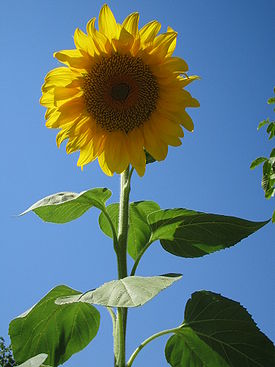 | |||||||||||||||||||||||||
| Scientific classification | |||||||||||||||||||||||||
|---|---|---|---|---|---|---|---|---|---|---|---|---|---|---|---|---|---|---|---|---|---|---|---|---|---|
| |||||||||||||||||||||||||
| International Scientific Name | |||||||||||||||||||||||||
Helianthus annuus L. , 1753 | |||||||||||||||||||||||||
| Security status | |||||||||||||||||||||||||
The popular name is sunflower .
Botanical description

Annual herbaceous plant.
The root system of sunflower oil is rod, penetrates into the soil by 2-3 m, which allows it to use the moisture of deep horizons [3] .
Stem up to 5 m (for olive varieties 0.6–2.5 meters), upright, mostly unbranched, covered with stiff hairs. Inside the stem is a soft, resilient core.
The leaves are alternate, on long petioles, upper sessile, lower opposite, green, ovate-heart-shaped with pointed ends, with a plate up to 40 cm in length, pubescent with short stiff hairs (which provides it with great drought resistance), with serrate edges.
The flowers in the apical, very large inflorescences - baskets surrounded by wrapping leaves, 30-50 cm in diameter, like buds, at a young age "stretch" to the sun and change their orientation from east to west during the day (see heliotropism ), however, as they mature and bloom, the plant is fixed in a certain position, indicating approximately eastward, while young leaves still continue to exhibit similar behavior [4] [5] . Edge reed flowers, 4-7 cm long, usually infertile; internal - tubular, bisexual, numerous (500-2000). The color of flowers from light yellow to dark orange, sometimes purple. The five-member corolla . There are five stamens in a flower with free threads, but with fused anthers . There are many cultivated varieties of sunflower oilseed, which are combined in three races: 1) simplex , simple (not terry), ordinary - common receptacle is flat, reed flowers one or more rows, several varieties (of which macrocarpus ); 2) tubulosus , tubular terry - common receptacle convex, without reed or with only one row of reed flowers, tubular flowers are highly developed, only one species is known ( globosus ); 3) ligulosus (flore pleno) , reed-terry - common receptacle somewhat convex, all reed flowers, several varieties [6] . Oilseed sunflower often forms one inflorescence , but there are also additional processes with small inflorescences. Blossoms in July - August for 30 days. Cross Pollinator (using bees, other insects and wind) [3] [7] . The pollen grains are triple-frosted-oras, globular in shape. In diameter (with spikes) 37.4—44.8 microns. Outlines from the pole and the equator are almost rounded. The furrows are 4-5 microns wide, short, with irregular edges, often with weakly visible contours, with blunt ends. The ores are oval, equatorially elongated, 4-5 microns wide, 6-6.5 microns long. The width of the mesocolpium is 22-25 microns, the diameter of the apocolpium is 11-14.2 microns. Exine thickness (without thorns) 1.2–1.8 microns. The underlying and underlying layers are thin. The height of the rods under the spikes up to 1 micron, between the spikes, 0.3-0.4 microns. The sculpture is prickly, the height of thorns is 3.5-5 microns, the diameter of the base is 1.2-1.5 microns, their ends are drawn and pointed; the spikes are evenly spaced; there are five spines on the mesocolpium in the polar projection. Golden pollen [7] .
Fruits - oblong-ovate seeds , slightly grained, slightly compressed, 8-15 mm long and 4-8 mm wide, with a leathery pericarp , white, gray, striped or black. They consist of a pericarp (peel, or husk) and white seed (kernel) covered with a seed coat. In the pericarp of modern sunflower varieties between the sclerenchyma and the cork fabric is an armor- clad layer, so that the seeds are not damaged by the sunflower fire . According to the morphological characteristics of the fruit is divided into groups: gryzovoy, oilseed and mezheumok. Coloring of oilseeds of the olive group is predominantly dark gray with weak striation, black-coal, rarely gray with stripes; Glacial - gray with stripes, rarely white [3] .
Chemical Composition
The leaves and flowers detected flavonoids (kvertsimeritrin) coumarin glycoside skopolin, triterpene saponins , sterols (glycoside sitosterolin), carotenoids (β-carotene, cryptoxanthin, taraksantin), phenol carbonic acids (chlorogenic, neohlorogenovaya, caffeic) anthocyanins . Seeds contain fatty oil (about 40%, sometimes up to 50-52%), proteins (up to 20%), carbohydrates (up to 25%), sterols, carotenoids, phospholipids . Seeds contain vitamin PP and E, as well as polyunsaturated fatty acids (especially linoleic ), etc. [8] .
From left to right: annual wild sunflower (Nevada, USA), stem, leaf, bud, pollen grains under a microscope | ||||||||||
Spread
The homeland of the annual sunflower is North America . Archaeological excavations confirm that the Indians cultivated this plant more than 2,000 years ago [9] . There are archaeological evidence of sunflower cultivation in the present states of Arizona and New Mexico . Some archaeologists claim that they began to cultivate sunflower even before wheat . In many Native American cultures, the sunflower has been used as a symbol of the deity of the sun, especially among the Aztecs and Otomies in Mexico and among the Incas in Peru .
Francisco Pizarro discovered him in Tavantinsuyu (Peru), where the locals worshiped the image of the sunflower as a symbol of the solar deity - Inti (another name is Punchao). The golden statues of this flower, as well as the seeds, were brought to Europe. However, academician P.M. Zhukovsky points out that the first seeds of the plant were brought to Europe much earlier by the Spaniards, who were returning from an expedition to New Mexico, and were sown in the Madrid Botanical Garden as early as 1510. The first description of sunflower was given by L'Aubel in 1576 under the name "flower of the sun." Initially, the plant began to grow in gardens as an ornamental, sometimes used in medicine, and later as a garden (seed) plant. It is believed that one-year-old sunflower from Spain penetrated into Italy and France, and by the end of the 16th century it was grown in Belgium, England, Holland, Switzerland and Germany. In the middle of the 17th century in England, young baskets of sunflower were fashionable to cook and bake on coals, and then eat with oil and vinegar, like artichokes . In Germany in the 18th century, sunflower was cultivated as a coffee substitute, but this did not last long [3] [6] [9] [10] .
From the wild forms of long-term selection were created large-fruited forms of rodent sunflower. For the first time the British thought about the production of oil from sunflower in Europe, there is an English patent of 1716 describing this process. However, large-scale production of sunflower oil began in Russia. The sunflower came to Russia under Peter I , who, seeing a strange overseas flower in Holland , ordered to send his seeds to Russia. The plant successfully acclimatized , initially served as a decorative and cheap folk delicacy.
The beginning of its use as an oil plant is associated with the name of Dmitry Bokarev , a peasant serf from the village of Alekseyevka (later became the city) of Biryuchinsky district of the Voronezh province. Bokarev was familiar with the production of flaxseed and hemp oil and decided to apply the same process to the production of sunflower. In 1829, he was the first to receive sunflower oil in a manual butter churn. In 1833, with the permission of Alekseyevka’s owner, Count Sheremetev, and with the assistance of Bokarev, the merchant Papushin built the first oil mill for the extraction of sunflower oil on a horse drive, and in 1865 the first steam oil mill. Later, industrial production of oil was established and the selection of high-ash varieties was started. By the middle of the XIX century, in many districts of the Voronezh and Saratov provinces, oilseed sunflower occupied 30-40% of the sown area. In the future, culture began to spread in the adjacent territories, penetrated into the North Caucasus, Ukraine and the Trans-Urals. Sunflower oil quickly became popular in Russia, largely because its use is allowed on the days of fasting in which oil is allowed (from where, incidentally, the second name for sunflower oil is vegetable oil). In the future, crops were reduced due to the significant spread of diseases and pests. Only the creation of a national selection of rust resistant varieties "Zelenka" and armor-clad varieties made it possible to re-occupy large areas of sunflower (980 thousand hectares in 1913).
Cultural oilseed sunflower was formed in Russia. At the end of the 19th century, emigrants from Russia brought the culture of sunflower and sunflower oil production to the USA and Canada. Soon the USA became one of the main (after Russia) producers of sunflower oil. In America, cultivated varieties of Russian breeding, such as the Russian Mammoth, Russian Giant and Russian Giant. American botanist Charles Heyzer noted: “Having quickly spread throughout Europe, the culture of sunflower reached its greatest success only in Russia”. In the USSR, high-oil low-earing (no more than 27%), broom-resistant , resistant to rust and sunflower flame (97–98% armor) varieties of oilseed sunflower were created. The successes of V. S. Pustovoit , L. A. Zhdanov and other breeders allowed to drastically increase the average oil content of seeds and increase the factory oil yield, respectively, from 28.6% and 25.15% in 1940 to 48.4% and 40.3% in 1973. The most prestigious world award in the field of sunflower breeding is named Pustovoit. At present, the production of sunflower and oil from it is distributed almost throughout the world. The main areas of crops in Ukraine, Argentina, Romania, Turkey, Spain, USA; in Russia - in the Volga region, in the North Caucasus and in Altai.
Economic value and application
Annual sunflower - the most famous and common type of sunflower.
In the 2010s, the sunflower cultivation center focused on the Black Sea region (Ukraine and southern Russia). In 2014, global production of sunflower seeds amounted to 41.4 million tons, while Ukraine and Russia accounted for 18.6 million tons (45% of the total world production) [11] . In both countries, the trend of growth in crop volumes continues, in 2016, the harvest in Ukraine amounted to a record 13.6 million tons [12] , and in Russia - a record 11.01 million tons [13] .
| The largest producers of sunflower seeds (thousand tons) [11] | |||
|---|---|---|---|
| A country | year 2014 | 2016 year | |
| Ukraine | 10133 | 13627 | |
| Russia | 8475 | 11010 | |
| Argentina | 2063 | 3000 | |
| China | 2380 | 2587 | |
| Romania | 2189 | 2032 | |
| Bulgaria | 2010 | 1874 | |
| Turkey | 1638 | 1671 | |
| Hungary | 1597 | 1535 | |
| USA | 1004 | 1204 | |
| France | 1584 | 1190 | |
| Tanzania | 1721 | 890 | |
The total heat demand of sunflower varies depending on the growing season, for short-ripened varieties and hybrids, the sum of active temperatures is 1850, for early ripening - 2000, for middle-ripening - 2150. The average yield of one-year sunflower seeds is 10 c / ha (1 t / ha or 100 t / km²). The maximum yield of 45 c / ha (4.5 t / ha or 450 t / km²) [14] .
The Indians also used sunflower seeds in ground form; crushed sunflower seeds were an exquisite dish. There is even evidence of Indian production of sunflower oil. Oil was used in baking and even, perhaps, as a cosmetic for lubricating the skin and hair. Indians also extracted purple dye from sunflower [15] .
Annual sunflower grown almost all over the world. First of all - for the production of sunflower oil from seeds, which is then used for cooking and for technical needs. Hydrogenation of sunflower oil produces salomas , which are later used in the production of margarine or soap . Oil is also used in the paint industry.
In Russia, before the invention of the production of sunflower oil, sunflower seeds were used as a national delicacy - seeds used raw and toasted. In addition, they are added to confectionery, salads, sunflower kozinaki are made . Ground sunflower seeds are the main component of sunflower halva .
In Ukraine , the North Caucasus , in a number of areas of the Black Earth zone , the Lower Volga region , Siberia and Kazakhstan is the most important honey culture, providing the main honey collection, as well as the replenishment of pollen reserves in the nests of bee colonies. Honey from the nectar of a flowering sunflower golden-yellow color, sometimes with a greenish tint, has a faint aroma and a slightly tart taste. It crystallizes in small grains and becomes light amber. Depending on weather conditions and agrotechnology of sowings, the average yield varies from 13 kg per hectare in Bashkortostan to 25 kg in the Voronezh region , and the nectar sugar content varies from 45% to 79%. According to others, medoproduktivnost is 40-50 kg / ha. A distinctive feature of nectar is an insignificant amount (3-4%) and even the complete absence of sucrose . Honey bees are harvested from annual sunflower flowers and pollen [7] [7] [16] [17] .
Oilseed sunflower is also used as a medicinal plant : tincture is prepared from dry leaves and marginal flowers to increase appetite. In folk medicine, an infusion of marginal reeds of flowers is used as a febrifuge. Sunflower oil is not only a valuable food product, but also an important therapeutic agent. It is used externally for rubbing sore joints, and is taken orally as a light and mild laxative. In the past, fresh sunflower oilseeds were recommended for use in allergies , bronchitis and malaria [18] .
Waste from the production of sunflower oil ( cake and meal ) is used as high-protein feed for livestock. Cake is also used for the manufacture of halva . Protein-rich green mass of tall varieties goes for silage and haylage . Cattle willingly eat threshed baskets , chaff and silage from plants harvested during flowering.
Sunflower stalks are raw materials for fiber and paper. In treeless areas they are also consumed for fuel. Sunflower husk is used for the production of biofuels - fuel briquettes . Potash is extracted from the ash from the burning of the stems. It is used in soap making, the production of refractory and crystal glass, in dyeing and as potash fertilizer. Sunflower is sown as a rocker plant for retention in the fields of snow [15] .
Less well known is that a sunflower is a rubber plant. Created varieties that emit latex from the incisions of the stem in significant quantities. Rubber produced on its basis, are hypoallergenic compared to natural and synthetic rubbers [18] .
There are decorative varieties of sunflower oil with multicolored and terry flowers.
From left to right: fruits of oil-bearing varieties, fruits of gryznyh varieties, decorative varieties (“Vanilla Ice”, “Chianti”, “Teddy Bear”) | ||||||||||
Other Information
In heraldry, a sunflower is a symbol of fertility, unity, sunshine and prosperity, as well as a symbol of peace [19] .
See also
- Jerusalem artichoke
Notes
- ↑ About the conditionality of specifying the class of dicotyledons as a higher taxon for the group of plants described in this article, see the section “APG Systems” of the article “Dicotyledons” .
- ↑ Great Russian Encyclopedia. - T.26. - M .: Great Russian Encyclopedia, 2014. - P. 569. - 767 p. - ISBN 978-5-85270-363-7 . - ISBN 5-85270-320-6 .
- ↑ 1 2 3 4 Sunflower - an article from the Great Soviet Encyclopedia .
- ↑ Solar Tracking: Sunflower Plants , Plants-In-Motion from Indiana University.
- Lla Shella GSG, Langa ARG, Salea PJM Quantitative methods of the sunflower, bean, pepper and cucumber (Eng.) // Agricultural Meteorology: journal. - 1974. - Vol. 13 , no. 1 . P. 25—37 . - DOI : 10.1016 / 0002-1571 (74) 90062-4 .
- ↑ 1 2 Sunflower // Brockhaus and Efron Encyclopedic Dictionary : 86 tons (82 tons and 4 extra). - SPb. , 1890-1907.
- ↑ 1 2 3 4 Burmistrov, A.N., Nikitina, V.A. Melliferous plants and their pollen: a Handbook. - M .: Rosagropromizdat, 1990. - p. 139. - 192 p. - ISBN 5-260-00145-1 .
- ↑ Medicinal properties of agricultural plants / Ed. M.I. Borisova. - Minsk: Urajay, 1974. - p. 174. - 336 p.
- ↑ 1 2 Sunflowers in culture . // In the world of plants : a journal.
- ↑ Sunflower , Biological Encyclopedic Dictionary.
- ↑ 1 2 UN Food & Agriculture Organization
- ↑ In 2016, Ukraine increased sunflower production
- ↑ Sunflower oil prices have reached a minimum since the fall of 2014
- ↑ Terentyeva, E. Sunflowers: a bit of history // In the plant world: magazine. - 2002. - № 10 . - pp . 28-35 .
- ↑ 1 2 Sunflower . Encyclopedia of the scientific library. The date of circulation is October 5, 2012. Archived October 19, 2012.
- ↑ Abrikosov, Kh. N. and others. Sunflower // Beekeeper's Vocabulary / Comp. Fedosov N. F .. - Moscow : Selkhozgiz, 1955. - p. 272.
- ↑ Vatolin, D. About honey and not only about him (Rus.) // Science and Life : Journal. - 2008. - № 11 . - S. 124 .
- ↑ 1 2 Sunflower / (Helianthus annuus L.) , Big medical encyclopedia. 1970.
- ↑ Heraldica.ru
Literature
- Biological Encyclopedic Dictionary / Ch. ed. M. S. Gilyarov; Editorial .: A. A. Baev and others - 2 nd ed., Corr. - M .: Owls. encyclopedia, 1989.
- All about medicinal plants in your beds / Ed. S. Yu. Radelova. - SPb. : SZKEO LLC, 2010. - p. 184. - 224 p. - ISBN 978-5-9603-0124-4 .
- Pustovoit, BC Sunflower. - M .: Kolos, 1975. - 591 p.
- Поликарпов, Г. Г. Поворачивается ли цветущая корзинка за солнцем (рус.) // Природа : журнал. — Наука , 1954. — № 5 . — С. 116—117 .
- Терентьева, Е. Подсолнечники // В мире растений : журнал. — 2002. — № 10 .