Electron emission from a metal is prevented by a potential barrier. Reducing this barrier as the applied external electric field increases is called the Schottky effect . We first consider the metal - vacuum system . The minimum energy that must be transferred to an electron at the Fermi level so that it leaves the metal is called the work function ( measured in electron volts ). For typical metals fluctuates around 2-6 eV and is sensitive to surface contamination.

An electron that is in a vacuum at some distance from the surface of the metal, induces a positive charge on the surface. The force of attraction between the electron and this induced surface charge is equal in magnitude to the force of attraction to the effective positive charge which is called the image charge . This force, also called image strength , is equal to:


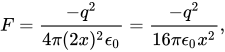
Where - electric constant of vacuum . The work to be done to move an electron from a point at infinity, equal to:

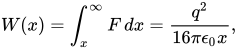
This work corresponds to the potential energy of an electron at a distance from the surface. Addiction usually depicted on the charts as a straight line.

If the system has an external electric field , then the potential energy of an electron will be equal to the sum:


- .

Schottky Barrier Reduction and distance at which the magnitude of the potential reaches a maximum is determined from the condition . Where we find:


![{\ frac {d [W_ {P} (x)]} {dx}} = 0](https://wikimedia.org/api/rest_v1/media/math/render/svg/6321370d81cfd8df8b0d69b72946d0fba4c77894)
- ,
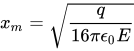
- .

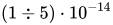
From these equations we find the barrier reduction value and the distance: AT, nm at V / cm and AT, nm at V / cm Thus, it is shown that a strong electric field causes a significant reduction in the Schottky barrier. As a result, the effective work function of the metal for thermionic emission decreases.


The results obtained above can be transferred to metal- semiconductor systems. In this case, the electric field replaced by a field in the semiconductor near the interface (where it reaches its maximum value), and the dielectric constant of vacuum is replaced by the dielectric constant of the semiconductor ( ), i.e:

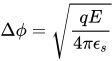
Value ( ) may differ from the static dielectric constant of a semiconductor. This is due to the fact that if the transit time of an electron from the metal-semiconductor interface to a point ( - the point where the potential energy reaches its maximum value) is less than the dielectric relaxation time of the semiconductor, then the latter does not have time to polarize. Therefore, the experimental value of the dielectric constant may be lower than the static (low-frequency) permeability. In silicon, these values practically coincide with each other.
Effective dielectric constant for contact, gold is silicon, determined from the results of photoelectric measurements. In practice, we have that the effective dielectric constant of the image forces is in the range of 11.5–12.5. With distance varies from 10 to 50 in the range of electric field changes about V / cm If we consider that the speed of the carriers is about cm / s, their flight time will be with. It turns out that the dielectric constant obtained by taking into account the image power is close to the value of permeability (~ 12) for electromagnetic radiation of the corresponding frequencies (with a wavelength of 3-15 microns). Since the dielectric constant of silicon is almost constant in the frequency range from zero, corresponding to the wavelength , in the passage of the electron through the depleted layer, the lattice has time to polarize. Therefore, the dielectric constant values obtained in photoelectric and optical experiments are close to each other. Germanium and gallium arsenide have similar frequency dependencies of the dielectric constant. Therefore, it can be assumed that in the case of these semiconductors, the value of the dielectric constant, which determines the image power, in the above field interval approximately coincides with the static values.





The Schottky effect is used in semiconductor technology and is implemented in Schottky diodes having high [ clarify ] frequency response. In the past, the effect has been used in copper-acid rectifiers .
Literature
- Zi S. Physics of semiconductor devices: In two books. Kn.1. Per. from the English .- 2nd processing. and dow. ed.-M .: Mir, 1984.-456s.
- Schottky, W. Physikalische Zeitschrift, 1914, vol. 15, p. 872.
See also
- Schottky Quantum Effect