The principle of separability (or the principle of separability ) is one of the principles of evidence in mathematics, based on the fact that some disjoint sets can be separated in some way in space. Being just a principle (and not an axiom ), the principle of separability requires proof of the validity of the application in each particular case.
The application of the principle of separability is essentially based on the fulfillment of the separability axioms for a given space .
Separation in Euclidean space
In finite - dimensional Euclidean space 
Separation in a Banach space
In functional (in particular, Banach ) spaces, it is rather difficult to guarantee the separability of arbitrary sets. Nevertheless, in special cases the problem is solved quite easily. For example:
- Any two disjoint convex sets , one of which has a nonempty interior, can be separated by a hyperplane .
- Any two disjoint closed convex sets, one of which is compact, can be strongly separated by a hyperplane.
Related Definitions
The sets A and B in a Banach space are called separable if there exists a functional p such that for any 

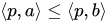
The sets A and B in a Banach space are called strongly separable if there exists a functional p such that for any

Application
The principle of separability is used in the proof of many strong geometric statements. In particular, the support principle and the Fenchel-Moreau theorem are justified with its help.
See also
- Functional separability
- Separability
Literature
- Polovinkin E. S, Balashov M. V. Elements of convex and strongly convex analysis. - M .: Fizmatlit , 2004 .-- 416 s - ISBN 5-9221-0499-3