Wheatgrass ( lat.Elytrígia ) - a genus of the family Cereals , includes about 100 species of perennial herbaceous plants. Representatives of the genus come from temperate regions of Eurasia and the northwestern regions of North America .
| Wheatgrass |
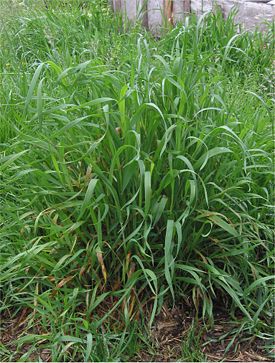
Wheat grass creeping |
| Scientific classification |
|---|
| Grade: | Monocotyledonous [1] |
|
| International scientific name |
|---|
Elytrigia Desv. , 1810 |
| Type view |
|---|
Elytrigia repens ( L. ) Desv. ex Nevski , 1933 |
|
Content
Rhizome horizontal, cord-like. Stems erect.
Leaves are alternate, flat, linear, glabrous, vaginal .
Spikelets are sessile, at the base of spikelet scales there are dents along which these scales break off during the fetus . Each spikelet is turned to the inflorescence axis with the long side, and not with a short edge, like a chaff [2] . Spikelet scales are not keeled, with clear lateral veins. The flowers are small, pale green. It blooms in June - July. Refers to mesophytes .
Fruits are single-seeded grains ripen by September.
- Elytrigia acuta ( DC. ) Tzvelev
- Elytrigia arenosa ( Spenn. ) H. Scholz
- Elytrigia campestris ( Godr. & Gren. ) Kerguélen ex Carreras
- Elytrigia corsica ( Hack. ) Holub
- Elytrigia elongata ( Host ) Nevski
- Elytrigia intermedia ( Host ) Nevski
- Elytrigia juncea ( L. ) Nevski
- Elytrigia meotica ( Prokudin ) Prokudin
- Elytrigia × mucronata ( Opiz ex Bercht. ) Prokudin
- Elytrigia obtusiflora ( DC. ) Tzvelev
- Elytrigia repens ( L. ) Desv. ex Nevski typus - Wheatgrass
- Elytrigia sosnovskyi ( Hack. ) Nevski
- Elytrigia stipifolia ( Czern. ) Nevski - Feathergrass Wheatgrass , or Cretaceous Wheatgrass
- Elytrigia × tesquicola Prokudin
Wheatgrass is a good food for herbivores.
Wheatgrass is a malicious, hard-to-eradicate weed in crops and plantings of cultivated plants.
It is used in medicine as a medicinal plant . Rhizomes contain starch , sugars, ascorbic acid , carotene , mucus , as well as poorly studied glycosides . As a medicine, rhizome is used, which must be collected either in early spring or late autumn. It has an enveloping, diuretic, hemostatic, expectorant and diaphoretic effect. Rhizomes are also used in homeopathy, they contain sugars and triticin , and they can be eaten. In Tibetan medicine, only green parts of the plant are used mainly [3] .
- ↑ For the conventionality of indicating the class of monocotyledons as a superior taxon for the plant group described in this article, see the APG Systems section of the Monocotyledonous article .
- ↑ Novikov V.S., Gubanov I.A. School Atlas-Key to Higher Plants: A Book for Students. - 2nd ed. - M .: Education , 1991. - S. 51. - 100 000 copies. - ISBN 5090034249 .
- ↑ Encyclopedic Dictionary of Medicinal, Essential Oil, and Poisonous Plants, 1951, p. 34
- Martynenko V. A., Gruzdev B. I. The determinant of vascular plants in the vicinity of Syktyvkar. - Yekaterinburg: Ural Branch of the Russian Academy of Sciences, 2005 .-- S. 211.
- Wheatgrass // Brockhaus and Efron Encyclopedic Dictionary : in 86 volumes (82 volumes and 4 additional). - SPb. , 1890-1907.
