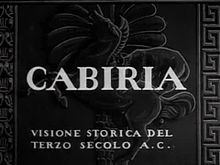
Cabiria ( Italian: Cabiria ) is a silent Italian feature film by Giovanni Pastrone of 1914 , a prototype of the peplum genre.
| Kabiriya | |
|---|---|
| Cabiria | |
 | |
| Genre | peplum |
| Producer | Giovanni Pastrone |
| Producer | Giovanni Pastrone |
| Author script | Gabriele D'Annunzio Titus Livus Giovanni Pastrone Emilio Salgari |
| In the main cast | Lydia Quaranta Umberto Mozzato Bartolomeo Pagano |
| Operator | Segundo de Chaumont Giovanni Tomatis Augusto Batalotti Natale Chiusano |
| Composer | |
| Film company | Itala |
| Duration | 123 min |
| Budget | 210 000 $ |
| A country |  Italy Italy |
| Tongue | |
| Year | 1914 |
| IMDb | ID 0003740 |
 Play media file
Story
The picture begins at the end of the 3rd century. BC e. in Catania ( Sicily ), on the estate of the Roman patrician Batto. The eruption of the volcano Etna turns the city into ruins [2] . Patricius believes that his only daughter, Kabiria, died. However, the girl saved by her nurse Kressa is kidnapped by Carthaginian pirates.
There is a Second Punic War . Hannibal crosses the Alps . Roman patrician Fulvius Axilla spies in Carthage with his slave, the invincible giant Maczist. The main priest of the Carthaginian temple of Moloch - Kartalo - buys Cabiria in the slave market in order to sacrifice it to his god [3] . However, the nurse Kressa persuades Axilla to save the child (gives him the ring that she had previously stolen in Batto's treasury). The Matsista, who had abducted the girl from the temple, was pursued by the Carthaginians, and he hides in the garden, where Princess Sophonizba agrees to shelter her from the priests. Due to numerical superiority, the pursuers defeat Matsista and chained him to the millstone, while Axilla sailed to Rome .
A few years later, Kabiriya, forgetting her origin, becomes under the name of Elissa the servant of Sofonizba. She takes part in a complicated intrigue between Sofonizba and two rivals: Masinissa and Sifaks . Sofonizba's father, Hasdrubal , gives her in marriage to Sifax, although she is already engaged to Masinissa.
Meanwhile, the Roman fleet attacks Syracuse , an ally of Carthage. Archimedes points incendiary mirrors at enemy ships, and they light up. The Fulvia Axillus participating in this battle is picked up by Sicilian fishermen. They recognize the ring that he received from the nurse Kressa, and take the prisoner to Batto, who, of course, is very glad that his daughter is possibly still alive.
In Africa, the forces of Scipio (assisted by Masinissa) clash on the one hand and the Carthaginians (supported by the army of Sifax) on the other. Fulvius Axilla again goes to spy on Carthage. There he frees Matsista, but then both of them are captured by the soldiers of Sifax. During these adventures, they again liberate Kabiriya from the temple of Moloch, which Sofonisba handed over to the priests. Fulvius and Matsista frees Massinissa, who led the attack of the Romans and the capture of Sifax. Sofonisba, meeting with Masinissa, asks him to save her and prevent the Romans from transferring her with Sifax to Rome. Masinissa again has feelings for the beautiful Sofonisba and he immediately married his beloved bride, believing that this would save her from Roman captivity. When Scipio expressed his disapproval to him about this, Masinissa, not being able to part with Sofonisba and not wanting to give her to the Romans, brought her a goblet with the poison she drinks. Before the death of Sofonisba, it is recognized that Elissa is Cabiria and gives it to Fulvia.
Artistic Features
A characteristic feature of the script of the film is the versatility of the action. The action takes place almost simultaneously in Carthage , Numidia , Sicily and Italy .
The main technical innovations in Kabiriya were the scenery , lighting and movement of the movie camera. Pastrone created many architectural structures, widely used monumental sculpture and paid special attention to the decoration of the floor in the pavilions.
In preparation for the filming of the film, Giovanni Pastrone August 5, 1912 patented a cart in Italy , " travel " ( Italian. Carello ). Along with the use of the trolley, Giovanni Pastrone first introduced several techniques: rectilinear or zigzag movement, moving parallel to the scenery, moving the camera closer and closer [4] .
Giovanni Pastrone used 12 arc reflectors of 100 amperes each, the brightness of which he enhanced with reflective screens, glued with sheets of tin foil. [four]
All the technical innovations of Kabiriya and other Italian historical films can be reduced to one of the most important artistic discoveries, namely the creation of space in the movie frame, a deep perspective that allows you to show the action in several plans [5] .
The influence of Kabiriya on Griffith is quite obvious. It clearly affects the production of the Babylonian episode Intolerance , which also introduced giant golden elephants supporting Massinissa’s palace in Cabiria. Griffith borrowed mainly the form of narration, a manner of continuous change of scene [4] .
Cast
- Lydia Quaranta - Cabiria in her youth
- Itala Almirante Mazzini - Princess Sophonizba (Sophonizba)
- Umberto Mozzato - Fulvius Axilla (Fulvius Axilla)
- Bartolomeo Pagano - Maciste
- Gina Marangoni - the nurse of Kressa (Croessa)
- Dante Testa - Priest of the Temple of Moloch (Karthalo)
- Rafael di Naples - innkeeper (Bodastoret)
- Vitale Di Stefano - Scipio African / Massinissa
- Alexander Bernard - Sifax
- Luigi Gellini - Scipio African
- Emilio Vardannes - Hannibal
- Edoardo Davesnes - Hasdrubal
- Enrico Gemelli - Archimedes
Interesting Facts
The idea of this film ripened at Pastrone in early 1913 . First, he called his future film “Symphony of Fire” [4] .
- The pilot Giovanni Widner four times described the circle over Rome , bombarding him with leaflets announcing the premiere of the film [4] .
- Bartolomeo Pagano was not a professional actor, but a loader in the Genoese port [4] .
- The film, and especially one of his characters, the giant Machiste (in the old Russian pronunciation Matsist ) performed by Bartolomeo Pagano , was so popular that it was mentioned in the novel by Ilf and Petrov “The Twelve Chairs ”: “ Ippolit Matveevich for his great growth, and "especially for a mustache, they nicknamed the institution a Matsist, although the real Matsist had no mustache."
- Pastrone laid glass on the painted floor, imitating polished marble [4] .
- To Enrico Gemelli did not seem unnatural in a false beard, Pastrone ordered him to release his own [4] .
- According to Jerzy Toeplitz , the script was written by Giovanni Pastrone, signing with the pseudonym Piero Fosco. Gabriele D'Annunzio only put his name in the credits [5] .
Notes
- ↑ http://www.flickriver.com/photos/truusbobjantoo/4194021047/
- ↑ Actually significant eruptions of Etna in the III century. BC e. not fixed .
- ↑ Most likely, they were going to sacrifice her to Baal-Hammon , who was one of the main gods of the Carthaginians. In addition, the innkeeper swears an oath to Baal. It is not entirely clear why Moloch is indicated in the intertitles.
- ↑ 1 2 3 4 5 6 7 8 J. Sadul . The general history of cinema. T. 1. - M .: "Art", 1958.
- ↑ 1 2 Jerzy Toeplitz . The history of cinema. 1895-1928. - M .: "Progress", 1967.