Euphrates ( Tour. Fırat , Firat [1] ; Arabic. الفرات , El Furat [2] , Assy . ܦܪܬ Pǝrāt , Armenian. Եփրատ Ep'rat , Kurd. Firat ) - the largest river in Turkey , Syria and Iraq in West Asia . It originates in the Armenian Highlands [3] , from where it flows south and, merging with the Tigris , forms the Shatt al-Arab . The length is 2700 km (with the Murat River - 3065 km) [4] , the basin area is 673 thousand km².
| Euphrates | |
|---|---|
| tour. Fırat , arab. الفرات | |
 River near the city of Abu Kamal , Syria River near the city of Abu Kamal , Syria | |
| Characteristic | |
| Length | 2700 km |
| Pool | 673,000 km² |
| Water consumption | 300-400 m³ / s |
| Watercourse | |
| Source | river confluence: Karasu and Murat |
| • Location | Armenian highlands |
| • Coordinates | |
| Mouth | Shatt al arab |
| • Coordinates | |
| Location | |
| Water system | Shatt al-Arab → Persian Gulf |
| Country |
|


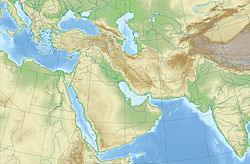


The Euphrates River
It originates in the mountains of the Armenian Highlands [3] [4] and is formed as a result of the confluence of two rivers: Karasu (Western Euphrates), the source of which is located in eastern Turkey north of Erzurum , and Murat (Eastern Euphrates), with its source southwest of the mountain Ararat and north of Lake Van .
The area of the river basin is 673 thousand km². The width of the river in some places (in the Mesopotamian lowland) reaches 500 m, the depth reaches 10 m. During floods, the water level can rise by 3-4 m. The average water discharge near the city of Khit (in Iraq) is 840 m³ / s, the largest - 3-4 thousand m³ / s, the smallest at the end of summer - 180 m³ / s; annual flow here is 26.4 km³. Toward the mouth, as a result of water intake for irrigation and loss of runoff due to evaporation and seepage, the average water flow rate decreases to 300-400 m³ / s [4] .
In the upper reaches it has a predominantly mountainous character, cuts out the marginal ranges of the Armenian Highlands - Malatya and Ergani in a narrow gorge, then crosses the desert plateau of Syria and northern Mesopotamia in the deep valley, flows along the flat Mesopotamian lowland [4] . In the lower reaches, the Euphrates merges with the Tigris River, forming the Shatt al-Arab River , which flows into the Persian Gulf [4] .
The main tributaries - Khabur (left), Belikh, Tokhma and Goksu (right) flow into the Euphrates in the upper and middle reaches; within Iraq, only dry valleys — the wadi (dry riverbeds), runoff of which is observed only during rainy periods — are suitable for the Euphrates [4] .
16 hydroelectric power stations have been created on the Euphrates River and its tributaries, most of which are located in Turkey, including: Ataturk Dam , Keban Hydroelectric Station The Dam of Karakai [5] .
The waters of the river feed the many canals in Basrah, forming vast swamps (largely drained by the Iraqi government in the 1990s). Since 2003, after the US invasion of Iraq , drainage activities have been halted.
Historical Information
Favorable natural conditions of the banks of the Euphrates led to the fact that from about IV millennium BC. e. the first flowering civilization of Sumer was born here. Many important cities of antiquity are located along the banks or near the river, including Mari , Sippar , Nippur , Shuruppak , Uruk , Ur and Eris . In the river valleys, the centers of later empires appeared - Babylonia and Assyria .
The ancient Egyptians, who first reached the banks of the Euphrates during the conquest of Thutmose III (XV century BC), called it “the great inverted river of Naharina, ” or “the river flowing the other way around” - so they were struck by the fact that the river does not flow to the north, as the familiar and familiar Nile , and to the south [6] .
The Euphrates River was the western border of the state of Great Armenia (190 BC - 428 BC) and the eastern border of neighboring Little Armenia (the state in 322-115 BC, later the Roman province).
On the banks of the Euphrates in 680, a battle took place near the city of Karbala , during which Imam Hussein , the grandson of the Prophet Muhammad, was martyred with his family and associates.
Etymology
The name of the river from Aramaic , literally - sweet water [4] .
| Tongue | Euphrates Name |
|---|---|
| Akkadian | Pu-rat-tu |
| Arab | الفرات Al-Furāt |
| Aramaic | ܦܪܬ Prāṯ, Froṯ |
| Armenian | Եփրատ Yeprat |
| Kurdish | فرهات Firat, Ferat |
| Ancient Persian | 𐎢𐎳𐎼𐎠𐎬𐎢 Ufrátu |
| Turkish | Fırat |
| Sumerian | BU.RA.NU.NU |
The Euphrates Origin Myth
According to the Enuma Elish epic, the initial state of the universe was chaos , formed by a mixture of two primitive water elements, the female sea Tiamat and the male freshwater Abzu . Through their union, six generations of gods were born. A war broke out between the gods, which began with the killing of Abza and ended with the fact that the god Marduk divided Tiamat into two parts, which formed heaven and earth; the Tigris and Euphrates rivers sprang from her eye sockets. Then Marduk created man from clay mixed with saliva and blood to serve the earth for the gods, while Marduk ascended to the throne in the Babylonian temple of Esagila - the temple "with a peak in heaven" as reigning over the world.
Euphrates in the Bible
In the Bible, the river is called " Prat " and is one of the four rivers: Pison (Pison), Geon (Gihon) and Tiger (Hiddekel) flowing from the Garden of Eden . This Hebrew word, derived from the word "flow" or "tear," was translated as the Euphrates.
| A river came out of Eden to irrigate paradise; and then divided into four rivers. The name of one Fison: it flows around the whole land of Havil <...> The name of the second river Gihon [Geon]: it flows around the whole land of Kush. The name of the third river is Hiddekel [Tiger]: it flows before Assyria. Fourth Euphrates River ( Genesis 2: 10-14 ) |
A river with the same name is mentioned as the north-eastern border of the land promised by God to Abraham and his descendants ( Isaac , Jacob , etc.):
| On this day the Lord made a covenant with Abram, saying: I give your seed to this land, from the river of Egypt to the great river, the river Euphrates ( Gen. 15:18 ) |
In the Bible, the Euphrates is often referred to simply as the “River” ( ha-nahar ) ( Gen. 15:18 ).
God says to the Israelites before entering the Promised Land:
| turn, go on a journey and go to the mountain of the Amorites and to all their neighbors, to the plain, to the mountain, to low places and to the southern edge and to the shores of the sea, to the land of Canaan and to Lebanon , even to the great river, the Euphrates river ( Deut. 1: 7 ) |
God (through Moses) promises the Israelites:
| every place on which your foot sets foot will be yours; from the desert and Lebanon, from the river, the river Euphrates, even to the west sea your limits will be ( Deut. 11:24 ) |
The revelation of John the Evangelist predicts that the Euphrates will dry up in preparation for the battle of Armageddon :
| The Sixth Angel poured his cup into the great river Euphrates: and the water dried in it, so that the kings would be ready to go from the rising of the sun. ( Rev. 16:12 ) |
| The sixth angel sounded, and I heard one voice from the four horns of the golden altar standing before God, saying to the sixth angel who had the trumpet: free the four angels bound by the great river Euphrates. And four Angels were set free, prepared for an hour and a day, and a month and a year, in order to kill a third of the people. ( Rev. 9: 13-15 ) |
Islamic Prophecies
Some of the prophecies of the Prophet Muhammad indicate that when the Euphrates runs out, unknown treasures will appear that will cause strife and war.
| Soon mountains of gold will cover the Euphrates River. So, who will be present at this time - should not take anything from there.Sahih al-Bukhari |
| The Prophet Muhammad said: “The hour will not come until the banks of the Euphrates River are dry and the mountains of gold are unveiled, over which people will fight. Ninety-nine out of a hundred will die [in battles], and all of them will say: “Perhaps I may be the only one who will survive.”Sahih al-Bukhari , Sahih Muslim |
| The Prophet Muhammad said: “The Euphrates discovers treasures within itself. He who sees him must not take any of them. ”Ali al-Muttaki al-Hindi, Al-Burhan fi'alamat Mahdi Ahir al-Zaman |
| He [Euphrates] will open a mountain of gold." Sunan Abu Dawood " |
Notes
- ↑ Instruction for Russian transmission of geographical names of Turkey. - M., 1980 .-- S. 22.
- ↑ Instructions for the transfer on maps of the geographical names of Arab countries. - M .: Nauka, 1966 .-- S. 22.
- ↑ 1 2 B. B. Piotrovsky . Kingdom of Van (Urartu) . - M. , 1959. - S. 132.
- ↑ 1 2 3 4 5 6 7 Article Euphrates in the Great Soviet Encyclopedia
- ↑ Cascade on the Euphrates. The battle for water . RusHydro Blog . RusHydro Press Service (September 21, 2011). Date of appeal April 14, 2017.
- ↑ Avdiev, 1959 , p. 94.
See also
- Fertile crescent moon
- Mesopotamia
Literature
- Euphrates, a river in Asia // Brockhaus and Efron Encyclopedic Dictionary : in 86 volumes (82 volumes and 4 additional). - SPb. , 1890-1907.
- Euphrates // Jewish Encyclopedia of Brockhaus and Efron . - SPb. , 1908-1913.
- V.I. Avdiev . The military history of ancient Egypt. - M .: Publishing House of the Academy of Sciences of the USSR, 1959. - T. II. - 147 p. - 2000 copies.
Links
- Bibliography on Water and International Law
- Jewish Encyclopedia: Links to the Euphrates in the Old Testament
- Tiger and Euphrates River Dispute, conflict and cooperation details
- Turkish National Water Use Policy Euphrates - Tiger Basin (THREE - STAGED PLAN) (Turkish)
- Euphrates River Photos Collection
- The documentary film "Damming the Euphrates" (2000, 2005).