Flavius Julius Valerius Maiorian ( Latin Flavius Iulius Valerius Maiorianus , (November 420 - August 7, 461 ) - Roman emperor in 457 - 461 years .
| Flavius Julius Valery Major | |||||||
|---|---|---|---|---|---|---|---|
| lat Flavius Iulius Valerius Maiorianus | |||||||
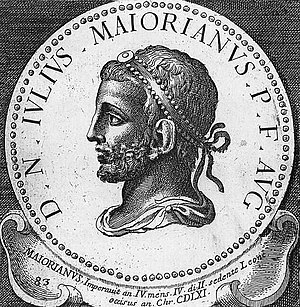 Portrait of Majorian 1754 . | |||||||
| |||||||
| |||||||
| Predecessor | Flavius Ricimer ( 456 - February 28, 457 ) | ||||||
| Successor | ?? | ||||||
| |||||||
| Predecessor | Avit | ||||||
| Successor | Liby Sever | ||||||
| Birth | about 420 | ||||||
| Death | August 7, 461 Durton , Italy | ||||||
| Kind | |||||||
| Religion | Christianity | ||||||
He became emperor after he and his friend Ricimer overthrew Avita . Majorian tried by laws to preserve the ancient monuments of Rome. He tried to return the provinces, but in 460 he was defeated in a campaign against the vandal king Geyserich . Ricimer, worried about the growing influence and power of Majorian, overthrew him and killed him. The death of Majorian was the beginning of the fall of the Western Roman Empire [1] .
Content
Biography
Early life
Majorian came from a Roman family in Gaul . The year of his birth is unknown, but based on the fact that in 458 Sidonius Apollinaris calls Majorian “ iuvenis ” (“young”) [2] , it is assumed that he could be born before 420 [3] .
His mother’s name has not been preserved [4] , but it is known that she was the daughter of Magister Mayorian , who was magister utriusquae militiae in 379 , commanded troops on the Illyrian border [5] under Emperor Theodosius I and successfully waged war with the tribes of Transdanuvia (region in modern Hungary ) [6] .
His father [7] , whose name is also unknown, was a government official in Gaul and was in charge of finance, possibly holding the numbering office (in the late Empire, an official engaged in bookkeeping and tax collection [8] ) under Flavius Aetius and remained in this post despite on repeated offers to take a post at the imperial court. He was a friend and loyal follower of the famous commander Aetius and had a good reputation [9] .
Military service (before 454 years)
Majorian served in the army for a long time, under the leadership of Flavius Aetius [10] and quickly gained military glory.
He participated in many battles in Gaul (see map of the province): on the Rhine ( lat. Rhenus ), Arara ( lat. Arar ), Rodan ( lat. Rhodanus ), Mose ( lat. Mosa ), Matron ( lat. Matrona, Materna ), Sekvan ( lat. Sequana ), Lede ( lat. Ledus ), Clitis [11] ( lat. Clitis ), Elaris ( lat. Elaris ), Atax ( lat. Atax ), Vahalis ( lat. Vachalis ), Liger ( lat . Liger ) [12] .
He participated in the defense of the city of Caesarodunum ( lat. Turones, Caesarodunum Turonum, Augusta Turonum ) from the attack of the barbarians [13] .
He later participated in hostilities for the “land of Atrebates” ( lat. “Atrebatum terras” ) [14] , which was captured by the Western Franks , led by their king Claudius . Namely, in a place (city or village) called Vicus Helena (the current location is unknown, according to one version of Lance ( Belgium ), according to another Hesdin or Hedin ( France ) [15] ), where the barbarians celebrating the wedding of one of their leaders were caught off guard and utterly broken [16] [17] . This event dates back, presumably, to 447 or 448 years [18] (at about this time Clodius died).
Majorian was a friend of Ricimer [19] , as well as a friend of Egidius [20] , with whom he served under Aetius.
In 454, he leaves military service and retires to his rural estate [21] . Perhaps Aetius dismissed him because of his wife Pelagia [22] , who, according to Sidonius Apollinaria , set her husband against Majorian in order to ensure the well-being of his son Gaudens [23] [24] [25] .
Career
Under Valentinian III
After Aetius was killed by Valentinian III in 454 , Valentinian, in order to unite the numerous troops who lost their commander, calls on Majorian to take command over them [26] .
What kind of post he received is unknown. It is possible that he appointed him to the post of committee of domestics ( lat. Comes domesticorum ), but this version is unlikely, since it is unlikely that he could have retained his post under Petronius Maxim and Avita [18] .
The struggle for imperial power in 455
After the assassination of Valentinian III in 455, Majorian was considered one of the most likely successors to the emperor [27] , given the fact that the widowed empress Licinius Eudoxia favored him [28] .
Another famous challenger was Maximian , the son of the Egyptian merchant Domnin [29] , who had a successful career in Italy. Maximian was a Domestic under Aetius . Some scholars tend to identify Maximian with Majorian, believing that John of Antioch made a mistake in the text. However, such assumptions are unfounded [30] .
Petronius Maxim , the organizer of the conspiracy against Valentinian III, sought no less than others. In the end, it was Maxim who seized power, and Eudoxia forcibly married himself, thus striving to legitimize his power.
John of Antioch describes the struggle of the candidates for the throne:
“ Rome was in a state of confusion and disorder, and the armed forces were divided among themselves, some wanted to appropriate the imperial power to Maxim, and some sought to give the throne to Maximian, son of Domnin, an Egyptian merchant who became successful in Italy. Maximian was in the position of a domestic under Aetius. In addition, Eudoxia, the wife of Valentinian, strongly advocated for Majorian. But Maxim, having gained control of the palace and the treasury, threatening her with death, forced him to marry him, believing that his position would be safer ” [28]
Comes domesticorum
The exact date on which the domestics committee takes office is unknown - perhaps 454 years (see Career section: under Valentinian III). However, at the time of the Battle of Placentia ( October 17, 456 ), he was in that position [31]
Magister equitum
On February 28, 457, Majorian was appointed head of the cavalry ( Latin Magister equitum ) [32] . His appointment to this post falls on the period of the emperor’s absence in the West, the emperor of the East was considered the only ruler of the whole empire.
Consequently, Majorian could be appointed to this position either under Flavius Marcian ( 450 - 457 ), or under Leo I ( 457 - 474 ).
Climbing the Throne
April 1, 457 was proclaimed emperor [33] in a military camp in Ravenna at the behest of Leo I Makella [34] . No doubt, his candidacy was recommended by Ricimer [1] , the de facto ruler in the West.
Jordan mistakenly writes that Marcian was appointed emperor of Majorian. The same historian skips Avita’s rule, saying that Majorian succeeded Maxim [35] .
Majorian himself says that he did not want to become emperor, but he could not refuse the duties offered to him out of a sense of duty to the state [36] .
Having ascended the throne of the Western Roman Empire , Majorian gained power only over part of it - Italy . Under previous emperors, the empire lost Spain , Britain and Africa . Gaul , until recently part of the Roman Empire, did not recognize the new emperor. However, the situation in Italy itself was unstable.
Vandal War
The vandals , who had not long ago plundered the city of Rome ( 455 ), did not leave the Western Roman Empire alone. Possessing dominance in the coastal waters of the central and western Mediterranean , the vandals regularly raided the Roman coast. During one of these raids, the Vandals and Moorish, who landed at the mouth of the Liris River and devastated Campania , were taken by surprise by Majorian troops. Vandals, having suffered heavy losses, fled to the ships, abandoning the loot. During this event, a relative of Geiserich was also killed. According to Gibbon [37] , it was a brother-in-law , and Michael Grant - a brother-in-law [1] .
Soon, Majorian (during the winter) began to gather troops in Liguria for a campaign in Africa [38] , the troops also included Germans, Huns and Scythians [1] .
In the story of Procopius of Caesarea, there is an episode (undoubtedly fictional) in which Majorian changed his name, dyed his blond hair black and, under the guise of a Roman ambassador, set off to investigate the situation with Geiserich [39] :
“ When he appeared to Giserich, the barbarian tried his best to scare him and, treating him as if with a friend, brought him to a certain room where he had collected all kinds of weapons, among which there were many excellent ones. And here, they say, the weapon moved by itself and made a sound that was not quiet and not random, Gizerich decided that an earthquake had occurred and, leaving the room, began to ask about this earthquake, but since none of the strangers confirmed his assumption, Gizerich decided that it was a great miracle, but could not decide what to attribute it to ”
And that supposedly Geiserich, learning about the deception, was afraid and began to gather an army.
In 460, the emperor arrived in Caesarugusta (modern Zaragoza ) [40] [41] .
Death
In August 461, near the Dertona (Burton) [42] some legions, which consisted of barbarians, revolted. Majorian was forced to renounce power. On August 2, 461, he was arrested at the command of Ricimer. Five days later, on August 7, Majorian died - according to some reports from dysentery , according to others - from the hands of the executioner (Gibbon; 36).
Isidore of Seville , Zaragoza Chronicle ( Latin Chronicorum Caesaraugustanorum Reliquiae ), 511 Gallic Chronicle ( Latin Chronica gallica a. DXI ) [43] directly indicate that Majorian was killed by Ricimer [40] [44] .
Sigebert of Gembloux [45] and Jordan [46] also hold versions of the murder.
Mari Avanshsky calls the scene of the murder: “he was killed on the river Ira [47] ” [42] , obviously referring to the data from the Chronicle of Marcellin Komit [48] or the work “ On the Origin and Acts of the Getae ” of Jordan [35] . The mentioned river Iria flows through Durton (see map of the city).
Procopius of Caesarea claims that Majorian died of dysentery [49] .
Personality and Board Assessment
Majorian was the last Roman emperor to whom the mind of a statesman and a sense of responsibility for the state entrusted to him were inherent.
Edward Gibbon evaluates Majorian’s rule as follows:
“ In the successor of Avita, we are pleased to see one of such noble and heroic personalities that sometimes appear in the era of decline in order to maintain the dignity of the human race. Emperor Majorian was a subject of well-deserved praise for contemporaries and for posterity ” [50]
According to Procopius , Majorian excelled in his dignity all the emperors of the Romans who ruled in the West [38] . He (Procopius) says that Majorian “ was indefatigable in all his labors, but in the dangers of war he was completely fearless ” [51] .
However, Majorian was still not the real ruler of the city, since he was almost omnipotent Ricimer and he could no longer completely stop the collapse of the Roman state, although he managed for some time to become a truly "ruling" emperor in the Western Roman Empire.
Majorian short stories (legislation)
The Code of Theodosius was published on February 15, 438 . Legislative acts issued after this date are retained as an appendix as part of the code. The application in this regard was called "Novels" (or "new laws") ( lat. Novellae leges ) [52] .
The Codex includes novels of emperors: Theodosius II , Valentinian III , Majorian, Marcian , Libya Severa , Antemiya [53] .
In total, twelve short stories of Majorian are known, but only nine of them survived [53] .
- On the beginning of the reign of Augustus Mayorian ( lat. De ortu imperii domini Maioriani Augusti ) ( January 11, 458 , Ravenna ) [36] - this is a message to the Senate on the occasion of assuming imperial duties, designed to win over the senatorial aristocracy and outline the principles of its rule . When referring to members of the Senate, he uses the epithet " fathers of senators " ( lat. Patres conscripti ). In this message, he claims that he entered the throne not of his own free will, but out of a sense of duty to the state, and calls on the Senate to take an active part in state affairs. The importance of the figure of patrician Ricimer , who is awarded the epithet “ our father ”, is also emphasized. Thriving under previous emperors, the practice of denunciation, he undertakes not only not to encourage, but also to punish, as well as strengthen the defenses of the Roman state.
- On the forgiveness of old debts ( lat. De indulgentiis reliquorum ) ( March 10, 458 , Ravenna ) [54] . The edict is addressed to the prefect of Praetorius Flavius Cecina Decius Vasily . It raised the question of collecting old tax obligations from residents of the province, which should have been paid a long time ago. However, the inhabitants of the province experienced frequent disasters and their property was plundered during the constant raids of the barbarians, and some debts accumulated so much that people could hardly pay them even for their whole lives. Understanding this, Majorian by the edict of De indulgentiis reliquorum forgave these debts.
- On the defenders of citizens ( lat. De defensoribus civitatum ) ( May 8, 458 , Ravenna ) [55]
- On public buildings ( lat. De aedificiis publicis ) ( July 11, 458 , Ravenna ) [56] . The edict was addressed to the prefect of Rome, Emilian . By the time of the proclamation of Majorian as emperor, the state of the city of Rome was rapidly deteriorating. And this was to blame for the residents themselves, who, with the connivance of the city authorities, used public buildings as quarries for the construction of houses, churches, etc. Majorian intended to end this barbarism of the Romans with this edict. It prohibited the extraction of building materials from any public buildings. The exception was the ruins of buildings that could no longer be restored, but they could be used in this way only with the consent of the Senate and the Emperor. Punishment was also introduced for indulging the authorities in the process of demolishing public buildings. Officials were punished by fines, lashes and cutting off hands.
- About abandoned property and property of the scribbled ( lat. De bonis caducis sive proscriptorum ) ( September 4, 458 , Ravenna ) - an edict addressed to the committee of private property ( lat. Comes rei privatae ) Ennodia based on the report of this committee. Property that turned out to be a draw due to the absence of legal heirs, or property of persons convicted by a court, by law, automatically becomes the property of the state. However, in the province this property did not go to the treasury, in most cases due to various kinds of fraud and venality of judges. The edict even mentions a lawsuit concerning a certain Severina and the property of her husband in Pitsen . Under this edict, judges convicted of property fraud are stripped of their status. Judges are also required to inform of such fraud [57]
Notes
- ↑ 1 2 3 4 M. Grant. Roman emperors. Marjoram.
- ↑ Sid. Ap. Carm. V. 299.
- ↑ Ralph W. Mathisen. Julius Valerius Maiorianus // De imeratoribus Romanis. University of South Carolina.
- ↑ PLRE. "Anonyma 7".
- ↑ Gibbon E. The History of the Decline and Collapse of the Roman Empire / Transl. from English V.N. Nevedomsky.- M .: OLMA-PRESS, 2001. p. 480
- ↑ Sid. Ap. Carm. V. 107-115.
- ↑ PLRE. "Anonymous 114."
- ↑ A real dictionary of classical antiquities. Edited by J. Geffken, E. Tsibart. - Toybner. F. Lubker. 1914.
- ↑ Sid. Ap. Carm. V. 116 −125.
- ↑ Sid. Ap. Carm. V. 198-200.
- ↑ This river, referred to by Sidonius Apollinaris , is closer unknown.
- ↑ Sid. Ap. Carm. V. 206-208.
- ↑ Sid. Ap. Carm. V. 211.
- ↑ Sidonius Apollinaris means lands in the province of Belgica ( Belgica Secunda ), near the capital of the Atrebat tribe - Nemetsotsenny , the historical region of Artois .
- ↑ Smith. W. Dictionary of Greek and Roman Geography (1854). "Vicus Helena."
- ↑ Sid. Ap. Carm. V. 212-215.
- ↑ Chateaubriand F. R. The general picture of the life of barbarians in the era of the Great Migration of Peoples.
- ↑ 1 2 PLRE. "Fl. Iulius Valerius Maiorianus. "
- ↑ Sid. Ap. Carm. V. 266-268.
- ↑ Prisc . fr. thirty.
- ↑ Sid. Ap. Carm. V. 290-300.
- ↑ PLRE. "Pelagia 1".
- ↑ Sid. Ap. Carm. V. 126-128.
- ↑ Sid. Ap. Carm. V. 203-206.
- ↑ Sid. Ap. Carm. V. 269—272.
- ↑ Sid. Ap. Carm. V. 306-308.
- ↑ Sid. Ap. Carm. V. 312-314.
- ↑ 1 2 Joh. Ant. fr. 201.6.
- ↑ PLRE. "Domninus 3".
- ↑ PLRE. "Maximianus 5".
- ↑ Gallic Chronicle of 511. 628.
- ↑ Fast. Vind. Priority sa 457.
- ↑ Hyd. Chr. 457.
- ↑ Marcellinus Comes. Chronicon. 457.
- ↑ 1 2 Jordan. Getics. 236.
- ↑ 1 2 Nov I. De ortu imperii domini Maioriani Augusti // Theodosiani Libri XVI, II, Berlin, 1905, Ed. Th. Mommsen, P. Meyer.
- ↑ Gibbon E. The History of the Decline and Collapse of the Roman Empire / Transl. from English V.N. Nevedomsky.- M .: OLMA-PRESS, 2001. p. 484
- ↑ 1 2 Procopius of Caesarea. War with the Vandals. VII, 4.
- ↑ Procopius of Caesarea. War with the Vandals. VII, 8.
- ↑ 1 2 Chronicorum Caesaraugustanorum Reliquiae.
- ↑ Roger Collins. Visigothic Spain. 409-711. Blackwell Publishing. 2004. - p. 32.
- ↑ 1 2 Mari of Avansha. Chronicle 461.
- ↑ Gallic Chronicle of 511. 635.
- ↑ Isidore of Seville. History of Vandals. 76.
- ↑ Sigebert of Gembloux. Chronicle 461.
- ↑ Jordan. On the origin and deed of the Getae. 236.
- ↑ Ira (Iria, modern Skrivia) - a river in Northern Italy, a tributary of Po .
- ↑ Marcellinus Comes. Chronicon. 461.
- ↑ Procopius of Caesarea. War with the Vandals. VII, 14.
- ↑ Gibbon E. The History of the Decline and Collapse of the Roman Empire / Transl. from English V.N. Nevedomsky.- M .: OLMA-PRESS, 2001. p. 480
- ↑ Procopius of Caesarea. War with the Vandals. VII. 5.
- ↑ Pokrovsky I.A. History of Roman law. IV. Absolute monarchy.
- ↑ 1 2 Leges Novellae ad Theodosianum Pertinentes // Theodosiani Libri XVI, II, Berlin, 1905, Ed. Th. Mommsen, P. Meyer.
- ↑ Nov II. De indulgentiis reliquorum // Theodosiani Libri XVI, II, Berlin, 1905, Ed. Th. Mommsen, P. Meyer.
- ↑ Nov III. De defensoribus civitatum // Theodosiani Libri XVI, II, Berlin, 1905, Ed. Th. Mommsen, P. Meyer.
- ↑ Nov IIII. De aedificiis publicis // Theodosiani Libri XVI, II, Berlin, 1905, Ed. Th. Mommsen, P. Meyer.
- ↑ Nov V. De bonis caducis sive proscriptorum // Theodosiani Libri XVI, II, Berlin, 1905, Ed. Th. Mommsen, P. Meyer.
Sources
- Chronicorum Caesaraugustanorum Reliquiae (text) .
- Guy Solly Modest (?) Apollinaris Sidonius . Carmina V (Panegyricus Julio Valerio Maioriano Augusto Dictus).
- Gallic Chronicle of 511 (text).
- Idations . Chronicle (lat.).
- John of Antioch . Fragments (Greek).
- Jordan On the origin and deeds of the Getae. 236.
- Isidore of Seville . History of Vandals.
- Mari Avanshsky . Chronicle
- Marcellin Komit . Chronicon.
- Priscus of Panius . Fragments.
- Procopius of Caesarea . War with the Vandals.
- Sigebert from Gembloux . Chronicle
Links
- Tsirkin Yu.B. Majorian and Ricimer. From the History of the Western Roman Empire (Rus.) // Mnemon. Research and publications on the history of the ancient world. Sat St. .. - SPb. , 2011 .-- T. 10 . - S. 309-334 .
- Mayorian's Edict on Public Buildings.