Foraminifera ( lat. Foraminifera ) - type [1] (according to other systems - class [2] ) of conch single-celled organisms from the group of protists .
| Foraminifera | |||||||||||
 Ammonia tepida | |||||||||||
| Scientific classification | |||||||||||
|---|---|---|---|---|---|---|---|---|---|---|---|
| |||||||||||
| International scientific name | |||||||||||
Foraminifera d'Orbigny , 1826 | |||||||||||
| Synonyms | |||||||||||
| |||||||||||
Content
Description
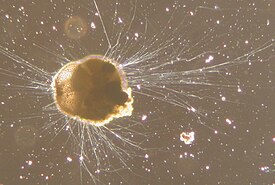
Foraminifera have a shell - the outer skeleton. Most shells are calcareous , sometimes forming chitinoid or consisting of foreign particles glued together by cell secretions. The internal cavity of the shell communicates with the environment through numerous pores, as well as through the hole in the shell - the mouth. Through it and the pores in the walls of the shells, the finest branching and interconnecting reticulopodia (special pseudopods ), which serve to move and capture food, protrude outward, form a net around the shell, the diameter of which is many times larger than the diameter of the shell. Food particles (for example, unicellular algae) adhere to foraminifera stick to such a net.
Foraminifera - solitary predominantly marine protists; some forms live in brackish and fresh water bodies; there are forms that live at great depths in loose liquid silt (up to 16 m from the bottom surface). For example, foraminifera were found at the bottom of the Mariana Trench at a depth of more than 10 thousand meters [3] .
Foraminifera are both benthic and planktonic . Shells of planktonic foraminifera are the most common component of the biogenic deposits ( foraminifera silt ) of the oceans, but no deeper than 4000 m, where the limestone shells of foraminifera dissolve in the water column before reaching the bottom. Nowadays, these silts cover at least a quarter of the planet’s surface and consist mainly of globigerina (globigerin silt) foraminifera shells. In previous eras, for example, fusulinic limestones (genus Fusulina, carbon) and nummulitic (genus Nummulites, Eocene) accumulated. Fossil foraminifers serve to determine the age of Paleozoic , Mesozoic and Cenozoic deposits. Modern foraminifers, as a rule, are small (0.1-1 mm), and some extinct species reached 20 cm. The bulk of foraminifera shells has a sand fraction size of more than 61 microns. The concentration of foraminifera in seawater is maximum in equatorial and high latitude waters. Moreover, the species diversity and complexity of the shell structure are characteristic only for the equatorial regions. The concentration of foraminifera can reach 100 thousand copies per 1 cubic meter of water. The average estimate for the ocean as a whole is 10 ind./ cubic meter [4] .
Foraminifera shells according to the method of formation are divided into secretion and agglutinated.
Secretion (from lat. Secretio - excretion) is formed by a mineral or organic substance secreted by the body itself.
Agglutinated shells (from lat. Agglutino - glued) consist of grains of sand grabbed from the surrounding water column and fragments of skeletons of other organisms glued together by a sticky substance secreted by the cell.
Foraminifera shells are the main component of writing chalk .
The composition of the foraminifera shell can be:
- organic - the oldest of all foraminifera, found from the very beginning of the Paleozoic;
- agglutinated - consisting of a wide variety of particles, sometimes with carbonate cement;
- secretory calcareous (carbonate) - composed of calcite (CaCO 3 ).
Shells can be single-chamber (among primitive representatives) or multi-chamber (more advanced version), and multi-chamber are divided into linear and spiral. Spiral can be wound in different ways, the glomerular method is considered more archaic than planospiral (when all turns are in one plane) and trochoid (turns are located one after another). Some foraminiferal fossils also had an orbitoid type of shell, i.e. chambers had a ring shape and grew concentrically. In multi-chamber, the initial camera is usually the smallest, and the youngest (last) - the largest. Secretion shells often have stiffeners to increase mechanical strength. [5]
Life Cycle
Foraminifera is characterized by a haplo-diphasic life cycle . The generalized scheme is as follows [6] : in individuals of the haploid generation - hamonts, intensive fission of nuclei occurs and two-flagellum gametes of the same type (usually) are formed, which then merge in pairs to form a zygote , from which the next-generation individual, agamont, develops.
Since the chromosome set doubles during the fusion of gametes, this generation becomes diploid. Intensive nuclear fission also occurs in agamonts, most of which later undergo meiosis . Around the nuclei that have become haploid as a result of reduction fission, the cytoplasm is isolated and a shell forms, as a result of which spore analogues — agametes — are formed, from which hamonts develop again.
Classification
Currently, about 10,000 modern species [7] and more than 40,000 species of fossil foraminifera [8] [9] [10] , about 65 superfamilies, and 300 families [11] are known. They are considered in the rank of a class or type of simple eukaryotic organisms . Previously, foraminifera were divided into five suborders in the single order Foraminiferida Eichwald, 1830 (according to: Loeblich and Tappan , 1964, 1987/88). Later, researchers increased the rank of foraminifera to a separate class or type Foraminifera d'Orbigny , 1826 (Maslakova, 1990; Maslakova et al., 1995 [12] ; Kaminski, 2004; Loeblich and Tappan, 1994).
The class is divided into 15 subclasses and about 40 units (Podobina, 2015) [13] :
- Subclass Allogromiata Furssenko, 1958
- Order Allogromiida Furssenko, 1958
- Subclass Astrorhiziata Podobina, 2014
- Order Astrorhizida Lankester, 1885
- Order Saccamminida Podobina, 2015
- Order Reophacida Podobina, 2014
- Subclass Ammodisciata Podobina, 2014
- Order Ammodiscida Furssenko, 1958
- Order Haplophragmiida Podobina, 2014
- Order Lituolida Podobina, 2014
- Subclass Lagenata Maslakova, 1990
- Order Lagenida Lankester, 1885
- Order Polymorphinida Wedekind, 1937
- Subclass Textulariata Podobina, 2014
- Order Palaeotextulariida Hohenegger et Piller, 1975
- Order Textulariida Lankester, 1885
- Subclass Ataxophragmiata Podobina, 2014
- Trochamminida Podobina Squad, 2014
- Order Ataxophragmiida Schwager, 1877
- Subclass Orbitolinata Podobina, 2014
- Order Orbitolinida Maslakova, 1990
- Order Tetrataxida Podobina, 2014
- Subclass Fusulinata Maslakova, 1990
- Order Parathuramminida Mikhalevich, 1980
- Order Moravamminida Maslakova, 1990
- Order Nodosinellida Maslakova, 1990
- Order Endothyrida Furssenko, 1958
- Order Fusulinida Wedekind, 1937
- Order Involutinida Hohenegger et Piller, 1975
- Subclass Miliolata Saidova, 1981
- Order Comuspirida Jirovec, 1953
- Order Miliolida Delage et Heronard, 1896
- Order Soritida Saidova, 1981
- Order Alveolinida Mikhalevich, 1980
- Subclass Rzehakiniata Podobina, 2014
- Squad Silicinida Podobina, 2014
- Order Rzehakinida Saidova, 1971
- Subclass Rotaliata Mikhalevich, 1980
- Order Rotaliida Lankester, 1885
- Order Nonionida Podobina, 2014
- Order Elphidiida Podobina, 2014
- Subclass Globigerinata Maslakova, 1990
- Order Globigerinida Lankester, 1885
- Order Heterohelicida Furssenko, 1958
- Subclass Buliminata Podobina, 2014
- Order Buliminida Furssenko, 1958
- Order Bolivinitida Podobina, 2015
- Order Pleurostomellida Podobina, 2014
- Order Cassidullinida Voloshinova, 1970
- Subclass Spirillinata Maslakova, 1990
- Order Spirillinida Hohenegger et Piller, 1975
- Subclass Nummulitiata Podobina, 2014
- Order Orbitoidida Baschkirov et Antonischin, 1974
- Order Nummulitida Lankester, 1885
Interesting Facts
- Since the middle of the Cretaceous, the distribution of many foraminifera species in the marine basins is bipolar: in the northern hemisphere, the shells of spiral curled shapes are twisted clockwise, and in the southern hemisphere.
- In the circumpolar basins, the number of foraminifera is about 100 times less than that of the equator.
- To improve the buoyancy of planktonic forms, gas bubbles, droplets of fat and fresh (i.e. less dense) water are formed in the cytoplasm .
- Individual individuals of foraminifera can live from 2 weeks to 1 month (planktonic forms) and up to 2 months (benthic forms).
- Foraminifera are filtering agents , predators and herbivores.
- In the Mariana Trench, huge shell-like amoeba Xenophyophorea 10 cm in diameter were discovered.
Notes
- ↑ Type of Foraminifera (English) in the World Register of Marine Species .
- ↑ Systematics of modern foraminifera in Barun K. Sen Gupta (2002) Modern Foraminifera
- ↑ Residents of the Mariana Trench build shells on imported raw materials . Infox.ru. Date of treatment April 8, 2012. Archived May 31, 2012.
- ↑ Kenneth J.P. Marine geology. In 2 vols. T. 2. Per. from English - M. World. 1987 .-- 384 p.
- ↑ I.A. Tikhomirov, A.A. Dobrovolsky, A.I. Granovich. 1 // Small workshop on invertebrate zoology .. - Moscow - St. Petersburg: KMK Scientific Publishing Fellowship, 2005. - P. 25, 28. - 304 p. - ISBN 5-87317-239-0 , UDC 592.
- ↑ V.I. Mikhalevich. Type Foraminifera // Protists: A Guide to Zoology / Ch. ed. A.F. Alimov. - St. Petersburg: ROS. Acad. Sciences, Zool. Institute, 2000 .-- T. 1.
- ↑ Ald SM et al. (2007). Diversity, Nomenclature, and Taxonomy of Protists Archived March 31, 2011. , Syst. Biol. 56 (4): 684-689, DOI : 10.1080 / 10635150701494127 .
- ↑ Pawlowski J., Lejzerowicz F., & Esling P. (2014). Next-generation environmental diversity surveys of foraminifera: preparing the future . The Biological Bulletin 227 (2): 93-106.
- ↑ World Foraminifera Database .
- ↑ Samuel S. Bowser, Andrea Habura, Jan Pawlowski: Molecular evolution of Foraminifera In: Laura Katz Olson, Laura A. Katz, Debashish Bhattacharya: Genomics and Evolution of Microbial Eukaryotes , 2006, S. 78-94, ISBN 0-19- 856974-2 .
- ↑ Pamela Hallock: Symbiont-bearing Foraminifera In: Barun K. Sen Gupta (Hrsg.): Modern Foraminifera . Springer Netherlands (Kluwer Academic), 2002, P. 123-139. ISBN 978-1-4020-0598-5 .
- ↑ Maslakova N.I., Gorbachik T.N. Systematic part. Class Foraminifera // Maslakova N.I., Gorbachik T.N., Alekseev A.S. , Barskov I.S. , Golubev S.N., Nazarov B.B., Petrushevskaya M.G. Micropaleontology : textbook. - M.: Publishing House of Moscow State University , 1995. - S. 13-111.
- ↑ Podobina V. M. The system of foraminifera (higher taxa). - Tomsk: Publishing House of Tomsk State University, 2015. - 172 p. - ISBN 978-5-94621-465-0 .