Fight at Wafangou - a battle between the 1st Siberian Corps and the Japanese 2nd Army, which took place on 1 (14) - 2 (15) June 1904 .
| Fight at Wafangou | |||
|---|---|---|---|
| Main Conflict: Russo-Japanese War | |||
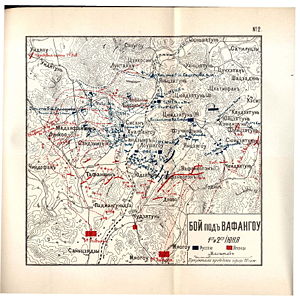 Map from the Wafangou article ("The Military Encyclopedia of Sytin ") | |||
| date | 1 (14) - 2 (15) June 1904 | ||
| A place | Liaodong Peninsula , near Wafangou Railway Station | ||
| Total | The victory of the Japanese troops | ||
| Opponents | |||
| |||
| Commanders | |||
| |||
| Forces of the parties | |||
| |||
| Losses | |||
| |||


Position before the battle
The landing of Japanese troops on the Kwantung Peninsula posed a threat to Port Arthur . To discard the Japanese forces, which had already cut off Port Arthur by this time, General A. N. Kuropatkin sent the 1st Siberian Corps of Lieutenant General Baron G. K. Stackelberg (consisting of the 1st and 9th East Siberian Rifle divisions reinforced by the 2nd brigade of the 35th infantry division, the 9th Siberian Tobolsk infantry regiment, two combat engineer companies and several cavalry and artillery units, total 33 thousand people, 96 artillery pieces). This offensive was undertaken at the request of the governor and commander of the land and naval forces in the Far East, Admiral E.I. Alekseev , who was worried about the fate of the fleet in Port Arthur.
The corps commander, Lieutenant General G.K. Stackelberg, was given the task: “By attacking in the direction of Port Arthur to draw on the greatest possible enemy forces and thereby weaken his army operating on the Kwantung Peninsula. To achieve this, the movement against the barrier sent to the north must be carried out quickly and decisively, bearing in mind the speedy defeat of the enemy's advanced units, if any are weak. With superior forces, it’s impossible to bring matters to a decisive collision and not to allow the exhaustion of our entire reserve in battle. ” The goal of the movement was, of course, to "take possession of the Jinzhou position and further advance towards Port Arthur." Setting such broad and distant goals and prescribing “to make movement quickly and decisively,” General Kuropatkin, along with Baron Stackelberg, as Zasulich had previously been to Yalu and Stessel, to Jinzhou ordered “not to bring matters to a decisive collision and not to allow the expenditure of his reserve in battle until the situation is clear. ”
Russian forces were opposed by the Japanese 2nd Army of Lieutenant General Oku (3rd, 4th and 5th Infantry Divisions, up to 40 thousand people and 216 artillery pieces).
Fight
In the event of the Japanese offensive, General Stackelberg decided to take a defensive battle at a position near the Wafangou railway station. The troops took up positions at heights south of the station. Strengthening of the position began on May 27. On May 31 (June 13) an offensive of the considerable forces of the Japanese was discovered, pushing the Russian vanguard back.
On June 1 (14), 1904, the Japanese went on the offensive, attacking the regiments of the 1st East Siberian Division at Wafanwopen, but were repelled.
Since the last battle showed that only two divisions were attacking from the Japanese side, Stackelberg decided the next day to go on the offensive with his left flank in order to defeat the enemy. For the offensive, the 1st East Siberian Rifle Division and the brigade of the 35th Infantry Division were appointed. On the night of June 1 (14) to June 2 (15), the Japanese managed to pull up artillery, so the advancing Russian troops immediately began to suffer heavy losses from its fire. The offensive on the left flank stopped.
On the morning of June 2 (15), the Japanese launched an attack on the front of the right section of the Russian troops, bypassing it simultaneously from the flank. At about 8 a.m., the 36th East Siberian Regiment, located on the far right flank, was already fired from three sides. To counter the detour, 2 companies were sent from the precinct reserve and the 35th East Siberian Regiment. Moving on the offensive to the hills west of Wafangou, these troops delayed the advance of the Japanese, but they continued to advance in the interval between the 35th and 36th regiments. Of the 4 battalions remaining in the reserve, 2 were deported between the 35th and 36th regiments, where the Japanese were trying to break through.
Around 11:30 at Stackelberg headquarters, information was received about the movement of large enemy forces to the rear of the corps north of Art. Wafangou. Stackelberg ordered a retreat. As it turned out later, the vanguard and cavalry of Stackelberg did not find in time the Japanese 4th division, which did not take part in the battle on May 31 (June 13), because it lost its way and did not have time to go to the rear positions of the 1st Siberian Corps from Fuzhou .
To cover the retreat, the last two battalions from the general reserve were taken. By evening, the corps troops retreated to the Vanzelin station.
Losses for June 1-2 (June 14-15) amounted to: among Russians - 569 people. killed, 2338 wounded and 192 missing, 17 guns, the Japanese - 217 people killed and 946 wounded.
Notes
- ↑ War with Japan 1904-1905 Sanitary and statistical essay. 1914.
Links
- Wafangou battle 1904 // The Greater Caucasus - The Grand Canal. - M .: Big Russian Encyclopedia, 2006. - S. 666-667. - (The Big Russian Encyclopedia : [in 35 vols.] / Ch. Ed. Yu. S. Osipov ; 2004—2017, vol. 4). - ISBN 5-85270-333-8 .
- N. E. Heinze . In the army : Among the wounded . Japanese atrocities . At the Red Cross Hospital . In Liaoyang .
- Wafangou .