Pasifaya ( ancient Greek Πασιφάη "all luminous" [4] [5] ) - in ancient Greek mythology, the daughter of Helios , the spouse of the Cretan king Minos [6] , known for her passion for the bull, the motherMinotaur , Ariadne , Fedra , Androgeya [5] [7] .
| Pasifaya | |
|---|---|
| Floor | |
| Father | |
| Mother | or |
| Brothers and sisters | , , and |
| Spouse | |
| Children | , , , , , , , , , and |
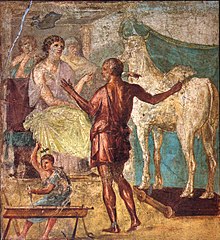
Fresco from House of the Vettii in Pompeii

The daughter of the solar god Helios and the Oceanides of Perseid [8] , sister of Kirka (Circe) [9] and Eethe [8] , Persa and Aloya , and also, according to her father, Faetus and Lampetia, Phaeton, Heliad [10] .
Pasifaya was raised as a princess in Colchis , was married to Minos, and became a Cretan queen [11] . Mother of Ariadne, Fedra, Androgey [7] [9] [12] , Katreya and Glaucus [8] , Akakallida , Deukalion , etc., see [13] [14] .
The myth ascribes to her a love affair with a sacrificial white bull: King Minos, claiming his authority in Crete, boasted the attention of the gods to his prayers and turned to God Poseidon to send him a bull to make a sacrifice. God heeded his request, and a snow-white bull appeared from the sea to the shore. Struck by his magnificence, Minos sent him to his own flocks, and laid another in his place [15] . Disgruntled, Poseidon inspired the consort of Minos Pasiphae with an unnatural attraction to the handsome bull [5] [6] [16] , and she fell in love with him. She told about her passion to the skillful master and inventor Dedalu , and he made a hollow wooden cow, covered it with a skin and rolled it out onto a meadow where a bull was grazing. Pasifaya climbed inside the cow and satisfied her passion with the bull of Poseidon (or it was Poseidon himself in the form of a bull [7] [17] ). After a while, she gave birth to the Minotaur, a monster with a human body and a bull's head [7] [8] [18] [19] [20] . According to another version, Aphrodite gave her the love of a bull in revenge for the fact that Pasifai's father Helios revealed to Aphrodite's husband Hephaestus the betrayal of Ares and her [8] [21] [22] . There are other variants of the myth, see [15] . Later, the bull ran wild and devastated Crete, until, according to Diodorus, Hercules caught him and brought him to Greece , where Tesey killed him [23] , see Cretan bull (Marathon bull). On the advice of the oracle Minos, in order to hide the shame of Pasiphai, he turned to Daedalus, and he built an underground labyrinth for him, where they hid the Minotaur [15] .
V.N. Yarkho notes that this myth reflected the most ancient totemic beliefs dating back to animalism , as in the Middle East and the southern Mediterranean, the bull often played the role of a totem-patron [21] .
The frequent adultery of Minos once made Pasifaeh so angry that she enchanted her husband: as soon as he and the woman were lying down, he turned the seed into a collection of poisonous snakes and scorpions that killed his partner. From this misfortune of Minos cured Procrida [24] . She managed to survive because she drank a decoction of magical herbs prepared according to the recipe of Circe, and she cured Minos by forcing him to emit filth into the bladder of the goat, and then converge with Pasiphaia.
The heroine of the tragedy Euripides “Cretans”, her monologue was found on papyrus [25] , the comedy of Alkea “Pasiphae”.
Content
Image in Art
According to some remarks, for the humanistic philosophers of the Renaissance, Pasifaya embodied deliberate mockery of the natural and divine law and rejection of the mind to please animal passion [26] .
- Giulio Romano, approx. 1530
- Gustave Moreau Pasifaya, 19th century
- Drama Henri de Monterlan "Pasiphae" ( 1936 ).
- Jackson Pollock canvas "Pasifaya" ( 1943 ) [27] .
- Roman Javier Aspetiy "Lamentation Minotaur" ( 2002 ).
- Fabris Hajjaj's play “Pasiphaia, or How they become the mother of Minotaur” ( 2009 ).
See also
- Minos
- Cretan bull
Notes
- ↑ Lubker F. Catreus // The Real Dictionary of Classical Antiquities by Lubker / ed. F. F. Zelinsky , L. A. Georgievsky , M. S. Kutorga, and others. - SPb. : Society of Classical Philology and Pedagogy , 1885. - p. 265.
- ↑ Lubker F. Deucalion // The Real Dictionary of Classical Antiquities by Lubker / ed. F. F. Zelinsky , L. A. Georgievsky , M. S. Kutorga, and others. - SPb. : Society of Classical Philology and Pedagogy , 1885. - p. 391.
- ↑ Lubker F. Minotaurus // The Real Dictionary of Classical Antiquities by Lubker / ed. F. F. Zelinsky , L. A. Georgievsky , M. S. Kutorga, and others. - SPb. : Society of Classical Philology and Pedagogy , 1885. - p. 873–874.
- ↑ Pasiphae // Dictionary of Antiquity
- ↑ 1 2 3 Pasiphae
- ↑ 1 2 Myths of the peoples of the world (see link below)
- ↑ 1 2 3 4 Betty Radish Pasifaya // “Who is who in the ancient world”
- ↑ 1 2 3 4 5 Pasifaya
- ↑ 1 2 Pasiphaus - Encyclopedic Dictionary - Encyclopedias & Dictionaries
- ↑ Lampetia
- ↑ Pseudo-Apollodor. Mythological library I 9, 1; III 1, 2.4; 15, 1.9; Ovid. Science of Love I 289–325
- ↑ Pasifaya
- ↑ R. Graves. The myths of ancient Greece: Minos and its surroundings. CHILDREN PASSIFIES
- ↑ A Dictionary of Greek and Roman biography, Paca'rius, De'cimus, Parysatis, Past'piiae
- ↑ 1 2 3 R. Graves. The myths of ancient Greece: Minos and its surroundings. MINOS AND HIS BROTHERS
- ↑ Apollodor, III 1, 3-4
- ↑ Meaning and interpretation of the term Pasifaya
- ↑ Bacchilide. Praises / M.L. Gasparov
- ↑ Esoteric Library "Mystery Library" - Minotaur
- A site about ancient Egyptian mythology
- ↑ 1 2 Greek mythology. PASSIFA
- ↑ Pasifaya
- ↑ Comment
- ↑ Greek mythology. PASSIFA
- ↑ see comm. 6 V.N. Yarho to Rus. Palefat
- ↑ Pasifaya
- ↑ Pollock. Pasifaya
Links
- Myths of the peoples of the world . M., 1991-92. In 2 t. T.2. P.291 / V.N. Yarkho
- Minotaur and Labyrinth // Losev A.F. The mythology of the Greeks and Romans. M., 1996.