Mariano Fortuny i Marsal ( Spanish: Mariano Fortuny y Marsal ; Cat. Marià Fortuny i Marsal , Maria Fortun y Marsal , full name - Maria Josep Maria Bernat Fortun y Marsal; June 11, 1838 , Reus - November 21, 1874 , Rome ) - a Spanish artist, one of the leaders of romantic orientalism . The father of designer and fashion designer Mariano Fortuni .
| Mariano fortuny | |
|---|---|
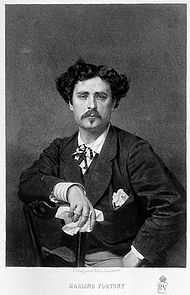 | |
| Birth name | Maria Josep Maria Bernat Fortuny i Marsal |
| Date of Birth | June 11, 1838 |
| Place of Birth | Reus , Catalonia |
| Date of death | November 21, 1874 (36 years old) |
| Place of death | Rome |
| Citizenship |  Spain Spain |
| Genre | painter |
| Study | Graduate School of Fine Arts, Barcelona |
| Style | Orientalism |
Content
Biography
Born June 11, 1838 in Reus ( Catalonia ) in a poor family. He studied at an elementary school in his hometown, where he began to engage in art. In 1850, after the death of his parents, he remained in the care of a grandfather, a joiner, who created a collection of wax figures and traveled with her from city to city. Young Mariano helped his grandfather by modeling and painting most of the figures.
In 1852 he went to Barcelona with his grandfather, where his handicrafts made a great impression on some influential people of the city: they turned to the municipality with a request to allocate Mariano a allowance for further studies (in the amount of forty-two francs per month).
In 1853 he entered the Higher School of Fine Arts in Barcelona , where he studied with Claudio Lorenzale for four years. In March 1857 he received a degree and continued his education in Rome . He worked in Barcelona , Granada , Seville , Paris (in 1860 and 1866 - 1867 ).
At first he worked under the influence of masters of baroque painting, of his contemporaries - Masonier .
The first trips to Morocco were associated with the outbreak of war between Spain and the Emperor of Morocco and with the order of the Barcelona authorities for the gigantic-sized painting “ The Battle of Tetuan ” (1862, Museum of Modern Art , Barcelona ).
In 1867, Mariano Fortuni married the pianist Cecilia de Madraso , the sister of his friend, artist Raimundo Madraso . In the marriage, a daughter was born Maria Louise and a son Mariano .
Fortune also visited Paris in 1868 . After a regular visit to Paris in 1870 and a two-year stay in Granada , returning to Rome , Fortuni died of malaria fever on November 21, 1874 .
Creativity
Thematically, the work of Mariano Fortuni can be divided into two parts - “Moroccan” and “Spanish”. The “Moroccan”, which provided him with leadership among Orientalists , include such works as “Arabian Fantasy” (1867, Walters Art Gallery, Baltimore ) and “Snake Charmers” (1870, A. Pushkin State Museum of Fine Arts , Moscow ); to the “Spanish”, depicting scenes of national life, - “Vicar” ( 1870 , Museum of Modern Art , Barcelona ). The work of Mariano Fortuni had a significant impact on the birth of Art Nouveau . The Spanish impressionist Jose Gallego y Arnos , who came to Venice to study the master’s paintings there, considered himself a student of the artist.
On the 9-meter canvas “The Battle of Tetuan” (1862), which was parodyed by Salvador Dali 100 years later, one of the episodes of the Spanish-Moroccan war of 1859 is captured. Fortune’s original romantic style was developed mainly on the basis of North African impressions.
Fortune has collected a rich collection of antiques. From it, in particular, comes the famous “ Fortune Vase ”, which is stored in the Hermitage .
Image in Art
A biographical novel about the artist was written by Pere Jimferrer (1983, Ramon Lule Prize).
Literature
- A Llenov M. M. Vrubel and Fortune // Issues of Art History M., 1993. No. 2-3. C.41-57.
- Matushinsky A.M. Mariano Fortuny // Bulletin of Fine Arts. 1883.№ 1.
- Carlos González López, Monserrat Martí Ayxelà : Mariano Fortuny Marsal, Barcelona 1989, ISBN 84-86719-25-9 .
- Carlos González López : Spanish Painters in Rome (1850-1900). Madryt: Sammer Galleries, 1975. ISBN 84-722-3933-0 .
- Eva V. Galán : Pintores del romanticismo andaluz. Grenada, 1994. ISBN 84-338-1842-2 .
- Man A.E. 19th Century Spanish Orientalism. Mariano Fortuny // Actual problems of the theory and history of art : Sat. scientific articles. Vol. one . Ed. S.V. Maltseva, E. Yu. Stanyukovich-Denisova — St. Petersburg: NP-Print - 2011 .-- p.335-340 ISBN 978-5-388-05174-6