The current coat of arms of Venezuela was first approved by the Congress on April 18, 1836, and has undergone some changes over time.
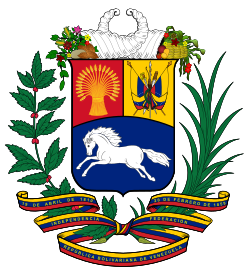
| Coat of arms of the Bolivarian Republic of Venezuela | |
|---|---|
 | |
| Details | |
| Approved | March 12, 2006 |
| Motto | 19 DE ABRIL DE 1810 - INDEPENDENCIA (April 19, 1810 - Independence) 20 DE FEBRERO DE 1859 - FEDERACIÓN (February 20, 1859 - Federation) REPÚBLICA BOLIVARIANA DE VENEZUELA (Bolivarian Republic of Venezuela) |
Content
Coat of arms elements
According to the Law on the National Flag, Coat of Arms and Anthem adopted on February 17, 1954 , the shield of the coat of arms is divided into fields painted in the colors of the national flag. A sheaf of rye , located in a red field, symbolizes the country's agriculture, the fertility of its soils, the wealth of the people and the national unity of Venezuela, and its 20 ears correspond to the number of states included in it. In the yellow field there are weapons (a sword , a saber and three spears ) and two national flags connected by a laurel branch, reminiscent of the glorious victories in the liberation struggle and the achievement of independence. At the bottom, in a dark blue field, a white horse galloping across endless expanses (according to one version it is a wild horse, according to another it is Simon Bolivar's personal horse), personifies freedom.
Above the shield - two crossed cornucopia spewing wealth, represent the natural wealth of Venezuela and its prosperity. The shield is framed by olive and palm branches tied with a ribbon in the colors of the national flag (yellow - the abundance of the nation, blue - the ocean that separates Venezuela from Spain , scarlet - blood and courage of the people). The following words are written in gold letters on a blue stripe:
- April 19, 1810 - Independence.
- February 20, 1859 - Federation.
- Republic of Venezuela.
- February 20, 1859 - Federation.
In March 2006, the National Assembly approved the draft of Hugo Chávez to change the national flag and coat of arms. On the new coat of arms the horse runs with his head bowed to the other side; according to the president, the idea of the emblem reform was inspired by his daughter Rosines, who thought that the horse was looking back. [1] Critics of Chávez associate the turn of the heraldic horse with the “left” political views of the president. From a strictly heraldic point of view, before the horse moved to the left, and after the changes began to run to the right.
Also, a machete (a symbol of the peasant movement during the struggle for independence) and a bow with arrows , denoting the indigenous peoples of Venezuela , who resisted the Spanish colonialists, were added to the emblem.
History of coat of arms
The emblem of the country from 1830 represented a circle with the image of a lictor's bundle surrounded by two horns of abundance, and from 1836 it acquired a look similar to the modern one. Since 1864, after the introduction of the federal system, the sheaf in the first field of the coat of arms began to be portrayed not solid, but consisting of twenty ears - by the number of states in the country.
In 1905–1930, the coat of arms differed from the current one in that the sheaf was white on a yellow field and consisted of seven ears of grain according to the number of original provinces, the second field of the coat of arms was red rather than yellow, there were two flags instead of three, and Flags and sabers were placed differently, and in the third field, the horse rode on white grass, not green grass.
In 1930, the coat of arms was restored in its previous form, and some of its minor stylistic details were clarified later. The colors of the fields of the coat of arms correspond to the colors of the flag stripes.
| Coat of arms of Venezuela in 1864-1954 | |
| Coat of arms of Venezuela in 1954-2006 |
Notes
- ↑ The horse on the coat of arms of Venezuela forced to turn over Neopr . Lenta.ru (March 13, 2006). Date of treatment August 13, 2010. Archived March 13, 2012.
Links
- History of the coat of arms of Venezuela (Spanish)