Softies [1] [2] [3] ( lat. Cantharidae ) - a family of beetles from the superfamily Elateroidea . Adult insects have elongated bodies with soft cuticles; antennae 10-12-segmented, filiform; abdomen with seven sternites . Ground or soil larvae with black, velvety covers. Most species of soft bodies inhabit countries with a cold and temperate climate. Telephorus larvae are called snowworms .
| Soft bodies |
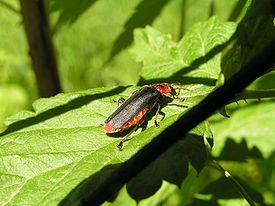
Softfoot Redfoot ( Cantharis rustica ) |
| Scientific classification |
|---|
| No rank : | Bilateral symmetrical |
| Subtype : | Tracheo-breathing |
| Infraclass : | Winged insects |
| Treasure : | Fully Transformed Insects |
| Infrastructure : | Elateriform |
|
| International scientific name |
|---|
Cantharidae Imhoff , 1856 |
| Subfamilies |
|---|
- Cantharinae
- Chauliognathinae
- Dysmorphocerinae
- Healthininae
- Silinae
|
|
Content
The body color is dark or bright, usually in a combination of yellow-red and black [4] .
The soft body body is elongated, more or less flattened dorsally, with soft integuments, especially elytra . Thin hairs cover the upper body. The head is large, stretched forward. The antennae are filiform, their bases are apart. There is no upper lip. Pronotum more or less quadrangular, often spread out on sides. The tops of the mandibles are simple. The clypeus is not separated from the forehead [5] . Elytra well developed, less often shortened, in tangled punctures (rarely with traces of carinae of dotted rows). Epiplurals are narrow. All coxae are closely related. Episternum narrowed at the back and notched at the inner edge. Abdomen with 8-10 sternites . Claws simple, different in different sexes [4] .
Sexual Dimorphism
The difference between the female and the male as a whole is small, but in individual genera it is well expressed, for example, in Trypherus , Silis , Malthodes [4] .
Adult beetles can be found on plants or their flowers . Usually they fly well and actively. The soft body diet includes small insects and plant leaves. They lead an active daily lifestyle, being alarmed, they squeeze limbs, pretending to be dead [4] .
Larvae are predators living in the litter or topsoil, under the bark of trees, in rotten wood, where they feed on eggs and larvae of small insects. They are characterized by extraintestinal digestion [4] .
Larva generation lasts two to three years. Pupils in the soil [4] .
Over 50 fossil species of soft bodies have been discovered. The oldest forms of Cantharidae were found in Early Cretaceous in Lebanese amber (about 130 Ma), Burmese amber (about 100 Ma) and Spanish amber (about 110 Ma) [6] .
- Cretaceous period
- Katyacantharis zherikhini Kazantsev & Perkovsky, 2019 (90 Ma) [7]
- Ornatomalthinus elvirae Poinar & Fanti, 2016 (100 Ma) [8]
- Myamalycocerus vitalii Fanti & Ellenberger, 2016 (100 Ma) [9]
- Archaeomalthodes rosetta Hsiao et al., 2016 (100 Ma) [10]
- Elektrokleinia picta Ellenberger & Fanti, 2019 (100 Ma) [11]
- Paleocene
- Lithocantharis lunglokshuiensis Lin, 1997 [66-56 Ma], Peng Chau Island, Lung Lok Shui (Hong Kong)
- Wongyekokia angustris Lin, 1997 [66-56 Ma], Peng Chau Island, Wong Ye Kok (Hong Kong)
- Podabrus santaritensis Cockerell, 1936 [65.5-56.0 Ma], Quebrada “El Griton”, “Sunchal Formation” (Argentina)
- Eocene
- Dominican Amber
- Tytthonyx geiseri Poinar & Fanti, 2016 [from 45-30 Ma to 20-15 Ma - Eocene or Miocene]
- Baltic amber
- Cantharis nigricans Burmeister, 1832 [38 / 37.2-33.9 Ma]
- Cantharis sucinonigra Kuśka, 1992 [38 / 37.2-33.9 Ma]
- Cantharis sucinokotejai (Kuśka, 1996) [38 / 37.2-33.9 Ma]
- Electronycha prussica Kazantsev, 2013 [38 / 37.2-33.9 Ma]
- Rhagonycha kryshtofovichi (Yablokov-Khnzorian, 1960) [38 / 37.2-33.9 Ma]
- Rhagonycha sucinobaltica Poinar & Fanti, 2016 [38 / 37.2-33.9 Ma]
- Sucinocantharis baltica Kuśka & Kania, 2010 [38 / 37.2-33.9 Ma]
- Sucinorhagonycha kulickae Kuśka, 1996 [38 / 37.2-33.9 Ma]
- Themus pristinus Kazantsev, 2013 [38 / 37.2-33.9 Ma]
- Cacomorphocerus cerambyx Schaufuss, 1892 [38 / 37.2-33.9 Ma]
- Cacomorphocerus jantaricus (Kuśka & Kania, 2010) [38 / 37.2-33.9 Ma]
- Macrocerus sucinopenninus (Kuśka & Kania, 2010) [38 / 37.2-33.9 Ma]
- Malthinus danieli Kuśka & Kania, 2010 [38 / 37.2-33.9 Ma]
- Malthodes ceranowiczae Kuśka & Kupryjanowicz, 2005 [38 / 37.2-33.9 Ma]
- Malthodes kotejai Kuśka & Kupryjanowicz, 2005 [38 / 37.2-33.9 Ma]
- Malthodes serafini Kuśka & Kupryjanowicz, 2005 [38 / 37.2-33.9 Ma]
- Malthodes sucini Kuśka & Kania, 2010 [38 / 37.2-33.9 Ma]
- Mimoplatycis notha Kazantsev, 2013 [38 / 37.2-33.9 Ma] - also in Rivne amber
- Curche pauli Alekseev & Kazantsev, 2014 [38 / 37.2-33.9 Ma]
- Electrosilis minuta Kazantsev, 2013 [38 / 37.2-33.9 Ma]
- Rivne amber
- Malthodes perkovskyi Kazantsev, 2010 [38 / 37.2-33.9 Ma]
- Malthodes rovnoensis Kazantsev & Perkovsky, 2014 [38 / 37.2-33.9 Ma]
- Florissant ( USA )
- Atalantycha humata (Wickham, 1913) [37.2-33.9 Ma]
- Rhagonycha hesperus (Wickham, 1914) [37.2-33.9 Ma]
- Podabrus cupesoides Wickham, 1917 [37.2-33.9 Ma]
- Podabrus florissantensis Wickham, 1914 [37.2-33.9 Ma]
- Podabrus fragmentatus Wickham, 1914 [37.2-33.9 Ma]
- Podabrus wheeleri Wickham, 1909 [37.2-33.9 Ma]
- Chauliognathus pristinus Scudder, 1876 [37.2-33.9 Ma]
- Trypherus aboriginalis Wickham, 1913 [37.2-33.9 Ma]
- Polemius crassicornis Wickham, 1914 [37.2-33.9 Ma]
- Softbodies (genus) ( Cantharis Linnaeus ):
- Brown soft beetle ( Cantharis fusca Linnaeus )
- Dark softbody ( Cantharis obscura Linnaeus )
- Softbodies // Brockhaus and Efron Encyclopedic Dictionary : in 86 volumes (82 volumes and 4 additional). - SPb. , 1890-1907.
- ↑ Gornostaev G.N. Identifier of orders and insect families of the fauna of Russia. - M .: Logos, 1999 .-- S. 59. - 176 p. - ISBN 5-88439-117-X.
- ↑ Scherbakov A.N., Nikitsky N. B. , Polevoy A.V., Humala A.E. To the fauna of beetle insects of the Pasvik reserve (Insecta, Coleoptera) // Vestnik MGUL - Lesnaya vestnik. : Magazine. - 2013. - T. 6 , No. 98 . - S. 16-21 . - ISSN 1727-3749 .
- ↑ Mamaev B.M. , Medvedev L.N. , Pravdin F.N. Identifier of insects in the European part of the USSR. - M .: Education, 1976 .-- S. 141. - 304 p.
- ↑ 1 2 3 4 5 6 Key to insects of the Far East of the USSR. T. III. Coleoptera, or beetles. Part 2 / under the general. ed. P.A. Lera . - L .: Nauka, 1992. - S. 29-40. - 704 s. - 1400 copies. - ISBN 5-02-025623-4 .
- ↑ Mamaev B. M., Medvedev L. N. and Pravdin F. N. Identifier of insects in the European part of the USSR. - Moscow: "Enlightenment", 1976. - S. 103-187. - 304 p.
- ↑ Fabrizio Fanti. World catalog of fossil Cantharidae (English) // Fossils & minerals. Special Issue: Magazine. - Perugia , Italia : Tipolito Properzio, 2017 .-- No. 2 . - P. 1-57.
- ↑ Kazantsev Sergey V., & Evgeny E. Perkovsky. The first Cretaceous beetle from Azerbaijan: Katyacantharis zherikhini gen. et sp.n. (Coleoptera, Cantharidae) from Cenomanian Agjakend amber (Eng.) // Palaeoentomology : Journal. - Auckland , New Zealand : Magnolia Press, 2019 .-- Vol. 2, no. 1 . - P. 7-12. - ISSN 2624-2834 . - DOI : 10.11646 / palaeoentomology . 2.1.2 .
- ↑ Poinar Jr., GO & Fanti, F. (2016). New fossil soldier beetles (Coleoptera: Cantharidae) in Burmese, Baltic and Dominican amber. - Palaeodiversity, 9: 1-7; Stuttgart December 30, 2016. Published online: May 31, 2016, DOI: 10.18476 / pale.v9.a1
- ↑ Fanti, F. & Ellenberger, S. (2016). Myamalycocerus vitalii: A new genus and species of soldier beetle in Burmese amber (Coleoptera Cantharidae). - Cretaceous Research, 71 (2017): 166-169. dx.doi.org/ 10.1016 / j.cretres.2016.11.01.019
- ↑ Hsiao, Y., Ślipiński, A., Deng, C., Pang, H. (2016). A new genus and species of soldier beetle from Upper Cretaceous Burmese amber (Coleoptera, Cantharidae, Malthininae). - Cretaceous Research, 69 (2017): 119-123. doi: 10.1016 / j.cretres.2016.09.09.002
- ↑ Fabrizio Fanti, Sieghard Ellenberger. New Cretaceous soldier beetle (Cantharidae) from Burmese amber with preserved coloration on the elytra (Eng.) // Zootaxa. - 2019-05-24. - Vol. 4609 , iss. 3 . - P. 594-600 . - ISSN 1175-5334 . - DOI : 10.11646 / zootaxa.4609.3.13 .
