The Galician army ( Ukrainian Galicia Army ) is the regular army of the Western Ukrainian People’s Republic (ZUNR), after the Zluka Act was proclaimed, one of the armies of the Ukrainian People’s Republic (UNR), from November 17, 1919, it became part of the Armed Forces of the South of Russia on Zyatkov’s agreements (VSYUR) as the Ukrainian Galician Army ( Ukrainian Ukrainian Galician Army ). Since the beginning of 1920, it was reorganized into the Red Ukrainian Galician Army ( Ukr. Chervona Ukrainian Galician Army ) as part of the Worker and Peasant Red Army (Red Army).
| Galician army ( Ukrainian Galitska Armіya ) | |
|---|---|
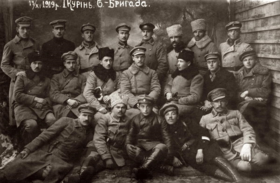 1st kuren of the 6th brigade of the Galician army in the rear of the Volunteer army on November 17, 1919 | |
| Years of existence | 1918 - 1920 |
| A country |  West Ukrainian People's Republic West Ukrainian People's Republic |
| Included in | Armed forces ZUNR 10/19/1918 - 01/22/1919 UPR Army 01/23/1919 - 11/06/1919 (during the period of the Act of Evil )  VSYUR VSYUR 11/17/1919 - 12/31/1919 [1] [2]  Red army Red army 01/01/1920 - 04/30/1920 |
| Type of | Military establishment |
| Participation in | Polish-Ukrainian war , Civil war in Russia : - Revolution and Civil war in Ukraine |
| Commanders | |
| Famous commanders | Dmitry Vitovsky , Anton Kravs , Miron Tarnavsky , Mikhail Pavlenko , Alexander Grekov , Osip Moyka , Joseph Vitoshinsky-Dobrovolya |
| History of the Ukrainian army | |
|---|---|
 | Army of Ancient Russia |
 | The army of the Galicia-Volyn principality |
 | Army Zaporizhzhya |
| Haidamaki | |
| Oprishki | |
 | Cossack troops: Black Sea , Azov , Bug , Danube |
 | Transdanubian Sich Slavic Legion |
 | Banat Sich Russian battalion of mountain shooters |
 | Armed forces of Austria-Hungary |
 | Ukrainian Sich Riflemen |
 | Russian imperial army |
 | Ukrainization : 1st and 2nd Ukrainian Corps |
 | Workers 'and Peasants' Red Army |
 | Army of the Ukrainian People's Republic |
 | Army of the Ukrainian State |
 | Ukrainian Galician army |
 | The revolutionary rebel army of Ukraine |
 | Carpathian Sich |
| Partisan movement |
 | Polesskaya Sich |
 | Ukrainian rebel army |
| Soviet army |
| Counties: KVO • OdVO • PrikVO • TavVO • HVO |
 | Armed forces of Ukraine |
Content
History of origin and existence
The Galician army was created on the basis of the legion of Ukrainian Sich Riflemen (OSS), stationed on November 1, 1918 in the Chernivtsi region (270 km from Lviv), as well as units of the Austro-Hungarian army, consisting entirely or mostly of Ukrainians. As of November 1, 1918, they were the 15th Infantry Regiment ( Ternopol ), the 19th Infantry Regiment ( Lviv ), the 9th and 45th Infantry Regiments ( Przemysl ), the 77th Infantry Regiment ( Yaroslav ), the 20th and the 95th infantry regiments (Stanislav, currently Ivano-Frankivsk ), the 24th and 36th infantry regiments ( Kolomyia ), the 35th infantry regiment ( Zolochev ).
The appeal to the Galician army of men 18-35 years old was carried out on the basis of the Law on universal military service ZUNR. According to this law, the territory of ZUNR was divided into 3 military regions (with centers in the cities of Lviv, Ternopol, Stanislav), each of which was divided into 4 military districts. Commanders - Anton Kravs , Miron Tarnavsky , Osip Mikitka .
The Origin of the Army
The first field units of the Galician army were created spontaneously during the creation of an independent Western Ukrainian state - the Western Ukrainian People's Republic - in response to the creation of Polish combat groups that opposed the independence of Galicia. Already on November 1, 1918, the Poles revolted in Lviv, and on November 11 occupied the strategically important city of Przemysl. Until the end of December 1918, the Galician army consisted of diverse combat groups that could not be called a regular army. There were fifteen in total. The most powerful were the groups operating near Lviv: “Navaria”, “Old Village” and “East”. In the north of ZUNR, the North group was created by Colonel Osip Mykytka. South-west of Lviv, the regional command in Stryi (Colonel Grits Kossak) had at their disposal the groups Komancha, Lyutoviska, Old Sambir, Glyboka, Krukenichi, Rudki, South-1 and South-2. " All of them practically acted in isolation from each other and often had no connection with the High Command. As a result of the replenishment, the strength of the army increased. On December 10, 1918, when the army was headed by General Omelyanovich-Pavlenko, its number was about 30,000 people with 40 guns, not counting the Dnieper units.
At that time, the front passed from Tisna in the southwest to Khirov and, bypassing Przemysl, to Lviv; the front line went around the city, then went to Yavorov and past Lyubachev to Ravu Russkaya - Belz, adjacent to the forces of the UPR in the Kholmshchina. In January-February 1919, the Galician army was reorganized into three corps and became a truly regular army.
Participation in hostilities
From November 1918 to July 1919, the Galician army took part in the Polish-Ukrainian war during the siege of Lviv, the Vovchukhov and Chertkov operations . From July to September 1919, together with the acting UPR Army, she took part in battles with the Red Army in Right-Bank Ukraine .
Having met in August 1919 with the units of the Armed Forces of the South of Russia advancing from Donbass and Odessa , she did not enter into combat clashes, figuring out their attitude to the independence of the Ukrainian People’s Republic .
After the opening of hostilities with the Armed forces of the South of Russia in September 1919, she took part in the battles against them together with the UPR Army . In November 1919, according to the agreement of the High Command of the Galician Army and the Commander of the Novorossiysk Region Troops of the All-Russian Union of Liberal Democratic Forces , the Galician Army (renamed the Ukrainian Galician Army ) after signing the agreement in Zyatkivtsi on November 6, 1919 and denouncing the Zluki Act in early December 1919 by the ZUNR government , entered into a military alliance with the Armed Forces of the South of Russia.
Being almost completely unworkable due to the typhoid epidemic, the Ukrainian Galician Army in the early 1920s switched to the side of the advancing Red Army , after which it was renamed and reorganized into the CHUGA (Chervona Ukrainian Galician Army), or the Red Ukrainian Galician Army . From December 1919 to April 1920, the army was stationed mainly in the Baltic and Olgopol counties of the Podolsk province . Army headquarters was in Balta .
The ban on national symbols, the persecution of clergymen in the army, the enmity between officers and soldiers led to dissatisfaction of the personnel with the conditions of service. According to the head of the branch of the National Institute for Strategic Studies in Odessa, this is precisely what led to the fact that in April 1920 the cavalry regiment, led by ataman Edmund Sheparovich, switched sides with the enemy during the spring offensive of the Polish army and the UPR . After that, by order of the CHUGA field headquarters, most of the Galicians were sent to the front. To close the hospital, where the wounded were still, a "team of units" was created. On April 8, the "command of the units" was arrested by security officers. The Cheka appealed to all UGA servicemen with a request to register - under the threat of execution. Arrests began. Many UGA servicemen hid in private houses in Odessa and from there moved to villages. Patients in the hospital were starving. In Odessa, the "Committee of Ukrainians" was founded, which collected money, bread, milk, and other food products. On April 20, Lieutenant Galitsky arrived in Odessa with powers from the central authority in Kiev. The arrested were released, and it was allegedly decided to be taken out of Odessa. On the evening of April 23, they boarded a train at the freight station. But the engine was not served, and people went to bed. At night the wagon was surrounded by a Cheka detachment and fired from machine guns. Killed from 20 to 60 people (in Soviet newspapers it was stated that they "fell victim to the anger of the working class, outraged by their betrayal"). The wounded were sent to the hospital, the rest were arrested. Then there were arrests in the hospital. On charges of "counter-revolution," the Cheka liquidated the "Committee of Ukrainians." Subsequently, many of the Galician officers were shot [3] , and those of the Galicians who managed to escape abroad ended up in Polish concentration camps, where most of them died from starvation, infectious diseases and ill-treatment.
Sort of troops
70% of the personnel were in the infantry (buttonholes and sleeve patches of blue color).
Artillery (buttonholes and red patches) had more than 60 batteries in service. In the initial period, Austro-Hungarian guns 8 cm FK M.5 were used , later - Russian 76-mm division guns of the 1902 model .
The cavalry was not attached much importance, since it was supposed to conduct a positional war , an equestrian brigade was formed (buttonholes and yellow patches).
There was also an aviation regiment with an air base in the village. Krasne , created, among other things, with the help of former officers of the Russian imperial army and was armed with about 40 aircraft, including 16 types of Brandenburg, 12 LFG, Newpors from the army of the former Russian Empire and German Fokkers. Colonel B. Huber commanded the regiment, after his death in an explosion at an airfield - Colonel Kanukov . The regiment included a flight school, hundreds of technical and airfield services. The result of the fighting of the regiment were 16 downed Polish aircraft. Also carried out tasks on reconnaissance and bombing of enemy positions
Parts of technical support included 5 sapper hundreds, a regiment of communication with telephone hundreds. The UGA motorcade consisted of 36 cars, 42 motorcycles and was reorganized into self-propelled smoking . The technical and engineering parts had buttonholes and sleeve patches of gray color. Armored vehicles in the UGA was represented by 8 armored vehicles and 2 armored trains .
The sanitary service was organized on the model of the Austro-Hungarian sanitary service and had at its disposal 2–5 field hospitals and a medical train .
In addition, there was a field gendarmerie , intelligence service, veterinary departments at headquarters, field mail posts, etc.
Organization
The Ukrainian Galician Army (UGA) did not have divisions, but only corps and brigades. The brigade consisted of a headquarters, headquarters (mace) hundreds, 4 smokers (battalions) of infantry, one horse hundreds, one artillery regiment with an artillery workshop and ammunition depot, one sapper hundreds, one communications department, a wagon warehouse and a brigade hospital. In some brigades there were more infantry smokers (5-6), and in some these smokers were also combined into regiments of a three-wheeled structure. The equestrian brigade consisted of 2 cavalry regiments, to which could be attached 1-2 horse-artillery batteries, equestrian technical hundred and equestrian hundred communications. The rudiments of their equestrian brigade already existed.
The individual CAA brigades had the following names:
- 1st Ukrainian Sich Riflemen
- 2nd Kolomyyskaya
- 3rd Berezhanskaya
- 4th Zolochivskaya
- 5th Ravskaya
- 6th Sokalskaya
- 7th Lviv
- 8th Sambir
- 9th Belzkaya
- 10th Yavorovskaya
- 11th Striyskaya
- 14th Stanislavovskaya
- 15th Stanislavovskaya
- 16th Chortkovskaya
- 17th Buchach
- 18th Ternopol
- 21st Ternopol
Command
All military affairs in the ZUNR were in charge of the State Secretariat (Ministry) of Military Affairs (GVVD). It operated until June 9, 1919 and consisted of 16 departments and the office. It was headed by Colonel Dmitry Vitovsky , and after his death in a plane crash in German Silesia (he flew to Berlin for German help) - Colonel Viktor Kurmanovich . Since the proclamation of the dictatorship (June 9, 1919), the functions of the department were transferred partly to the High Command of the UGA, and partly to the newly created Military Office of the dictator (chief - Colonel Karel Dolezhal , Czech by nationality). The High Command was in charge of all units located at the front and conducting hostilities. All other units were subordinate through the rear district commands of the GVVD. The structure of the command and staffs completely copied the Austro-Hungarian.
Uniforms and insignia
In the initial period of its existence, the army personnel wore mainly the Austrian uniform, supplemented by elements of national symbolism. On January 31, 1919, Chetr Bobersky, the head of the GVVD's written department, was instructed to begin developing a new uniform and insignia. Some interim developments were demonstrated to the military leadership at a meeting on March 26. The final version was approved by XLVI by the decree of the State Internal Affairs Directorate of April 22, 1919, published in early May, in the 11th part of the "Bulletin of the State Secretariat of Military Affairs" [4] .
A uniform uniform was established for all military branches, consisting of a mazepinka hat, field uniform, trousers, and overcoat. The uniforms were field and dress at the same time. For military priests provided a uniform of a special cut - the so-called "spiritual zhupan." The material was a woolen cloth of greenish-earthy color, in the absence of such material the use of other colors was allowed [5] .
The field uniform ( Ukrainian blues ) was single-breasted, on six smooth metal buttons with a diameter of 20 mm, a stand-up collar and four pockets with buttons on the buttons - upper patch pockets, with a vertical fold in the center, lower welt pockets. On the uniform there were cloth shoulder straps ( bards ), the lower edge of which was sewn into the shoulder seam, and the upper was fastened with a button. The right shoulder strap had a counter-runner ( fork ), located at a distance of 5 cm from the shoulder seam [6] .
The overcoat (officially - a raincoat ) was fastened with six buttons, in two rows, placed on the valves sewn to the left edge. There was a section on the back buttoned up - two by infantrymen and four by cavalrymen and artillerymen. There were uniforms similar to uniforms. There was a special button with a button on the collar, which made it possible to fix the collar in a raised state. On the overcoat, as well as on the uniform, were the buttonholes of the color of the military branch [6] .
Pants loose in hips and knees, fitting below the knees, with two pockets. Elders and elders were allowed to wear long pants of loose cut out of service, made of black cloth with edgings of the color of the military branch. Shoes served as winding shoes or boots [6] .
Buttonholes ( pitchforks ) of rectangular shape, had a length of 7.5 cm, and three triangular cutouts above and below, giving them a characteristic serrated shape [7] . As mentioned above, the buttonholes were the colors of the military branch:
- High Command - Raspberry Velvet
- Infantry, musicians - dark blue
- Artillery (including mortars) - cherry red
- Cavalry - Yellow
- Minesweepers, pioneers, railway workers, telegraphists, radio operators, pilots, drivers, projectors - ashen
- Wagon train - dark green
- Doctors, orderlies - black
- Engineers and serfs - dark yellow
- Veterinarians - Coffee
- Military Priests - Purple
- Military Lawyers - Steel
- Quarters - maroon red in velvet
- Bookkeepers - light green
- "Food" foremen - blue
- Military officers - light bronze [8]
On the left sleeve it was supposed to wear military specialties in the form of letters, and they partially duplicated the colors of the military branch:
- Mm - mortars
- Sp - sappers
- Mon - pioneers
- Evil - railway workers ( zeliznikniki )
- Tґ - telegraphists
- RD - radio operators
- Lt - pilots
- Cx - drivers ( samokhіzhd )
- St. - floodlights ( svіtilnіki )
- Lk - doctors ( lіkarі )
- Cc - machine gunners ( high-speed )
- TF - telephone operators
- Ms - musicians [7]
Patches ( springs ) in the lower part of the sleeve served as insignia. Up to the rank of colonel, inclusive - on a cloth lining of the color of the military branch. The appearance of the stripes, lined with a dark blue (infantry) color, is shown in the table below (it should be noted that ordinary (archers) stripes were not supposed) [9] :
| Older Sagittarius | Whistun | Tenmaster | Older foreman (Undercount) | Mace |
| Corral | Cetar | The guarantor | Centurion | Otaman |
| 90px | ||||
| Lieutenant colonel | Colonel | General cetar | General bailiff | General centurion |
Rewards
In August 1928, in Berlin, the College of Elders of the Ukrainian Galician Army (UGA) established the Order of the Galician Cross. The Knights of the Order included the commander of the Ukrainian Galician Army, Coronet General Miron Tarnavsky , Lieutenant General Mikhail Omelyanovich-Pavlenko , Coronet General Anton Kravs and others (15 full members and 10 candidates). The award was made in Vienna. It was awarded to UGA soldiers and civilians, and it was planned to award all officers and servicemen of the UGA with various degrees.
Notes
- ↑ Tomyuk I. M. Reasons for that extravagance of the inspired education of the Ukrainian Galician Army with the Volunteer Army A.I. Denika (leaf fall - chestnut 1919 p.) // News of the National University of Lviv Polytechnic: Thematic issue of “Power and Army”. - 2008. - Issue. 612 . - S. 86-91 . - ISSN 0321-0499 .
- ↑ Soldier V.F. Tragic Party of Ukraine on the Ukrainian Front: UGA Agreement with the Bylogical Guard // Sobornist Yak official of the Ukrainian State (before the 90th Act of Seriousness) / Ed. R. Ya. Pie. - Kyiv, 2009. - P. 53-63. - 229 p.
- ↑ Article (in Ukrainian) “Ukrainian Galician army and its Odessa tragedy” on the website “Odessa from A to Z”
- ↑ Chmir M., Pinak Є., Muzichuk S. Galitska Armіya, 1918-1920. - Rivne: Oleg Zen, 2008 .-- S. 19, 25, 28, 31 .-- 80 p. - ISBN 978-966-2096-19-4 .
- ↑ Chmir M., Pinak Є., Muzichuk S. Galitska Armіya, 1918-1920. - Rivne: Oleg Zen, 2008 .-- S. 31. - 80 p. - ISBN 978-966-2096-19-4 .
- ↑ 1 2 3 Chmir M., Pinak Є., Muzichuk S. Galitska Armіya, 1918-1920. - Rivne: Oleg Zen, 2008 .-- S. 32. - 80 p. - ISBN 978-966-2096-19-4 .
- ↑ 1 2 Chmir M., Pinak Є., Muzichuk S. Galitska Armіya, 1918-1920. - Rivne: Oleg Zen, 2008 .-- S. 33. - 80 p. - ISBN 978-966-2096-19-4 .
- ↑ Chmir M., Pinak Є., Muzichuk S. Galitska Armіya, 1918-1920. - Rivne: Oleg Zen, 2008. - S. 32-33. - 80 p. - ISBN 978-966-2096-19-4 .
- ↑ Chmir M., Pinak Є., Muzichuk S. Galitska Armіya, 1918-1920. - Rivne: Oleg Zen, 2008. - S. 34-35. - 80 p. - ISBN 978-966-2096-19-4 .
See also
- Jewish strike battalion
Links
- Form ukrainian vіyska. Ukrainian Galician Army
- The last march of CAA
- UKRAINIAN GALITSK ARMY (Ukrainian)
- Jewish Jewish Impact Battalion
- STOP ACT OF TRAGEDIN UKRAINIAN-GALITSKЇ ARMІЇ (Ukrainian)
- Ukrainian Galicia army: Vіyskovo-patriotichny vihovannya ta vishkіl (1918-1920 pp.) (Ukrainian)
- The diary of the Primary Command of the Ukrainian Galician Army (Diary of the High Command of the UGA) - New York.: Chervona Kalina, 1974 (Ukrainian)
- Aviation of the Ukrainian Galician Army
Literature
Books:
- "History of Ukrainian Vіyska", Lviv, view of Svіt, 1992 rіk.
- “Ukrainian Republic of Galicians”, Lviv, view of “Svіt”, 1997 rіk.