Sigismund II August ( lit. Žygimantas Augustas , Polish. Zygmunt II August ; July 1 or August 1, 1520 - July 7, 1572 ) - the Grand Duke of Lithuania from October 18, 1529, the King of Poland from February 20, 1530. Until 1548 he ruled with his Father Sigismund I. In his reign, in 1569, the Union of Lublin was adopted, according to which the Grand Duchy of Lithuania and the Kingdom of Poland united into a federal state - the Commonwealth , whose ruler with the title of King of Poland and Grand Duke of Lithuania was Sigismund August. He was the last representative of the Jagiellonian dynasty on the throne.
| Sigismund II August | |||||||
|---|---|---|---|---|---|---|---|
| polish Zygmunt ii august | |||||||
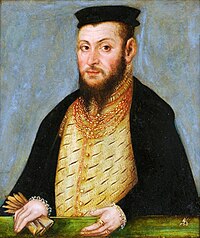 Portrait of the Polish King Sigismund II by Lucas Cranach the Younger , circa 1553 | |||||||
 | |||||||
| Predecessor | Sigismund I | ||||||
| Successor | Heinrich Valois | ||||||
| |||||||
| Predecessor | Sigismund I | ||||||
| Successor | Heinrich Valois | ||||||
| Birth | August 1, 1520 Krakow | ||||||
| Death | July 7, 1572 (51 years old) Knyszyn , Podlaskie Voivodeship , Poland . | ||||||
| Burial place | Cathedral of Saints Stanislaus and Wenceslas , Krakow , Poland | ||||||
| Kind | Jagellons | ||||||
| Father | Sigismund I | ||||||
| Mother | Bona Sforza | ||||||
| Spouse | Elizabeth Habsburg Barbara Radziwill Ekaterina Habsburg | ||||||
| Children | not | ||||||
| Autograph |  | ||||||
Content
Foreign Policy
In external affairs, Sigismund August tried to maintain peace, remained in good relations with Austria and Turkey, but could not avoid a war with Ivan the Terrible due to the latter's claims to some parts of Livonia , with which Sigismund August concluded a defensive and offensive alliance . Long negotiations on a truce with Moscow and on the marriage of John with the sister of the Grand Duke of Lithuania Catherine were unsuccessful, and after the annexation of Livonia to Lithuania ( 1561 ), the Russo-Lithuanian War (1561-1570) began, ending for Lithuania with the temporary loss of Polotsk . After the signing of the Union of Lublin (1569), the Russian state had to fight with the forces not only of the ON , but also of Poland; in addition, in 1569, Turkish-Tatar troops march to Astrakhan . However, the ON was then too exhausted by the protracted war, so at the end of 1569 a new “great embassy” left for Moscow, this time from the Polish-Lithuanian Commonwealth. According to the terms of the 3-year truce (1570), Polotsk, Sitno , Ezerishche , Usvyaty and several other castles went to Moscow.
Conversions
Meanwhile, public affairs demanded the king the most intense influence. The Reformation Movement reached its zenith and became the subject of state discussion in a number of Dietes, beginning with the Petrokovsky one (in May 1550 ). In the struggle of Catholicism and Protestantism, the king did not take an active part and did not even take decisively on the side of one or another group. When Rome began relations with John the Terrible , Sigismund Augustus considered himself offended for some reason, and the curia - ungrateful, and inclined to the protection of the Protestants; but this momentary flash did not have serious consequences. When the Catholic reaction began, the leaders of domestic politics were papal nunciations, not the king. Sigismund August paid much more attention to the legislative work of a number of Dietes, embracing the most diverse issues of the internal state system ("naprawa Rreczy pospolitej"). In the Warsaw Sejm ( 1563 - 1564 ) and Petrokovsk Seym from them assigned to the maintenance of the army ( wojsko kwarciane ). Then the king almost single-handedly carried on his shoulders the whole affair of the Union of Lublin .
June 7, 1563 Sigismund II August signed a new privilege on the equation in the rights of Orthodox and Catholics (the privilege text is included as a preamble in the Statute of the Grand Duchy of Lithuania of 1566) [1] .
The reign of Sigismund Augustus is the era of the highest prosperity of the nobility in the sense of the development of state consciousness in it; wishing to go hand in hand with the royal power, the gentry proposed a very reasonable project for the establishment in each county of royal prosecutors ( instygators ), who would monitor the actions of other ranks, report to the king on all their abuses and at the same time support all royal orders of military force . This project was not accepted.
Sigismund Augustus was a lover and patron of fine arts, science and literature, who achieved with him, mainly under the influence of the reformation, a flourishing state.
Family life
The son of Sigismund I and Bona Sforza . As far back as 1529 he was elected Grand Duke of Lithuania, then King of Poland and crowned in Krakow in 1530 . Education under the guidance of the mother weakened his spiritual strength and developed in him a dreaminess and indecision.
Sigismund Augustus was married three times and had no children in any of the marriages. In 1543 he married Elizabeth of Austria ( 1526 - 1545 ), daughter of Emperor Ferdinand I. Fearing her influence on her son, Bona tried to separate the young spouses and, leaving her daughter-in-law with her, sent Sigismund Augustus to the Principality of Lithuania , which he had ruled since 1544 .
After the sudden death of Elizabeth in June 1545 , poisoned, it is believed, by Bona, Sigismund August secretly married Barbara Radziwill (widow of Gastold), which brought on the terrible wrath of Bona. The question of this marriage was raised at the very first Sejm (Petrokov), convened after the accession of Sigismund Augustus to the throne ( 1548 ). Almost all the Zemstvo ambassadors demanded that the king terminate the matrimony insulting to his dignity, which was concluded without the knowledge of government officials. Primate Dzierzgowski promised to give him absolution, and lay the blame of the marriage vow on the conscience of all citizens. The king, however, remained adamant and subsequently ( 1550 ), although without the consent of the Sejm, solemnly crowned Barbara in Krakow.
However, a year later, Barbara died, too, as some believe, being poisoned at the instigation of Bona. In 1553, Sigismund August entered into a third marriage with Catherine of Austria ( 1533 - 1572 ), the sister of his first wife. He soon parted with her forever and even began the chores of a divorce. Unhappy in family life, desperate to leave a legitimate heir behind him, the king surrendered to a hectic life and surrounded himself with witches, hoping that they would restore his health, which had collapsed from incontinence.
Death
He died in 1572 in Knyszyn ; the Jagiellonian dynasty ceased with him. Anticipating the strife and turmoil of the non- populist , Sigismund Augustus in his spiritual testament urged his subjects to keep peace and harmony and called a curse on those who would start a quarrel and sow public strife.
Notes
- ↑ National Legal Internet Portal of the Republic of Belarus (inaccessible link)
Literature
- Khranevich K.I. Sigismund II August // Brockhaus and Efron Encyclopedic Dictionary : in 86 volumes (82 volumes and 4 additional). - SPb. , 1890-1907.
Links
- Vishnitser M. L. Sigismund II August // Jewish Encyclopedia of Brockhaus and Efron . - SPb. , 1908-1913.