The “red” border of the photoelectric effect is the lowest frequency (longest wavelength ) light , at which an external photoelectric effect is still possible, that is, the initial kinetic energy of photoelectrons is greater than zero. Frequency depends only on the output work electron :


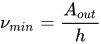
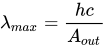
Where Is the work function for a particular photocathode , h is the Planck constant , and c is the speed of light . Exit work depends on the material of the photocathode and the state of its surface. The emission of photoelectrons begins as soon as light is incident on the photocathode with a frequency or with wavelength .


Red border photoelectric effect for some substances
| Substance | Red border [1] |
|---|---|
| Barium | 484 nm |
| Barium in tungsten | 1130 nm |
| Tungsten | 272 nm |
| Germanium | 272 nm |
| Nickel | 249 nm |
| Barium oxide | 1235 nm |
| Platinum | 190 nm |
| Rubidium | 573 nm |
| Silver | 261 nm |
| Thorium on Tungsten | 471 nm |
| Cesium | 662 nm |
| Cesium on tungsten | 909 nm |
| Cesium on platinum | 895 nm |
See also
- Photo effect
- Planck Constant
Notes
- ↑ A quick reference to physics. Enokhovich A.S. 2nd ed., Rev. and add. - M.: Higher School, 1976. - 288s. (see page 164)