Linus Carl Pauling ( English Linus Carl Pauling ; February 28, 1901 , Portland , Oregon - August 19, 1994 , Big Sur , California ) - American chemist , crystallographer , winner of two Nobel Prizes : in chemistry ( 1954 ) and the Peace Prize ( 1962 ), as well as the International Lenin Prize "For strengthening peace between peoples" (1970).
| Linus Carl Pauling | |
|---|---|
 Linus Carl Pauling in 1954 | |
| Date of Birth | |
| Place of Birth | Portland (Oregon) , USA |
| Date of death | |
| Place of death | |
| A country | |
| Scientific field | , and |
| Place of work | California Institute of Technology |
| Alma mater | |
| supervisor | Richard Chase Tolman |
| Awards and prizes |  Nobel Prize in Chemistry ( 1954 ) Nobel Peace Prize ( 1962 ) Nobel Prize in Chemistry ( 1954 ) Nobel Peace Prize ( 1962 )  US National Science Medal (1974) US National Science Medal (1974)  Grand Gold Medal named after M.V. Lomonosov ( 1977 ) Grand Gold Medal named after M.V. Lomonosov ( 1977 )  |
| Signature | |
Biography
The early years
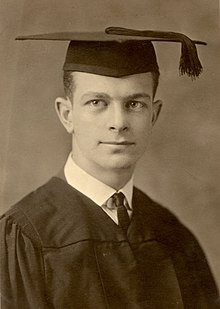
(Oregon State University, 1922)
Linus Carl Pauling was born in Portland, Oregon on February 28, 1901,
Linus Pauling was the first child of Herman Pauling, the son of German immigrants, and Lucy Isabelle (Darling) Pauling, descended from a pre-revolutionary Irish family. The family had two younger daughters: Pauline Darling (b. 1902) and Lucille (b. 1904). Herman Pauling was a traveling salesman for a medical supply company at that time and moved to Condon, Oregon in 1905, where he opened his own pharmacy. [10] It was in this city, in a dry place east of the coast, that Pauling went to school for the first time. He learned to read early and began to "absorb" books. In 1910, the family moved to Portland, where his father wrote a letter to The Oregonian, a local newspaper, asking for advice on suitable reading literature for his nine-year-old son, who had already read the Bible and Darwin's theory of evolution.
Linus did well at school. He collected insects and minerals, and eagerly read books. He decided to become a chemist in 1914 when a classmate, Lloyd A. Jeffress, showed him some of the chemical experiments that he set up at home. With the reluctant approval of his mother, he left school in 1917 without a diploma and entered the Oregon College of Agriculture in Corvallis as a chemical engineer, but two years later his mother wanted him to leave college to earn money to support his family. He impressed his teachers, in 1919, after a summer job as an Oregon pavement inspector, he was offered a full-time position as a teacher of quality analysis at the Department of Chemistry. [eleven]
In 1922, he married Ave Helen Miller (died in 1981), who gave birth to four children: Linus Karl, Peter Jeffress, Linda Elena (Kamb), and Edward Krellin [12] .
Pasadena
Pauling entered graduate school at the California Institute of Technology in 1922 and remained there for over 40 years. He chose the California Institute of Technology because he could defend a doctorate for 3 years (Harvard 6 years), and offered him a modest part-time scholarship as a teacher. It was a good choice for both Pauling and the California Institute of Technology. At the end of his life, Pauling wrote: “Years later ... I realized that there was no better place in the world in 1922 where I would be better prepared for my career as a scientist” (1994) [12] . Pauling's doctoral work was devoted to determining the crystal structure of molecules by X-ray diffraction under the guidance of (1894-1945), who received his doctorate two years earlier (he was the first to receive a Ph.D. in Kaltech). Noyes received one of the newly created Guggenheim Fellowships for a rising star and sent him and his young wife to the Institute of Theoretical Physics under the direction of Arnold Sommerfeld (1868-1951), in Munich. They arrived in April 1926, at which time the Bohr-Sommerfeld model was supplanted by “new” quantum mechanics. It was an exciting time, and Pauling knew that he was lucky to be there in one of the centers. He was the only chemist at the Sommerfeld Institute and immediately saw that new physics was destined to provide a theoretical basis for understanding the structure and behavior of molecules. The year in Europe had a decisive influence on the scientific development of Pauling. In addition to staying in Munich, he visited Copenhagen in the spring of 1927, and then spent the summer in Zurich [11] .
One of the immediate results of his stay in Munich was Pauling's first article (1927) in the Proceedings of the Royal Society in London, presented by Sommerfeld himself. Pauling was eager to apply new wave mechanics to calculate the properties of many-electron atoms, and he found a way to do this using hydrogen-like single-electron wave functions of external electrons with an effective nuclear charge based on empirical constants of internal electrons.
After World War II
Upon returning to Stanford in 1973, Pauling became the co-founder of a nonprofit organization named after him (the “The Linus Pauling Institute of Science and Medicine” ), now operating at the University of Oregon (USA) [13] [14] .
Death
Linus Pauling died on his ranch in Big Sur (California) on August 19, 1994 from prostate cancer [15] .
Research
Most scientists create a certain niche for themselves, but Pauling had an extremely wide range of scientific interests: quantum mechanics , crystallography , mineralogy , structural chemistry , anesthesia , immunology , medicine , evolution . In all these areas, and especially in related areas with them, he saw where the problems lie and, relying on the speedy mastery of the basic facts and his phenomenal memory, he made a special and decisive contribution [16] . He is best known for his definition of a chemical bond , the discovery of the basic elements of the secondary structure of a protein : the alpha helix and beta sheet , and the first identification of a molecular disease ( sickle cell anemia ); In addition, he has many other important achievements. Pauling was one of the founders of molecular biology in the true sense of the word. For these achievements, he was awarded the 1954 Nobel Prize in Chemistry .
However, Pauling was known not only in the world of science. In the second half of his life, he devoted his time and energy to health issues and the need to exclude the possibility of war in the nuclear age. His active opposition to nuclear testing led to political persecution in his country. Pauling influenced the provision in 1963 of an international treaty banning atmospheric tests . With the award of the Nobel Prize in 1962, Pauling became the first person to receive two personal Nobel Prizes (Marie Curie received one and shared the second with her husband). Pauling's name is also known to the general public thanks to his propaganda, based on a personal example, the use of large doses of ascorbic acid ( vitamin C ) as a dietary supplement to improve overall health and prevent (or at least reduce the severity of) diseases such as colds and cancer ( orthomolecular medicine ). For the treatment of cancer, he administered huge doses of vitamin C to patients: 10,000 milligrams per day, despite the fact that the daily norm does not exceed 100 mg [17] .
The nature of chemical bonding
In 1927, Pauling returned to the California Institute of Technology as an assistant professor of theoretical chemistry. Over the next twelve years, a remarkable series of articles are being published that create him an international reputation. His abilities were quickly recognized thanks to promotion (associate professor - 1929; professor - 1931), awards (Langmuir Prize, 1931), and elections to the National Academy of Sciences (1933). Thanks to his writings and lectures, Pauling established himself as the founder of the so-called structural chemistry, which made it possible to take a fresh look at molecules and crystals. [16] Pauling's Rule: Whereas binary electrolytes, such as alkali metal halides, are limited in their types of crystalline structures, the variety of structures open to more complex substances such as mica, KAl 3 Si 3 O 10 (OH) 2 may be limitless. Pauling in 1929 formulated a series of rules on the stability of such structures, which turned out to be extremely convenient both in testing the correctness of the proposed structures and in predicting the unknowns. [18]
Quantum Chemistry
In 1927, Berro decided that the Schrödinger equation for the hydrogen ion of the H 2 + molecule in elliptical coordinates and the obtained values for the interatomic distance and binding energy are in good agreement with experiment. Burro's wave function is not able to lead to a physical understanding of the stability of the system. Subsequently, Pauling (1928) emphasized that although approximate processing of the perturbation would not provide new information, it would be useful to know how this happens: “Since the perturbation methods can be applied to many systems for which the wave equation cannot be precisely solved ...”. Pauling first showed that the classical interaction of a hydrogen atom in the ground state and a proton is repulsion in all intervals. However, if the electron is not localized on one of the atoms, and the wave function is taken as a linear combination of the two ground states of the atomic wave functions, then the interaction energy has a clear minimum in the range of about 2 au [19] This was the first example of what happened afterwards known as the Linear Combination of Atomic Orbitals (LCAO) method. Much has been done by Pauling for valence bond (VB), the theory of molecular orbitals (MO). The latter, developed by Fritz Hund (born 1896), Erich Hückel (1896–1980), and Robert S. Mulliken (1896–1986), works in terms of the orbitals distributed throughout the molecule; they are assigned two orbitals according to their estimated energy an electron with opposite spins to each of the connected orbitals. Electronic excited states correspond to the transfer of one or more electrons from the binding to the loosening orbital. [20] Currently, the theory of molecular orbitals has established itself as suitable for computer calculations of multicenter molecules.
In 1954, the Nobel Committee awarded Pauling a prize in chemistry "for studying the nature of chemical bonds and its application to explain the structure of complex molecules." In his Nobel lecture, he said that future chemists would “rely on new structural chemistry, including precisely defined geometric relationships between atoms in molecules, and the strict application of new structural principles” and that “thanks to this methodology, significant progress has been made in solving the problems of biology and medicine using chemical methods. ”
In September 1958, at a symposium dedicated to the memory of Kekule , Linus Pauling introduced and justified the theory of curved chemical bonds instead of σ, π - descriptions for double and triple bonds and conjugated systems. [21]
Pauling was president of the American Chemical Society ( 1948 ) and the Pacific branch of the American Association for the Advancement of Science (1942-1945), as well as vice president of the American Philosophical Society (1951-1954). Pauling deduced his concept partially from the ionic bond. The binding energy can be considered as the sum of two contributions - the covalent part and the ionic part. The thermochemical binding energies D (AB) between atoms A and B are, in general, greater than the arithmetic average of the energies D (A-A) and D (BB) of the homonuclear molecules. Pauling attributed the additional energy Δ (AB) to ion resonance and found that he could assign XA values, etc., so that such elements with Δ (AB) were approximately proportional to (XA-XB) ². The values of X form a scale (scale of electronegativities), in which for fluorine x = 4, it is the most electronegative element, for cesium x = 0.7. In addition to providing a basis for estimating the binding energies of heteropolar bonds, these x values can also be used to estimate the dipole moment and ionic nature of the bonds. [22]
Molecular Biology
A study of the nature of chemical bonding perhaps marks the culmination of Pauling's contribution to chemical bonding theory. In particular, achievements follow from an important article (1947) on the structure of metals, but interest in chemical bonds has now flowed into interest in the structure and functions of biological molecules. There are hints of this in the chapter on hydrogen bonds. Pauling was one of the first to state its significance for biomolecules: because of its low binding energy and low activation energy, which characterize its formation and destruction, hydrogen bonding plays a role in reactions that occur at normal temperature. It was recognized that hydrogen bonds stabilize the spatial structure of protein molecules ... [23]
The importance of hydrogen bonds in the protein structure can hardly be overestimated. “The loss of native conformation destroys the characteristic properties of the protein. Due to the difference in entropy between the native and denatured forms of trypsin, it was found that about 10 20 conformations are available for the denatured protein molecule. When heating or changing the pH of the solution near the isoelectric point of the protein, the unfolded segments of the acidic or main side chains become entangled with each other, linking the molecules together, and ultimately this leads to the formation of a clot. " [24] This was the first modern theory of native and denatured proteins.
Political Activities
Pauling was known not only as a scientist; he was also a famous public figure in the United States. He was awarded the Presidential Medal of Merit, the highest civilian honor in the United States, and was awarded by President Truman in 1948. Immediately after August 1945, Pauling became interested in involving atomic achievements in international relations and the need to control nuclear weapons. His lectures and letters on this subject soon drew the attention of the FBI and other government services. Not afraid of this, he, with the support of his wife Ava Helen, began to take a more active position. He signed petitions, joined organizations (such as the Emergency Committee of Atomic Scientists, led by Albert Einstein, and the American Civil Liberties Union), and strongly opposed the development of nuclear weapons. During the McCarthyism period, and especially during the Korean War, this was enough to suspect him of a security risk [10] .
In March 1954, after the Castle Bravo “dirty” thermonuclear bomb detonated on Bikini Atoll, Pauling was again the subject of news reports when he began to draw public attention to the international danger of radioactive fallout in the atmosphere. Pauling stated that an increase in the concentration of radioactive isotopes in the atmosphere is not only dangerous for living now, but also for future generations too.
In June 1961, Pauling and his wife convened a conference in Oslo, Norway, against the proliferation of nuclear weapons. In September of the same year, despite appeals to Nikita Khrushchev, the USSR resumed testing of nuclear weapons in the atmosphere, and the next year, in March, the United States did. Pauling also drafted a proposed treaty banning such tests. In July 1963, the United States, the USSR, and Great Britain signed a nuclear test ban treaty based on this project.
In 1962, Pauling was awarded the Nobel Peace Prize . In his Nobel lecture, he expressed the hope that the nuclear test ban treaty would "begin a series of treaties that would lead to the creation of a new world where the possibility of war would be forever ruled out."
In the same year, he retired from the California Institute of Technology and became a research professor at the Center for the Study of Democratic Institutions in Santa Barbara, California. Here he was able to devote more time to the problems of international disarmament. In 1967, he also became professor of chemistry at the University of California, San Diego, hoping to spend more time researching in the field of molecular medicine. Two years later, he left there and became a professor of chemistry at Stanford University in Palo Alto (California).
In 1992, he signed the “ Warning to Humanity ” [25] .
Критика научных идей Полинга в СССР
В конце 1940-х годов в СССР была начата кампания идеологического вмешательства в химию, призванная, наряду с аналогичными пропагандистскими мероприятиями в других областях науки , «очистить советскую науку от буржуазных, идеалистических теорий» и «рабского преклонения перед буржуазными научными авторитетами». [26]
Основным объектом критики стала теория резонанса , предложенная Л. Полингом как часть представлений об электронной структуре молекул с делокализованной электронной плотностью. В СССР теория была объявлена «идеалистической» — и поэтому неприемлемой для использования в науке и образовании.
В критических публикациях (в частности, Б. М. Кедрова ) в адрес теории Полинга фактически накладывался запрет на использование физических методов в химии, физических и химических в биологии и т. п. Была сделана попытка связать теорию резонанса с вейсманизмом-морганизмом , то есть как бы заложить основу объединенного фронта борьбы с передовыми научными направлениями [27] :
«Теория резонанса», будучи идеалистической и агностической, противостоит материалистической теории Бутлерова, как несовместимая и непримиримая с ней;… сторонники «теории резонанса» игнорировали её и извращали её существо. «Теория резонанса», будучи насквозь механистической, отрицает качественные, специфические особенности органического вещества и совершенно ложно пытается сводить закономерности органической химии к закономерностям квантовой механики… Мезомерийно-резонансная теория в органической химии представляет собою такое же проявление общей реакционной идеологии, как и вейсманизм-морганизм в биологии, как и современный «физический» идеализм, с которыми она тесно связана.
— Кедров Б. М. Против "физического" идеализма в химической науке. Cit. по [27]
В июне 1951 года прошла Всесоюзная конференция по состоянию теории химического состава органической химии, на которой резонансная теория Полинга и теория мезомерии Ингольда были объявлены буржуазными и лженаучными [28] .
Гонения на теорию резонанса в органической химии получили негативную оценку в мировой научной среде. В одном из журналов Американского химического общества в обзоре, посвящённом положению в советской химической науке, в частности, отмечалось: [29]
В большинстве русских статей на эти темы (…), по-видимому, преобладает шовинистическая идея, что теория резонанса Лайнуса Полинга противоречит догмам диалектического материализма и поэтому должна быть отвергнута. Размах и резкость этого осуждения не имеет аналогов в истории химии
Original textThe large majority of Russian papers on these subjects (...) apparently arising from the chauvinistic idea that the resonance theory of Linus Pauling opposes the tenets of dialectical materialism and therefore must be rejected. The intensity and crudeness of this invective appear to be without parallel in the annals of chemistry.
Теория об особой роли витамина C
В 1966 году, после предложения Ирвина Стоуна, Полинг начал принимать 3 грамма аскорбиновой кислоты каждый день. Почти сразу он почувствовал себя живее и здоровее. В течение нескольких последующих лет простуда, которая мучила его всю жизнь, стала менее суровой и частой. Благодаря этому опыту Полинг стал верить, что ежедневный приём больших доз витамина C приносит пользу здоровью. Он стал пропагандировать приём витамина C, читать посвящённые этому вопросу лекции и выпускать популярные книги, что вызвало недовольство американского медицинского сообщества. [thirty]
В монографии «Витамин С и простуда» (1971) Полинг обобщил практические и теоретические доводы в поддержку терапевтических свойств витамина С. В начале 1970-х годов он сформулировал теорию ортомолекулярной медицины , в которой подчеркивалось значение витаминов и аминокислот. В 1973 году был основан Научный медицинский институт Лайнуса Полинга в Пало-Альто. В течение первых двух лет он был его президентом, а затем стал там профессором. Его книга о витамине C быстро стала бестселлером. В результате в Америке и позже в других странах миллионы людей были убеждены, что ежедневное потребление 1—2 граммов аскорбиновой кислоты оказывает благоприятное воздействие на здоровье и хорошее самочувствие.
Полинг полагал, что приём витамина C и других антиоксидантов в больших дозах может способствовать излечению от множества различных болезней, включая рак. Хотя опыты на клеточных культурах и животных и показывают, что для некоторых форм рака витамин C может уничтожать опухолевые клетки [31] [32] , но анализ проведённых двойным слепым методом медицинских исследований с участием сотен тысяч людей показывает, что влияние приёма витамина C и других добавок-антиоксидантов на смертность от рака, сердечно-сосудистых и других заболеваний нейтрально или негативно, вопреки воззрениям Полинга [33] [34] . В целом, вопрос полезности витамина C при лечении тяжёлых заболеваний по-прежнему исследуется [33] [35] .
Полинг как человек
Полинг прожил длинную и продуктивную жизнь. Как учёный, посредством своих статей и личного воздействия, он повлиял на несколько поколений химиков и биологов. Как политический активист он бросил вызов политическому и военному сообществу Соединенных Штатов и помог им измениться. Как борец за здоровье он покорил медицинское сообщество и убедил миллионы людей есть дополнительное количество витаминов. Как отмечал в своих воспоминаниях британский кристаллохимик , «он мог быть действительно очень убедительным. Его лекции очаровывали и у него был характерный простой литературный стиль. Честолюбивый? Эгоистичный? Undoubtedly. Без этих черт он был бы не в состоянии достигнуть того, что сделал. Но он, с веселым мерцанием в глазах, был очень очаровательным как в обществе, так и в личных встречах» [16] .
Awards and recognition
Полинг был удостоен следующих наград:
- 1926 — Стипендия Гуггенхайма (получал эту стипендию так же в 1927 и в 1965 году) [36]
- 1931 —
- 1931 —
- 1945 — Силлимановская лекция
- 1946 — Премия Уилларда Гиббса
- 1947 — Медаль Дэви от Лондонского королевского общества
- 1954 — Нобелевская премия по химии , «за изучение природы химической связи и его применение к объяснению строения сложных молекул»
- 1959 — Мессенджеровские лекции
- 1961 — Гуманист года
- 1966 —
- 1962 — Нобелевская премия мира , за его деятельность, направленную на запрещение ядерных испытаний в атмосфере
- 1966 —
- 1967 — Медаль Рёблинга
- 1970 — Международная Ленинская премия «За укрепление мира между народами»
- 1971 —
- 1974 — Национальная научная медаль США
- 1975 — Медаль «За научные достижения» Национального научного фонда США
- 1977 — Золотая медаль имени М. В. Ломоносова АН СССР
- 1979 —
- 1984 — Медаль Пристли от Американского химического общества
- 1986 —
- 1989 — Премия Вэнивара Буша
- 1990 —
- 1994 —
- 2008 - Introduced to the
Interesting Facts
- Linus Torvalds was named by parents after Pauling for his political activism [37] .
See also
- Theory of Curved Chemical Bonding
- Color scheme of Corey - Pauling - Koltun models
Literature
- Pauling L. The nature of chemical bonds / Per. from English M.E. Dyatkina. Ed. prof. Y. K. Syrkin. - M .; L .: Goskhimizdat, 1947 .-- 440 p.
- Pauling L. There is no war! / Per. from English under the editorship of Acad. A. Topcheva. - M .: Foreign Literature, 1960 .-- 236 p.
- Pauling L. Vitamin C and Health / Per. from English T. Litvinova and M. Slonim, ed. V. N. Bukina. - M .: Nauka, 1974.- 80 p.
- Pauling L. General chemistry. Per. from English - M .: Mir, 1974.- 846 p.
- Pauling L., Pauling P. Chemistry / Ed. M.L. Karapetyantsa. - M .: Mir, 1978.- 683 p.
- Cameron I., Pauling L. Cancer and Vitamin C. Discussion of the nature, causes, prevention and treatment of cancer (The special role of vitamin C) / Ed. M.L. Karapetyantsa. - M .: Cobra International, 2001 .-- 336 p.
- Pauling L., Ikeda D. All life in the struggle for peace. Dialog / Per. from English Yu. M. Kantsura. - M .: Publishing House of Moscow State University, 2004. - 144 p. - ISBN 5-211-05034-7 .
Notes
- ↑ 1 2 3 4 5 6 Biography.com // Biography.com - 2014.
- ↑ 1 2 BNF identifier : Open Data Platform 2011.
- ↑ 1 2 Committee of Historical and Scientific Works - 1834.
- ↑ 1 2 SNAC - 2010.
- ↑ http://muse.jhu.edu/journals/biography/v019/19.4.article.html
- ↑ Linus Pauling, Obituary // The Daily Telegraph / W. Lewis - London , Thailand : 1994. - ed. size: 622719 - ISSN 0307-1235
- ↑ Wade, Nicholas Twists in the Tale of the Great DNA Discovery - The New York Times , 2011.
- ↑ LIBRIS - 2013.
- ↑ Pauling L.K. The Determination With X-Rays of the Structures of Crystals, Dissertation (Ph.D.) - 1925.
- ↑ 1 2 Kauffman GB, LM Kauffman. An interview with Linus Pauling // . - 1996. - T. 73 , No. 29 . - S. 32 .
- ↑ 1 2 A. Sakharov. Memoirs (English translation by R. Laurie (Eng.) // NewYork: Knopf . - 1990.
- ↑ 1 2 T. Hager. Force of Nature: The Life of Linus Pauling (Eng.) // New York: Simon & Schuster . - 1995.
- ↑ About the Linus Pauling Institute . Linus Pauling Institute . Oregon state university. Date of appeal September 12, 2018.
- ↑ Linus Pauling Biography . Linus Pauling Institute . Oregon state university. Date of appeal September 12, 2018.
- ↑ Paul Offit. The Vitamin Myth: Why We Think We Need Supplements . The Atlantic (July 19, 2013). Circulation date May 31, 2019.
- ↑ 1 2 3 Jack D. Dunitz. Linus Carl Pauling // National Academies Press, Washington DC . - 1995.
- ↑ A universal and cheap cancer medicine found in the face of vitamin C
- ↑ Pauling, L. The principles determining the structure of complex ionic crystals (Eng.) // J. Am. Chem. Soc. . - 1929. - T. 51 , No. 1010 . - S. 26 .
- ↑ Pauling, L. The nature of the chemical bond. Application of results obtained from the quantum mechanics and from a theory of paramagnetic susceptibility to the structure of molecules. (English) // J. Am. Chem. Soc. . - 1931. - T. 53 , No. 1367 . - S. 1400 .
- ↑ Pauling, L. The application of the quantum mechanics to the structure of the hydrogen molecule and hydrogen molecule-ion and to related problems. (English) // Chem. Ren. . - 1928. - T. 5 , No. 173 . - S. 213 .
- ↑ Edited by R. Kh. Freidlina. "Theoretical Organic Chemistry.". - Per. from English Cand. Chem. Sciences Yu. G. Bundel. - M .: Publishing house of foreign literature, 1963. - T. 1. - 365 p.
- ↑ Pauling, L. The theoretical prediction of the physical properties of many-electron atoms and ions: Mole Refraction, diamagnetic susceptibility and extension in space. (English) // Proc. R. Soc. Lond. . - 1927. - T. A114 , No. 181 . - S. 211 .
- ↑ Pauling, L. The nature of forces between large molecules of biological interest. (English) // Nature (London) . - 1948. - T. 161 , No. 707 . - S. 709 .
- ↑ Mirsky, AE, and L. Pauling. On the structure of native, denatured, and coagulated proteins. (English) // Proc. Natl. Acad. Sci. USA - 1936. - T. 22 , No. 439 . - S. 47 .
- ↑ World Scientists' Warning To Humanity . Circulation date May 31, 2019.
- ↑ A. S. Sonin. The sad anniversary of one campaign // Bulletin of the Russian Academy of Sciences . - 1991. - T. 61 , No. 8 . - S. 96-107 . Archived on May 5, 2010.
- ↑ 1 2 Operation "Theory of resonance" / Lisichkin V. A., Shelepin L. A. The Third World (Information-Psychological) War. - M .: Eksmo, Algorithm, 2003 .-- 448 p.
- ↑ Lauren Graham “Natural Science, Philosophy, and the Science of Human Behavior in the Soviet Union, Chapter IX. Chemistry"
- ↑ I. Moyer Hunsberger. Theoretical chemistry in Russia (Eng.) // J. Chem. Educ. : journal. - 1954. - Vol. 31 , no. 10 . - P. 504-514 . - DOI : 10.1021 / ed031p504 .
- ↑ Hemilä, H. Vitamin C and the common cold. (English) // Br. J. Nutr .. - 1992. - Vol. 67. - P. 16.
- ↑ Vitamin C was able to defeat incurable forms of cancer
- ↑ Vitamin C selectively kills KRAS and BRAF mutant colorectal cancer cells by targeting GAPDH // Science
- ↑ 1 2 G. Bjelakovic et al. Mortality in Randomized Trials of Antioxidant Supplements for Primary and Secondary Prevention: Systematic Review and Meta-analysis // JAMA . - 2007. - Vol. 297. - P. 842-857. - DOI : 10.1001 / jama.297.8.842 .
- ↑ DP Vivekananthan et al . Use of antioxidant vitamins for the prevention of cardiovascular disease: meta-analysis of randomized trials // The Lancet . - 2003. - Vol. 361. - P. 2017–2023. - DOI : 10.1016 / S0140-6736 (03) 13637-9 .
- ↑ High-Dose Vitamin C (inaccessible link) , High-Dose Vitamin C - for health professionals // NCI
- ↑ Linus Pauling on the website of the John Simon Guggenheim Memorial Fund
- ↑ Moody, Glyn. Rebel Code: Linux and the Open Source Revolution . - Perseus Books Group, 2002. - P. 336. - ISBN 978-0-7382-0670-7 .
Links
- Hramov Yu. A. Pauling Linus Carl ( Physics: Biographical reference book / Ed. A.I. Akhiezer . - Ed. 2nd, rev. and add. - M .: Nauka , 1983 .-- S. 218. - 400 p. - 200,000 copies. (in per.)