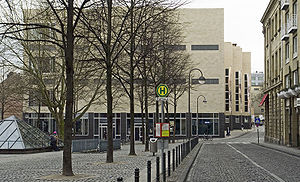
The Wallraf-Richartz Museum ( German: Wallraf-Richartz-Museum & Fondation Corboud ) in Cologne is one of Germany 's largest art galleries. The Museum is housed in the Cologne Museum building , which was built in 2001 and stores the largest collection of medieval paintings in the world, in particular, the Cologne painting school , as well as an extensive collection of graphics .
| Wallraf-Richartz Museum and the Corbo Foundation | |
|---|---|
| Wallraf-Richartz-Museum & Fondation Corboud | |
 | |
| Established | 1861 |
| opening date | |
| Location | |
| Address | Koln |
| Visitors per year | |
| Director | |
| Site | |
Content
History
In 1827 - 1860, Walrafium was located in Cologne at 7 Trankgass 7 , which subsequently gave rise to many Cologne museums, university and city libraries and the historical archive . The title he owed to the scientist, canon and rector of the University of Cologne, Ferdinand Franz Wallraf , who donated his extensive collection of “manuscripts, documents, seals, prints and books, paintings and engravings, coins and vessels, antiquities and much more” that formed the basis the museum.
In 1851, Cologne merchant Johann Heinrich Richartz donated 232 thousand talers for the construction of a museum building in Cologne. The Wallraf-Richartz Museum opened on July 1, 1861 in a building designed by the Cologne architect Ernst Friedrich Zwirner in the territory of the former Minorite Monastery after the death of Richard.
Between 1941 and 1945, museum director Otto H. Ferster sold at least 105 paintings by old masters from museum reserves to collector and art dealer Heinz Kisters . With the money raised, the director planned to purchase the works of contemporary artists that were offered to him during the German occupation of Paris and Amsterdam [2] .
During the Second World War, the museum building was destroyed. In its place in 1956, a new museum building was built, which is currently occupied by the Museum of Applied Arts . Ten years later, the collection of pop art Peter Ludwig moved there, and thus the exposition possibilities of the building were exhausted. In 1986, the Wallraf-Richartz Museum and the new Ludwig Museum moved to a new building near Cologne Cathedral . Peter Ludwig and his wife Irena continued to acquire new works of art, Peter Ludwig also transferred his collection of works by Picasso to the museum that received his name. Even before Ludwig's death, it was decided that the Wallraf-Richartz Museum will occupy a new building near the Ludwig Museum.
On January 19, 2001, the new building of the Wallraf-Richartz Museum was opened, which settled approximately at the place where Stefan Lochner 's workshop was once located.
In a cube-shaped building between the town hall and Gürzenich , designed by architect Oswald Mathias Ungers on an area of 3,500 square meters. m. expositions of graphics and paintings covering the period from the Middle Ages to the XIX century. After in 2001 the Swiss collector Gerard Corbo transferred the collection of impressionists to the museum for long-term use, the museum is officially called the Wallraf-Richartz Museum & Corbo Foundation .
Collection
The Wallraf-Richartz Museum houses one of the largest collections of medieval painting. No other city has preserved such a large collection of medieval paintings due to the fact that Cologne passed large fires and iconoclasts . During secularization, museum founder Ferdinand Franz Wallraf collected altar paintings that became the basis of the museum’s medieval department. With this collection of works by masters of the Cologne school can only compare the collection of the Old Pinakothek in Munich . In the museum’s collection you can see the works of Stefan Lochner , Masters of St. Veronica , Masters of St. Lorentz, Masters of the Legend of George , Masters of Bartolomeus, Masters of the Glorification of Mary , Masters of St. Severin , Masters of the legend of Ursula and other representatives of the Cologne school of painting.
The Baroque department perfectly reflects the diversity of art after 1550 . The structure of the collection, with an emphasis on painting in the northern Netherlands, is rather heterogeneous. The most famous exhibits are the works of Rembrandt , Merten van Heemskerk , Gerrit van Honthorst , Jan Vikors , Francois Boucher , Paris Bordone , Peter Paul Rubens and Antonis van Dyck .
On the example of exhibits in the department of the XIX century, one can trace the development of art in the XIX century. German artists who worked in Rome at the end of the 18th century are represented by Jacob Philip Hackert , Johann Christian Reinhart , Joseph Anton Koch . The museum presents early and late romantics Caspar David Friedrich , Karl Blechen , Gerhard von Kugelgen and Nazarenes Eduard Bendeman , Julius Schnorr von Carolsfeld . They are complemented by a large collection of works by the Cologne artist Wilhelm Leible , works by Gustave Courbet and Max Lieberman and the Symbolists Arnold Böcklin , Franz von Stuck , Marianne Stokes , James Ensor , Edward Munch . The collection of the Corbo Foundation, which was included in the museum's exposition, demonstrates works of late impressionism. In the department of the XIX century. also represented are sculptural works by Hudon , Rudolf Shadov , Pierre-Auguste Renoir and Auguste Rodin .
The funds of the collection of graphics cover 75,000 works on paper, including exquisite miniatures on parchment , unique sketches and inks on paper and cardboard, a number of sketch albums and numerous printed graphics in various techniques.
Master of the legend of Ursula . The phenomenon of angels. OK. 1500
Albrecht Durer . Drummer and flutist. OK. 1504
Hans von Aachen . Self portrait. OK. 1574
Rembrandt Self portrait in the image of Zeusxis . OK. 1669
Edouard Manet . A bunch of asparagus . 1880
Pierre-Auguste Renoir . Portrait of a couple of Sisley. 1868
Vincent van Gogh . Bridge in Arles . 1888
Marianne Stokes Melisande 1895 −1898
Notes
Bibliography
- Rainer Budde, Roland Krischel (Hrsg.) Unter Mitarbeit von Thomas Blisniewski und Eva Hartmann: Das Wallraf-Richartz-Museum. Hundert Meisterwerke von Simone Martini bis Edvard Munch. Köln 2001
- Maria Heer: Ein Kunstmuseum ist das Gewissen der Stadt. Vom Wallrafianum zum Bau von Oswald Mathias Ungers: das Kölner Wallraf-Richartz-Museum hat sein eigenes Zuhause. In: Neues Rheinland. 44. 2001, 1, S. 10-11.
- Martin Oehlen: Museen in Köln. DuMont Köln, 2004, ISBN 3-8321-7412-5
Links
- Wikimedia Commons has media related to Wallraf-Richartz Museum
- Wallraf-Richartz Museum at Cologne Museum Site