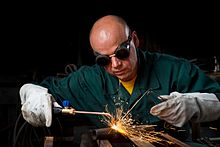
Gas or gas welding, also gas welding - fusion welding using a mixture of oxygen and a combustible gas , mainly acetylene ; less often - hydrogen , propane , butane , blaugaz , gasoline , etc. The heat generated by the combustion of a mixture of oxygen and combustible gas melts the surfaces to be welded and filler material to form a weld pool - the metal of the weld being in a liquid state. The flame can be normal, oxidizing or reducing , this is regulated by the amount of oxygen. Depending on the composition of the base metal , the composition of the filler bars is selected; and depending on the thickness of the base metal, the diameter .
Application
Gas welding is characterized by smooth and slow heating of the metal, which determines the main areas of its application for welding:
- steel with a thickness of 0.2-5 mm (with an increase in the thickness of the metal, due to slow heating, productivity decreases)
- non-ferrous metals
- tool steels requiring gradual mild heating and delayed cooling
- cast iron and some special steels requiring heating during welding
It is also used in repair work, hard soldering and some types of surfacing .
Advantages:
- Simpler equipment than for electric welding methods;
- Gas / mixture for welding / cutting can be purchased without problems;
- Gas welding does not need a powerful source of energy and protective environments (as appropriate);
- The flame / mixture can be controlled - change its power, types, regulate the heating of parts during welding and for cutting.
Disadvantages:
- Low speed of heating metals with a burner (semi-automatic is more profitable).
- Gas welding has a wide heat-affected zone ;
- The heat is strongly dissipated, poorly concentrated than with an arc;
- A noticeable minus lies in the price of fuel / electricity. Of course, the apparatus of arc welding or electrode welding consumes electricity mercilessly, but when counted it will still be cheaper than the same acetylene and oxygen;
- Poor thermal concentration reduces the efficiency of gas welding / cutting with increasing thickness: with a thickness of 1 mm, the pace will be approximately 10 meters per hour, and with 1 cm of thickness only 2 meters per hour. Therefore, for parts from 5 mm, the arc method or semiautomatic / electrode welding is used;
- Mechanized poorly. Automatic occurs when welding pipes with a thin wall in a longitudinal seam during operation of a multi-flame torch, and then only in some operations (production of thin-walled hollow tanks, gas welding of pipes of small diameter, gas welding of aluminum, gas welding of cast iron, various alloys thereof).
See also
- Electric gas welding
Literature
Links
- Gas welding - an article from the Great Soviet Encyclopedia .
- Gas welding
- Gas welding and cutting