Asparagus ( lat. Asparagales ) - the order of monocotyledonous plants. In the classification system, APG II is included in the monocoty group.
| Asparagus | |||||||||||||||
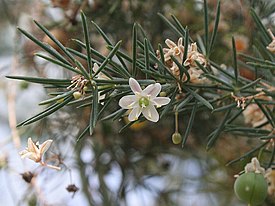 Asparagus fallax | |||||||||||||||
| Scientific classification | |||||||||||||||
|---|---|---|---|---|---|---|---|---|---|---|---|---|---|---|---|
| |||||||||||||||
| International scientific name | |||||||||||||||
Asparagales Bromhead ( 1838 ) | |||||||||||||||
| Families | |||||||||||||||
Content
- 1 Representatives of the order
- 2 Classification
- 2.1 APG II system
- 2.2 Earlier systems
- 3 notes
- 4 Literature
- 5 Links
Representatives of the Order
The most famous food plants from this order are representatives of the onion and asparagus genera .
Among asparagus there are many decorative flowering plants, for example, lily of the valley , daffodil , amaryllis , orchids and others.
Indoor plants included in this order: agave , aloe , yucca .
Classification
APG II system
According to the APG II System ( 2003 ), the Asparagales order consists of 25 families :
- § Alliaceae Batsch ex Borkh. (1797) , nom. cons. - Onion
- [+ Agapanthaceae F. Voigt (1850) ] - Agapanthus
- [+ Amaryllidaceae J. St.-Hil. (1805) , nom. cons.] - Amaryllis
- § Asparagaceae Juss. (1789) , nom. cons. - Asparagus
- [+ Agavaceae Dumort. (1829) , nom. cons.] - Agave
- [+ Aphyllanthaceae Burnett (1835) ] - Afillant
- [+ Hesperocallidaceae Traub (1972) ] - Hesperocallis
- [+ Hyacinthaceae Batsch ex Borkh. (1797) ] - Hyacinths
- [+ Laxmanniaceae Bubani (1901−02) ] - Laxmanniaceae
- [+ Ruscaceae Spreng. (1826) , nom. cons.] - Needle
- [+ Themidaceae Salisb. (1866) ]
- Asteliaceae Dumort. (1829) - Astelian
- Blandfordiaceae R. Dahlgren & Clifford (1985) - Blendfordia
- Boryaceae ( Baker ) MWChase , Rudall & Conran (1997) - Borovies
- Doryanthaceae R. Dahlgren & Clifford (1985) - Doriant
- Hypoxidaceae R. Br. (1814) , nom. cons. - Hypoxic
- Iridaceae Juss. (1789) , nom. cons. - iris
- Ixioliriaceae Nakai (1943) - Ixiolirion
- Lanariaceae H. Huber ex R. Dahlgren & AEvan Wyk (1988) - Lanariaceae
- Orchidaceae Juss. (1789) , nom. cons. - orchid
- Tecophilaeaceae Leyb. (1862) , nom. cons. - Tecophilean
- § Xanthorrhoeaceae Dumort. (1829) , nom. cons. - Xanthorrhoeae
- [+ Asphodelaceae Juss. (1789) ] - Asphodelaceae
- [+ Hemerocallidaceae R. Br. (1810) ] - Hemerocallis, or Daylily
- Xeronemataceae MWChase , Rudall & MFFay (2001) - Xeronemic
- nom. cons. - lat. nomen conservandum : a conserved name whose use is officially authorized, despite the fact that it contradicts one or more provisions of the International Code of Botanical Nomenclature (IBC) [2] ;
- [+ ...] - a family that can be separated from the previous one;
- § - a family whose composition has changed in comparison with the APG System.
- [+ ...] - a family that can be separated from the previous one;
Earlier Systems
In the Kronquist classification system ( 1981 ), the Asparagales order is absent. Most of the taxa included in this order in the APG II System in the Kronquist System are included in the Liliales order of the subclass Liliidae of the class Liliopsida .
In the Takhtajyan classification system ( 1997 ), the Asparagales order is part of the Lilianae super order of the subclass Liliidae of the class Liliopsida .
Notes
- ↑ For the conventionality of indicating the class of monocotyledons as a superior taxon for the plant group described in this article, see the APG Systems section of the Monocotyledonous article .
- ↑ Jeffrey, Charles . Biological nomenclature: Per. from English - M .: Mir, 1980 .-- S. 113.
Literature
- An update of the Angiosperm Phylogeny Group classification for the orders and families of flowering plants: APG II. // The Linnean Society of London, Botanical Journal of the Linnean Society. 2003. No. 141. - S. 399-436. (eng.)
- Full text: pdf (inaccessible link) • Full text: html • Overview Reviewed July 24, 2008
- Plant life. In 6 vols. T. 6. Flowering plants / Ed. A. L. Takhtadzhyana . - M.: Education, 1982. - S. 94-203.
Links
- Asparagus (English) : Information on the APWeb website (Retrieved April 20, 2010) .
| |||||||||||||||||||||||||||||||||||||||||||||||||||||||||||||||
| •• Angiosperm Phylogeny Group (including Bremer B. , Bremer K. , Rivil D. , Chase M. ) • APG I • APG II (+ list ) • APG III (+ list ) •• |