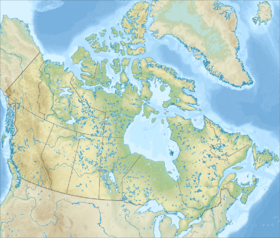
Cliff of Persé ( French: Rocher Percé , “perforated cliff”) is a rocky rock formation located in the Gulf of St. Lawrence , at the tip of the Gaspe Peninsula ( Quebec , Canada ). It is considered one of the most beautiful natural arches in the world. National landmark of the province of Quebec.
| Cliff of perse | |
|---|---|
| fr. Rocher percé | |
 Cliff of perse | |
| Highest point | |
| Absolute height | |
| Location | |
| A country |
|
| Provinces | Quebec |



Content
Quick Details
Perce cliff is a limestone formation. The deposition of this limestone belongs to the Devonian period ; it consists of petrified shells of brachiopods and ostracods , trilobite shells and other marine animals. The length of the cliff is 433 m, the width is 90 m, and the maximum height is 88 m. The cliff got its name because of the 15 m high natural arch located on the sea side.
Cliff of Perce is part of the National Park "Bonaventure Island and Cliff of Perce". It is protected by the state.
Once there were two arches in the limestone wall, but the second, smaller in size, collapsed on June 17, 1845 . At low tide, you can approach the cliff by a dry route, which is used by many tourists.
The first of Europeans to cliff Perse discovered and described the French traveler Jacques Cartier .
The part of the cliff, separated by a fault from the main massif, has a special name - the Obelisk (fr. L`Obélisque). Apparently, due to the fact that the Obelisk at the top ends with a strange chip, similar to a hawk claw, a legend has developed.
The Cliff Legend of Perce
Captain Duval was a pirate , though not as famous as Morgan or Blackbeard , but his name was forever associated with the Cliff of Perce.
According to legend, when the British warships pressed Duval's sloop to the Gaspe Peninsula , the captain, as was customary at the time, preparing for flight, decided to bury the looted treasures as reliably as possible.
Allegedly, the Indian conductor showed him a secret path leading to the top of Perce Cliff, from where one of the pirates began to fire musket bullets with a thin line tied to them on the top of the Obelisk. After many unsuccessful attempts, the pirates managed to fix the end of the rope on the jagged crest of the Obelisk, and then one of the sailors got over there and managed to draw chests full of gold behind him. In order to protect the treasures from lovers of easy money, a barrel of gunpowder was blown up at the top of the Obelisk - legend says that it was this explosion that created a claw-like cliff overhanging the sea.
Of course, there are no documents either confirming or refuting the legend, however, at the beginning of the 19th century a certain moneybags named Kingsley hired a team of geologists who were required to confirm or deny the legend about the origin of the claw-shaped ledge.
The expert opinion was very careful. After a month in Gasp, rock analyzes and numerous calculations, they replied that the possibility that the claw-like cleavage was not the result of an explosion at the top could not be completely rejected. In fact, a natural cataclysm would rather break the cliff to its very foundations.
This more than cautious conclusion, however, served as the beginning of a treasure-hunting campaign on the cliff, which continues to this day, although the Quebec government, under the threat of a large fine, prohibits any exploration of the Perse cliff.
The reason for this is very prosaic - during high tide, sharp pitfalls threaten the death of a daredevil who wants to get closer to the Obelisk by water, the only side accessible for lifting ends at the top with the same ledge, which cost the lives of more than a dozen daredevils. Attempts to reach the top by helicopter are also doomed due to the constant hurricane force of the winds blowing from the sea.
Despite the ongoing attempts to get (contrary to the ban of the authorities) to the top of the Cliff, the legend has not yet received any confirmation or final refutation.
Sources
- Cliff of Perseus, history and legends (fr.)
- Cliff of Perseus (Fr.)
- Cliff of Perse in the Canadian Encyclopedia
- Cliff of Perseus in the book. One Hundred Great Treasures, Moscow, Veche, 2007
Gallery
Perce village and cliff, photo taken from the nearby Mont Saint-Ann Mountain.
Perce village (right), Perce cliff (left), Bonaventure island (far).
Cliff of Perse at low tide.
Cliff of Perseus. View from the sea
See also
- Mount John Lory
- The London Arch is a similar rock formation in Australia .