The Sand Icon of God, the Mother of God, is a miraculous icon of the Virgin Mary, which appeared in 1754 in the village of Peski in the Kharkov province (now the district of Izyum ) to Bishop Joasaph of Belgorod .
| Sandstone Icon Of the Mother of God | |
|---|---|
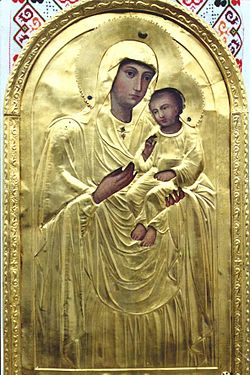 | |
| Date of appearance | 1754 year |
| Location | Ascension Cathedral (Raisins) |
Acquisition and History of the Icon
In the suburban Sands, Izyum Uyezd, Kharkov Province, two miles from the county town of Izyum, in the local parish church there is a miraculous icon called the "Peschanskaya". The history of the glorification of this icon is connected with the life of the prelate of the Belgorod diocese of Joasaph (in the world - Joachim Andreevich Gorlenko). Here is what is conveyed in the “Tales” available in the church about this icon: In 1754, St. Joasaph , circling his diocese, which also included the current Kharkov province, arrived in Izum . The first church he visited was Ascension on the outskirts of the city, called the "Bridge". Met by the clergy and entering the narthex, the saint stopped in amazement and began to peer at the large icon of the Mother of God, which stood in the corner of the narthex and served as a partition, behind which coal was poured for the censer. For a long time he looked with emotion at the holy icon, then, overshadowing himself with a sign of the cross, fell on her knees in front of her and said loudly: “Queen of Heaven! Forgive the negligence of Your servants; they don’t know what they are doing. ” Then, having made a remark to the dean for such a careless attitude to the shrine, he said: “Why is this image not put in the best place? In this image, the special grace of God abounds: in it the Most Holy Lady reveals a special sign of His intercession for this whole country and for the whole country , ”and he immediately ordered this icon to be placed in a more decent place. The Dean, in justification, noted that the church has many icons from the old iconostasis, which have no place. Then the saint, quickly entering the middle of the church, looked on all sides, and, drawing attention to the large icon case behind the left choir, laden with small icons from the old iconostasis, said: “This is the most decent place for the icon of the Mother of God. Put her in the place of these already dilapidated icons and that she always stood in this icon case . ” Since then, the icon has always stood in this place, and even after moving the church to the Sands. After the construction of a new stone church in 1826, due to a change in the plan, the icon is still placed in the icon case on the left side of the iconostasis.
Saint Joasaph lived in Raisins for more than three days; daily, morning and evening, he came to the Ascension Church and prayed before the Image of the Mother of God, which was then transferred and placed in the place indicated by the saint.
The news of the attention paid by the saint to the icon, of his prayer before it, spread among the inhabitants and many began to resort to it as having special grace; moreover, at that time they began to transmit a rumor that the saint had a dream before leaving Belgorod: as if he was inspecting the churches and in one of them, in the narthex, he saw on the garbage heap an icon of the Mother of God with a bright radiance emanating from it, and an unknown voice indicated to this icon as a source of grace for the country. This dream made such an impression on the saint that during his trip to the diocese he carefully examined every church, as if he expected to find a resemblance to what he saw in a dream. Arriving in Raisins, he was struck by the resemblance of the Ascension Church to that seen in a dream, and therefore, looking at the icon of the Mother of God in the narthex, he realized that his dream was related to this church and this icon. And, indeed, after this, many began to pray to the Mother of God and received from this image the fulfillment of the requested; as a result, the news of the church, in which the wonderful image of the Mother of God is kept; spread far beyond the limits of Raisins, and numerous crowds who wished to bow to the icon began to flock to this church.
Wonderful help from the icon
With the transfer of the Ascension Church in 1792 from Zamostyanskaya Street to Sands, the icon was also transferred, attracting more and more reverence and reverence, both parishioners and surrounding residents.
The evidence of miracles has been preserved. Around 1800, the teacher of the local school Stefan Gelevsky lived in Izum, whose children were dying: finally, the last surviving son, Peter, also gets sick. Despite the great sorrow, the parents did not lose hope for the mercy of God and, believing in the gracious power of the image of the Mother of God on the Sands, they promised to serve a prayer before this image, for which they went to Sands: on the road their son died; Mother wanted to go back, but father insisted on keeping this promise. Upon arrival in the Sands, not telling anyone about the death of the child, shedding tears, they asked the priest to serve a prayer service before the icon of the Mother of God. During the prayer, parents with tears begged the Intercessor of Christians to be their Comforter. And their faith was not put to shame. During the third reading of the kondakka “O Mother of the Whole ...”, the child, who was lifeless until then, suddenly cried out so hard that she horrified everyone present, while her father and mother lost their feelings. Having come to their senses, they told how their son died along the way, but before the icon he came to life at the intercession and prayers of the Queen of Heaven. After listening to the liturgy and introducing the baby St. Mystery, the parents happily returned home, praising God and His Most Holy Mother for the mercy shown to them. This baby soon recovered, grew up, then served in St. Petersburg and died in old age with the rank of colonel. The rumor of such an unusual case quickly spread and began to attract crowds of pilgrims and especially the inhabitants of Raisins to the Sands. The church and fences were crowded with those who came to pray at the miraculous image, so that the priest did not have time to serve a prayer service. At that time, in Izum, there was a dean and main member of the Spiritual Board the cathedral archpriest Joasaf Pogorlevsky, who, according to whether the Izium clergy informed that the Izumsk parishioners exclusively serve prayers in the Sands before the glorified icon of the Mother of God, or because of some other reasons, forbade the Peschansky clergy to serve before the image of the service to outside pilgrims. But this prohibition served even more to glorify the icon of the Mother of God. Soon after the ban, Archpriest Pogorlevsky fell ill with a painful disease: he lived with convulsions and, as a result, cramps of all members, with severe pain in his whole body, intensifying with the slightest movement. Suffering severely, the patient came to the conclusion that this disease is the punishment of God sent to him for the order to stop the glorification of the Peschan Icon of the Mother of God. Conscious of his guilt, he decided to turn to the Healer of all diseases, and ordered him to carry himself to the miraculous image of the Mother of God in the Sands, since he could not be carried due to severe pain from the concussion. Brought to the Sands on sheets and laid before the icon, he prayed fervently to the Most Holy Theotokos while praying, asking for forgiveness and healing from his illness. As soon as the moleben ended; and the patient attached himself to the image, immediately he felt so relieved that he left the church without help, while he was brought to the church on sheets. A few days later Pogorlevsky was completely healthy. After that, he did not forbid the service of prayers before the image to all who came, always reverent before him, and advised everyone to turn to him as a visible source of grace. In 1830, cholera appeared in the city of Izyum, and in such a misfortune the Peschansk Icon of the Mother of God was a true comfort to all the inhabitants of Izyum and its environs. Struck by cholera, raisins resorted to the help of the Queen of Heaven, raised Her miraculous icon, solemnly brought to Raisins and served a touching prayer service in the square, then went around with the icon all the houses of the raisins, sprinkled them with St. water, offering fervent prayers to the Queen of Heaven for an end to the fierce disease. After that, cholera suddenly stopped, so that all residents considered such a quick end to the epidemic a miraculous sign from the Peschan miraculous icon of the Mother of God. In the same epidemic, the inhabitants of the suburbs: Zamosc, Goncharovka, Sand, Popovka, Gnidovka, in fear of near danger, immediately turned to God's mercy for help: they lifted the miraculous icon of the Mother of God, went around all the above-mentioned places not only along the streets, but also along houses, and the danger passed: in those areas no one died of cholera. The veneration of the Peschansk icon in Russia was so great that in 1861, on the way from the Holy Mountains to Petersburg, Emperor Alexander II and his wife visited the Ascension Church and bowed to the image.
Religious procession
In 1883, as a result of the petition of the residents of Izyum by the Holy Synod, it was established annually on the eve of May 15, in memory of the Holy Coronation of Sovereign Emperor Alexander III and Sovereign Empress Maria Feodorovna, to make a procession with the Peschansky image from the village of Sand to the town of Izum, where the icon It remained 8 days, and then on May 22, it was transferred back to the Sands procession. With the accession to the throne of Nicholas II and the establishment of the celebration of St. Coronation on May 14, the procession began to take place on May 13, back on May 22. In 1892, by decree of the Holy Synod of March 7, No. 1034, the clergy of the Ascension Church of v. Sand “to visit the parishes of Izyum Uyezd, located in this church with the miraculous icon of the Mother of God, at the request of their inhabitants, to serve before this icon a moleben”. As if the crown of that great event from June 3 to 12, 1913 was the Kharkov procession with the Peschan icon of the Mother of God. About 10 thousand people escorted the icon after the service on June 3 in the Ascension Church from the village of Peski to Izium. From there, a train decorated with flowers brought her to Kharkov, where the clergy, city authorities and people awaited on the forecourt. Despite heavy rain, the streets were filled with people. The military band began to play "Kohl Glorious." To the bell ringing and church chants of the pilgrims, the procession proceeded to the Cathedral of the Assumption Cathedral. A prayer service was held here, an all-night vigil took place, and the image was solemnly transferred to the Pokrovsky monastery. The day after the Liturgy, the procession moved to Belgorod, where it arrived on June 7. Bishop Nicodemus met him at Red Settlement. Vladyka uttered a warm word about the intercession and intercession of the Mother of God, which began with a marriage in Caen, continuing in the longitude of two thousand years until now and promised until the end of the century. Having bowed before the icon, he read the akathist to the Lady, and everyone went to the Trinity Cathedral. Under heavy rains along blurred roads, believers accompanied the shrine to Kharkov, all 75 miles. At these moments, Father Arseniy told about the former healing of an incurable patient. Kharkov pilgrims handed over to Archbishop Stephen a blessing of the Belgorod Trinity Monastery, a copy of the image of the Peschanskaya Mother of God. On June 9, the icon was still crowded, and on June 12 the grand procession ended. The icon was returning to the Sands.
Peschansk icon and the fate of Russia
Saint Joasaph of Belgorod in 1914 appeared in visions at the same time to one pious old man living in the village. Sands, and Colonel O., who was then at the front. Two years before the First World War, Saint Joasaph of Belgorod appeared in a dream to the colonel, elevated him to a high mountain and showed all of Russia, covered in blood. “Repent ... So far this is not, but it will be so,” warned the Prelate. The more the colonel told about the prophetic dream, the more they laughed at him and mistook him for a madman. In the end, they hid in a house of the insane. War broke out. The colonel, a military doctor, was at the front. Seeing a sea of blood, he began to pray fervently, asking for mercy from God. During prayer, Saint Joasaph appeared in his room. “Late,” said the Prelate, “now only one Mother of God can save Russia. The Vladimir image of the Queen of Heaven, with which my mother blessed me for monasticism and who now dwells on my crayfish in Belgorod, also the Peschansky image of the Mother of God that in the village of Pesky, near the town of Izyum, acquired by me when I was bishop of Belgorod, must be delivered immediately to the front, and while they will be there, until the mercy of the Lord does not leave Russia. Mother of God wants to go along the front lines and cover it with her omophorion from enemy attacks ... There is a source of grace in these icons, and then the Lord will have mercy through the prayers of His mother. " The same vision was for one pious old resident of Sand. The colonel reached the capital, risking to be in a madhouse again, found the Brotherhood of Saint Joseph Belgorod and told them everything. Active members of the fraternity Archpriest A.I. Malyarevsky and Prince N.D. Zhevakhov believed his excited story. Having obtained the personal order of Empress Alexandra Feodorovna, Prince Zhevakhov took the icons to headquarters. The crowded procession accompanied the train from Kharkov . And in a completely different way the icons were met in Mogilev: there was no religious procession, the Tsar was not informed of the arrival of travel from Kharkov, and the prince was told that there was no time to deal with trifles at headquarters. However, a short meeting between Prince Zhevakhov and the Sovereign took place, after which the icons were left at headquarters for several months until the end of 1915, but a procession with them along the front lines did not take place. Prince Zhevakhov subsequently wrote that during the stay of the icons in the rate of defeat at the front, there were no victories, but, on the contrary, only victories were gained. In December, the icons were taken away - the procession did not take place. With the first wave of Russian scattering, the miraculous image was transported abroad and soon disappeared from sight. “But as it is clear that all the troubles were the result of disobeying the will of God, it is also clear that the Lord will forgive this sin only after the command of St. Joasaph is fulfilled. So think those who, for eight years of their refugee life, wrote Zhevakhov , unsuccessfully searched for the Peschansky image of the Mother of God throughout Europe and did not find it, so think those who believed the Athos elders who linked the salvation of Russia with the acquisition of this image and proclaimed that the moment of its acquisition will be the first real moment on the path to the salvation of the Fatherland. This moment has come: the Athos elders prayed for mercy from God and this image by the wondrous ways of the Providence of God appeared to one of them and was escorted to Europe to those people who are foreseen to go ahead of the sacred ratification and whose holy names, hitherto hidden, will be from generation to generation famous for noble offspring. The first step towards the salvation of Russia was taken by God Himself, who bestowed on foreign Russia the Peschansky image of the Mother of God. The second step should be taken by anyone who believes in God ... ”This call was made in 1928. In 1991, relics were reappeared. For twenty years they were stored under a thin layer of slag filling in one of the attic floors of the Kazan Cathedral, where the museum of religion and atheism was located. Despite previous restoration work, the shrine was not discovered. The second acquisition of incorrupt relics led to the renewal of veneration of the saint, the creation of a parish of his name at the chapel in the same hospital and the revival of the brotherhood of St. Joasaph.
The New Acquisition of the Icon and the Procession “Through the Air”
In the summer of 1999, the Great Religious Procession along the borders of Russia by plane took place - a five-day flight by plane over a distance of more than twenty-five thousand kilometers around Russia.
Back in 1997, S. A. Matveev came to the elder Archpriest Nikolai Guryanov on the island of Zalit to receive a blessing for the organization of an Orthodox publishing house. Having talked about everything, Sergey Alexandrovich and his friend were already stepping out of the gate when Valentina, the cell-mate of Father Nikolai, shouted after her: “Father blessed the Akathist to read the Peschanskaya Icon of the Mother of God, find her original and fly around it with the Religious Procession by plane.” Matveev, without understanding anything, took the akathists from her and left for Moscow. What kind of icon is Peschanskaya? Where to look for her? What religious procession, and even on an airplane along the borders of Russia? Probably, father Nikolay said something wrong: he probably does not understand how much it costs. Such thoughts spun in the head of a perplexed Sergey. But obedience had to be fulfilled. In Moscow, with his staff, he spoke of an unusual blessing and began to act. Soon, he went to travel around the country. И вот, летом 1998 года в Прохоровке, на Курской дуге, в дни памяти битвы 1943 года представителям филиалов фонда славянской культуры и письменности, собравшимся со всей страны, были розданы материалы о Песчанской иконе Божией Матери, и рассказано о благословении залитского старца — искать икону, которая со времён революции считалась утерянной. Уже через две недели раздался звонок от Галины Толстых из Харькова с радостной вестью — икона найдена. Она находится в Преображенском храме села Пески близ города Изюма. Там же — копия, подаренная самим Государем Николаем Александровичем. С этой вестью С. А. Матвеев вновь приехал на остров Залит. Отец Николай сказал, что если икону не будут давать на Крестный ход, не настаивать, а продолжать заниматься организационными вопросами, о деньгах не думать. Образ по непонятным причинам не дали. В третий раз С. А. Матвеев приехал к отцу Николаю, рассказал о трудностях с деньгами и то, что икону на самолёт не решаются дать. Тогда отец Николай благословил взять список иконы Песчанской Божией Матери, который был привезен ему в дар из Канады. Находился он в доме у женщины, тяжко болеющей, живущей у самой пристани острова и, несмотря на свою болезнь, с любовью и терпением принимающей всех приезжающих.
Икона была привезена в Москву. Отчаявшись, Сергей Александрович решил было ехать на остров, чтобы просить о снятии казавшегося невыполнимым благословения. Но однажды в день преподобного Сергия он познакомился с иноком Курской Коренной пустыни Антонием, который предложил встретиться с ещё одним человеком. Это был русский предприниматель из казаков Сергей Дронов.
Не дослушав до конца накатанную за долгое время поисков речь, хозяин скромного кабинета сказал: «Можно попробовать, только возьму благословение».
Какие же события предшествовали встрече двух рабов Божиих Сергиев? 19 мая 1999 года на Крестном ходе в Москве в честь дня рождения Государя С. А. Матвеев стал свидетелем трёхкратного мироточения святого образа Царя-Мученика и приложился к нему. Тут же он внёс икону в список святынь, которые должны были лететь на самолёте, получив на это согласие хранителя иконы Олега Ивановича Бельченко. 20 мая С. В. Дронов, случайно зайдя в храм Трёх Святителей, где в этот день находилась чудотворная икона Царя-мученика, с благоговением приложился к образу. А 21 мая произошла эта встреча С. Матвеева и С. Дронова, решившая судьбу Крестного хода.
Важнейшим в этих событиях стало благословение Святейшего Патриарха Московского и всея Руси Алексия II , полученное 3 июня 1999 года в день праздника Сретения иконы Владимирской Божией Матери сразу после патриаршей службы у чудотворной иконы Владимирской прямо в алтаре храма святителя Николая в Толмачах.
Крестный ход был совершён за шесть дней с 14 по 19 июня 1999 года. Спустя 84 года. В числе семнадцати икон и прочих святынь, благословлённых к перелёту, сошлись иконы Божией Матери Песчанская, Владимирская и икона Царя-Мученика, а всего на борту самолёта-часовни было несколько сотен различных икон Царицы Небесной, Царя-Мученика и различных святых.
С 2 по 5 октября 2008 года вокруг Харькова был проведен многотысячный крестный ход с чудотворной Песчанской иконой Богоматери и иконой Царя-Мученика.
Песчанская чудотворная икона Божией Матери находится в Свято-Вознесенском кафедральном соборе ( Изюм (город) , ул. Московская, 30). Названа Песчанской по имени места обретения и нахождения в посёлке Пески (ныне находящемся в черте города Изюма).
Literature
- Акафист и житие иже во святых отцу нашему Иоасафу, Епископу Белгородскому. — Белгород: Преображенский Кафедральный Собор, 2002.
- Песчанская чудотворная икона Божией Матери. История её прославления и Акафист. — Харьков, 2000.
- Песчанская чудотворная икона Божией Матери. История её прославления с описанием благодатных исцелений, совершившихся пред этой иконой. — Харьков, 2000. — 54 с.