Gosudarev Bastion - one of the two eastern bastions of the Peter and Paul Fortress in St. Petersburg , facing the Neva . The Neva Curtain connects it with the Naryshkin Bastion , and the Petrovskaya Curtinou connects it with the Menshikov . From the east, the bastion is covered by the St. John Ravelin .
| bastion | |
| Sovereign Bastion | |
|---|---|
 Sovereign bastion from the outside | |
| A country |  Russia Russia |
| Location | St. Petersburg , Peter and Paul Fortress |
| Project author | J. G. Lambert de Guerin |
| Builder | V.A. Kirshtenstein |
| Building | 1703-1709 |
| Status |  Object of cultural heritage of the peoples of the Russian Federation of federal significance. Reg. No. 781610427160116 ( EGROKN ). (Wikigid BD) Object of cultural heritage of the peoples of the Russian Federation of federal significance. Reg. No. 781610427160116 ( EGROKN ). (Wikigid BD) |
History
It was laid down on May 16, 1703, giving rise to the construction of the original wooden-earth fortress and St. Petersburg on Zayachy Island . The construction of the bastion was supervised by Tsar Peter I , in whose honor he was named Gosudarev.
The sovereign's bastion (from Italian. Bastionato ) was erected under the direction of engineer V.A. Kirshtenstein , presumably according to a project drawn up by engineer J. G. Lambert de Guérin with the personal participation of Peter I.
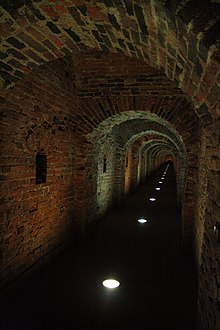
In 1717-1732, the project of the architect Domenico Trezzini with the participation of the military engineer Burkhard Christoph von Minich, the Sovereign's bastion was rebuilt in stone. Inside housed two-tier battle casemates . Under the bastion was arranged worn . In 1752, a vaulted stone ramp was brought to the gorge of the bastion for importation of tools on the walls. In 1782-1784, according to the design of engineer R. R. Tomilov, the Neva facade of the bastion was faced with granite slabs. In the middle of the XIX century, casemates were rebuilt into single-tier ones with a change in window openings.
In October 1703, after the construction of the earthen ramparts of the fortress was completed, a keyr-flag fortress was raised on the Sovereign bastion, and in 1704 the first lighthouse in the city was lit. In the 18th century, workshops, a warehouse of pipes, and gunpowder cellars were located in the casemates. In 1726-1766, the little boot of Peter the Great, the “Grandfather of the Russian fleet”, was kept in one of the bastion premises.
In the middle of the XIX century, there were barracks, an infirmary for military prisoners and warehouses in the dungeons, and under the ramp there was a prisoner bath.
In the 1920s, these premises occupied the services of the Leningrad Military District. During the Great Patriotic War, direction finders were installed on the bastion to detect enemy aircraft on the approach to the city.
In 1954, the bastion was transferred to the State Museum of the History of Leningrad (since 1991 - St. Petersburg). In 1999–2003, the scraped -out walkways were recreated “for the passage of sentries” from the Sovereign’s spitz-dog to the Naryshkin bastion. On May 27, 2003, a memorial sign to the “300th anniversary of St. Petersburg” was opened on the Gosudarev Bastion.
The bastion got into the films “ Midshipmen, forward! (Execution of Anna Bestuzheva) and “ Treasure Island ” (port of Bristol).