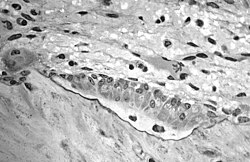
Osteoblasts (from other Greek. Ὀστέον - " bone " + other Greek. Βλάστη - "sprout, offspring, shoot") are young bone cells (15-20 microns in diameter) that synthesize the intercellular substance - matrix . As the intercellular substance accumulates, the osteoblasts are walled up in it and become osteocytes . Osteoblasts are rich in elements of the granular endoplasmic reticulum , ribosomes , and have a well-developed Golgi complex . Their numerous processes are in contact with each other and with processes of osteocytes. An auxiliary function of osteoblasts is participation in the deposition of calcium salts in the intercellular substance (matrix calcification) due to the high content of alkaline phosphatase , which indicates a high synthetic activity of osteoblasts. In this case, cavities (gaps) are formed in which they lie, turning into osteocytes.
Osteoblasts arise from mesenchymal stem cells [1] . Osteoblasts are divided into three groups in shape: cubic, pyramidal and angular (polygonal).
In the formed bone, osteoblasts are found only in places of destruction and restoration of bone tissue, while in the developing bone they continuously cover almost the entire surface of the forming bone beam. Osteoblasts are located around the primary bone beams formed by collagen fibers. Once between them, many osteoblasts are walled up in the intercellular substance and become osteocytes. So there is bone tissue.
Osteoblasts are also found in large numbers in the periosteum and in the endosteum .
Osteoblasts separate bone from extracellular fluid. Phosphate and calcium from and into bone cannot be transported by passive diffusion, because dense osteoblastic joints isolate the internal space of the bone. Calcium is transported through osteoblasts by passive transport (i.e., transporters that do not pump calcium against the gradient). In contrast, phosphate is actively transported by a combination of secretion of phosphate-containing compounds, including ATP- cleavage of phosphate phosphatases at the front of mineralization. Alkaline phosphatase is a membrane protein that is a characteristic marker of osteoblasts; it is found in large quantities on the apical (secretory) surface of active osteoblasts.
Phosphoric acid accumulates in a closed system during mineralization, quickly lowering the pH and stopping further precipitation. Cartilage does not interfere with diffusion, so the acid dissipates, which allows the sediment to precipitate. In osteon , where the matrix is separated from the extracellular fluid by tight junctions, this does not happen. In a controlled closed compartment, the removal of H + leads to precipitation in a wide range of extracellular conditions if calcium and phosphate are available in the matrix compartment [2] . Osteoblasts have the ability to exchange Na + / H + through exchangers Na / H, NHE1 and NHE6 [3] . This H + exchange is the main method of acid removal, although the mechanism by which H + is transferred from the matrix space to the osteoblast barrier is unknown.
Osteoblasts are also connected by gap junctions, which allows cells in one cohort to function together. This has been demonstrated by introducing low molecular weight fluorescent dyes into osteoblasts; it was shown that the dye diffuses into the surrounding and deeper cells in the bone blocks [4] . Desmosomes also connect the deeper layers of cells with the surface layer. The bone consists of many such blocks, which are separated by impermeable zones without cellular connections called cement lines.
Notes
- ↑ MF Pittenger, AM Mackay, SC Beck, RK Jaiswal, R. Douglas. Multilineage potential of adult human mesenchymal stem cells // Science (New York, NY). - 1999-04-02. - T. 284 , no. 5411 . - S. 143–147 . - ISSN 0036-8075 .
- ↑ S. Schartum, G. Nichols. Concerning pH gradients between the extracellular compartment and fluids bathing the bone mineral surface and their relation to calcium ion distribution // The Journal of Clinical Investigation. - May 1962. - T. 41 . - S. 1163–1168 . - ISSN 0021-9738 . - DOI : 10.1172 / JCI104569 .
- ↑ Li Liu, Paul H. Schlesinger, Nicole M. Slack, Peter A. Friedman, Harry C. Blair. High capacity Na + / H + exchange activity in mineralizing osteoblasts // Journal of Cellular Physiology. - June 2011. - T. 226 , no. 6 . - S. 1702-1712 . - ISSN 1097-4652 . - DOI : 10.1002 / jcp.22501 .
- ↑ CE Yellowley, Z. Li, Z. Zhou, CR Jacobs, HJ Donahue. Functional gap junctions between osteocytic and osteoblastic cells // Journal of Bone and Mineral Research: The Official Journal of the American Society for Bone and Mineral Research. - February 2000. - T. 15 , no. 2 . - S. 209–217 . - ISSN 0884-0431 . - DOI : 10.1359 / jbmr.2000.15.2.2.209 .