The black-headed gull [2] [3] , or the common gull [3] , or the river gull [3] ( lat. Chroicocephalus ridibundus ), is a species of small birds from the genus Chroicocephalus of the gull family (Laridae) [1] , nesting in the vast territory of Eurasia as well as on the Atlantic coast of Canada . It is common on the territory of Russia - it can often be observed in the summer on rivers and lakes, where it circles around passing ships in search of feeding [4] . In most of the range, the migratory bird, although in some areas of Western Europe leads a sedentary lifestyle.
| Black-headed gull |
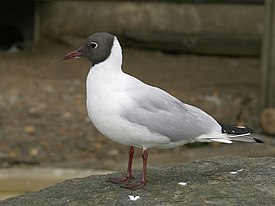
Black-headed gull in summer plumage |
| Scientific classification |
|---|
| No rank : | Bilateral symmetrical |
|
| International scientific name |
|---|
Chroicocephalus ridibundus
( Linnaeus , 1766 ) [1] |
| Synonyms |
|---|
- Larus ridibundus Linnaeus, 1766
|
| Area |
|---|
 Nesting range Wintering places |
| Security status |
|---|
Least ConcernedIUCN 3.1 Least Concern : 22694420 |
|
Content
Nests mainly in small freshwater reservoirs in colonies, the size of which can reach several thousand pairs. Often settles near large cities and food dumps. In the mating attire, among other types of gulls, a dark brown head and a white nape are distinguished. This is one of the most common gulls in the world - its total number exceeds 2 million pairs [5] .
Appearance
Black-headed gull in spring
A small, elegant gull with a rounded head and a thin beak. Length 35–39 cm, wingspan 86–99 cm [6] , weight 200–350 g [5] . Significantly (about a third) larger than the small gull , but slightly smaller than the sea dove and the blue-headed gull . Among the peculiarities of the color are a wide white stripe in the upper front part of the wing and a black border in the back, which is also characteristic of a sea dove and a Bonaparte gull , but not found in other species. Refers to a group of gulls with a two-year plumage cycle.
In the mating attire, the head is dark brown, but not completely, as in some other species (for example, small or Aztec gulls), but to the back of the head, where there is a distinct oblique border between the dark and light plumage. A thin white rim is clearly visible around the eyes. The beak is slightly bent down, without any decorations (such as a bend at the end or a red spot on the mandible), a maroon color. Brown iris . The back of the head, neck, chest, belly, tail, and nape are white, sometimes with a slight pinkish tinge. The mantle and upper wing are gray. The wings are pointed, like terns. On the front edge of the wing there is a wide white stripe, wedge-shaped expanding towards the end, and on the rear edge is black, formed by black vertices of the primary flywheels. The lower part of the wing is predominantly gray with a wide dark border on the primary wing. In winter, in adult birds, the head becomes white with clearly visible black-gray spots in the area of the ears and in front of the eyes, the beak is light red with a dark ending, and the legs are light red. In winter, the gull's color resembles a sea dove, differing from it by a shorter beak and neck.
Black-headed gull in winter plumage
The plumage of young birds on the head and upper body is dominated by reddish and gray-brown tones. In the first year of life, the bird is more reminiscent of the inhabitants of the shallow water of stonewalls ( Arenaria interpres ) than of gulls. The wings are mottled from above, with an abundance of brown, red and gray mottles, a white front and black rear edge. At the end of the white tail there is a clearly visible brown transverse strip. Beak and legs more dull, dirty yellow [5] [6] [7] [8] .
Voice
In the colony, lake gulls are unusually active and loud, often making sharp and crackling sounds, something like a rolling "carr", sometimes repeated at short intervals. Also characteristic are “meow”, “clatter” and short “cake” signals, reminiscent of laughter in a series.
Nesting Range
It nests in the temperate climate of the Black Sea all the way from west to east. In Western , Southern and Northern Europe in the 19th — 20th centuries The area has expanded significantly, largely due to the development of agriculture and food industry [7] . In the continental part of Europe, the southern border of the range passes through southern France , the valley of the river. Po in northern Italy , Serbia , Bulgaria , the northern coast of the Black Sea , Transcaucasia and the Caspian Sea [5] . Locally found in the central part of the Iberian Peninsula and in the northwest of the Mediterranean . Breeds in Corsica , Sardinia and Sicily . In northern Europe, nests in the British and Faroe Islands , in Scandinavia along the coast [7] .
In Russia, it climbs north to Kandalaksha Bay on the White Sea , the upper river. Vychegda in the Arkhangelsk region, 60 ° C. w. in the Urals , 67 ° C. w. in the Ob basin, 65 ° C. w. on the Yenisei , 68 ° C. w. in the Lena Valley, 69 ° C. w. in Kolyma and 61 ° C. w. on the coast of the Bering Sea . The southern border in Asia runs through 40 ° C. w. in the region of the Caspian Sea, the southern coast of the Aral Sea , the valleys of rivers and lakes Syr Darya , Son-kul , Issyk-Kul , Zaysan , Markakol , Ubsu-Nur , Tuul and Buir-Nur . It is also found in the east in Kamchatka , in Primorye , Sakhalin, and in the northeastern Chinese province of Heilongjiang [5] .
In the 20th century, it began to nest far beyond the borders of the mainland: in Iceland (since 1911), in the south-west of Greenland (since 1969) and on Fr. Newfoundland (since 1977) off the coast of North America [7] .
Migration
Migratory, partially migratory, or settled bird. Populations north of the January isotherm of −2.5 ° С move almost completely. In Western and Southern Europe , they are mostly sedentary, while in the intermediate regions they partially migrate. The percentage of migration also increases from west to east. Winters to the south and west of the January isotherm of 0 ° C - in most of Europe, the coasts of the Mediterranean , Black , Caspian seas , Indian and Pacific oceans , as well as the Japanese islands . Since the second half of the 20th century, the winter range of the black-headed gull has expanded beyond the Palearctic - in Africa along the Atlantic to Nigeria and on the Indian Ocean to Kenya and Tanzania , in North America on the east coast from Newfoundland to New York [8] .
Habitats
During the breeding season, it lives mainly in inland waters with shafts and creases of the bush - lakes, floodplains and river deltas , ponds, marshes, peat quarries , where it nests in shallow water and overgrown islands. Less commonly nests on the sea coast in swampy bays, lawns and dunes . In recent years, it has become more and more a synanthropus , in search of feed, mastering urban landfills , fish processing plants, light industry enterprises and urban water bodies. On migration and in wintering places it is mainly found on the seashore and in the deltas of large rivers.
Black-headed gulls begin reproduction at the age of 1–4 years, and females tend to reproduce earlier. They nest in colonies, often mixed, the size of which can vary over a wide range from several tens to several tens of thousands of pairs [8] . Unlike the close small gull , colonies are constant in their location and, in the absence of adverse factors, can persist for decades. Birds arrive at the nesting sites quite early, when water bodies just begin to open and the first thawed areas appear on the ground - most often in late March – mid-April. Monogamous pairs form before arrival at the nesting sites or immediately after it. It happens that the final pair formation is preceded by a change of several partners. After arrival, birds usually stay close to the colony and wander in search of food. During this period, pronounced demonstrative behavior is characteristic - birds with screams chase each other in the air, with their heads stretched up and forward, they make sharp screams towards the enemy, “meow”, “cluck” and peck the ground. When forming a pair, the female bends her head, asking for food, and the male feeds her ritually [8] .
For a future nest , a place inaccessible for terrestrial predators is chosen — as a rule, a marshy ravine or a small grassy island [9] . Sometimes it nests in peat bogs, in a swamp (usually lowland), less often in dunes or in a coastal meadow. The protected area is 32–47 cm around the nest [8] , the distance between adjacent nests is from 50 cm in dense colonies to several tens of meters in sparse ones [10] . The nest is a small sloppy pile of last year's aquatic plants, without lining. As a material, cane , cattail , reed , sedge or horsetail stalks are usually used. Laying includes 1-3 (most often 3) eggs ; in case of loss, re-laying is usual. The color of the eggs can vary in a wide range from light blue or buffy without a pattern to dark brown with a large number of spots, but most often greenish-buffy or olive-brown. The size of the eggs is (41–69) × (30–40) mm [10] . Both parents incubate; incubation time is 23-24 days [4] . If an uninvited guest appears in the colony, a general commotion begins, during which the birds circle, scream heart-rendingly and water the offender with droppings. The chicks are covered with buffy-brown with black-brown spots fluff, merging them with the environment. Parents feed the chicks directly from the beak, or throw food from the goiter into the nest, where the chicks peck it [4] . Chicks begin to fly at the age of 25-30 days [10] .
The basis of nutrition is invertebrate animals - earthworms , dragonflies , beetles and their larvae , dipterans and other insects . From animal feed, it also eats small fish and mouse-like rodents , such as the gray vole . Often fed with food waste in landfills, in places of processing fish and other products, and in cities. The forage is extracted afloat from the surface of the water, on land and in the air.
- ↑ 1 2 Coursers, noddies, gulls, terns, auks, sandgrouse : [ eng. ] / F. Gill & D. Donsker (Eds). // IOC World Bird List (v 8.1). - 2018 .-- DOI : 10.14344 / IOC.ML.8.1 . (Retrieved March 17, 2018) .
- ↑ Koblik E.A., Redkin Y. A., Arkhipov V. Yu. List of birds of the Russian Federation. - M.: Partnership of scientific publications of KMK, 2006. - S. 121. - ISBN 5-87317-263-3 .
- ↑ 1 2 3 Boehme R. L. , Flint V. E. The Bilingual Dictionary of Animal Names. Birds. Latin, Russian, English, German, French / Ed. ed. Acad. V. E. Sokolova . - M .: Rus. lang., "RUSSO", 1994. - S. 91. - 2030 copies. - ISBN 5-200-00643-0 .
- ↑ 1 2 3 Buturlin S.A. et al. Birds. The animal world of the USSR. - 1940. - online .
- ↑ 1 2 3 4 5 Nazarenko E.A., Bessonov S.A. Larus ridibundus Linnaeus, 1766 - Black-headed gull // Vertebrate animals of Russia. Read 2008-05-02.
- ↑ 1 2 Killian Mullarney, Lars Svensson, Dan Zetterström, & Peter J. Grant. 1999. Birds of Europe. Princeton University Press, pp. 170. ISBN 978-0-691-05054-6 .
- ↑ 1 2 3 4 Klaus Malling Olsen, Hans Larsson. 2004. Gulls of Europe, Asia and North America. Christopher Helm Publishers Ltd. ISBN 978-0-7136-7087-5 .
- ↑ 1 2 3 4 5 Ilyichev V.D., Zubakin V.A. Lake gull // Birds of the USSR. Gulls. - M., 1988.
- ↑ Bogolyubov A.S., Zhdanova O.V., Kravchenko M.V. Key to birds and bird nests of central Russia. - M .: Ecosystem, 2006. - online .
- ↑ 1 2 3 Ryabitsev V.K. Birds of the Urals, Urals and Western Siberia. - Yekaterinburg: Publishing House of the Ural University, 2001. - ISBN 5-7525-0825-8 .