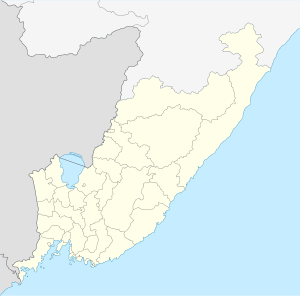


A radiation accident in Chazhma Bay is an accident of a nuclear power plant in a nuclear submarine of the Pacific Fleet , which entailed radioactive contamination of the environment, the death of 11 and the irradiation of hundreds of people.
Content
Crash
On August 10, 1985, the K-431 nuclear submarine of Project 675 , located at pier No. 2 of the Navy's shipyard in Chazhma Bay, Strelok Bay, Sea of Japan ( Shkotovo-22 village ), recharged the active zones of the reactors . The work was carried out in violation of nuclear safety and technology requirements: emergency lifting devices were used. The starboard reactor was recharged normally.
When lifting (the so-called "undermining") of the reactor cover, a compensating grating and absorbers rose from the reactor. At that moment, ignoring the speed limit signal raised on the firewall, at 12 knots the torpedo boat passed. The wave he raised led to the fact that the floating crane holding the lid lifted it even higher, and the reactor went into starting mode, which caused a thermal explosion. Instantly killed 11 (according to other reports - 10) [1] officers and sailors carrying out the operation [2] . The bodies of the dead were destroyed by an explosion. Later, while searching the harbor, small fragments of the remains were found [1] .
In the center of the explosion, the radiation level, determined subsequently from the surviving golden ring of one of the dead officers, was 90,000 x-rays per hour [1] . The submarine started a fire, which was accompanied by powerful emissions of radioactive dust and steam. According to expert Alexei Mityunin, the entire reactor core was eventually thrown out of the boat. Eyewitnesses who extinguished the fire spoke of large flames and clubs of brown smoke that burst from the technological hole in the boat’s hull [3] . The reactor cover weighing several tons was thrown back a hundred meters. [one]
Extinguishing was done by unprepared employees - employees of a ship-repair enterprise and crews of neighboring boats. At the same time, they had neither overalls nor special equipment. Extinguishing the fire took about two and a half hours. Specialists of the emergency naval team arrived at the emergency site three hours after the explosion. As a result of uncoordinated actions of the parties, the liquidators stayed in the infected area until two in the morning in anticipation of a new set of clothes to replace the infected [3] .
At the scene of the accident, an information blockade was established, the plant was cordoned off, the plant's access control was strengthened. In the evening of the same day, the village was disconnected from the outside world. Moreover, no warning and explanatory work was carried out with the population, as a result of which the population received a dose of radiation exposure [3] .
It is known that a total of 290 people suffered as a result of the accident. Of these, 10 died at the time of the accident, 10 recorded acute radiation sickness , 39 - radiation reaction . Since the enterprise is a sensitive one, the military personnel who were among the first to liquidate the consequences of the catastrophe were mostly affected [3] .
Among the units that took part in eliminating the consequences of the accident was a separate company of chemical protection for the Marine Corps under the command of Captain Vyacheslav Ivanovich Pechnikov [3] .
Consequences of the accident
The axis of radioactive fallout crossed the Danube Peninsula in a northwest direction and reached the sea on the coast of the Ussuri Gulf . The length of the plume on the peninsula was 5.5 km (further, aerosol particles fell on the surface of the water area up to 30 km from the place of release).
As a result of the accident, a center of radioactive contamination of the bottom of the Chazhma Bay was formed. The area of intense radioactive contamination was concentrated in the accident area and, within the limits of the exposure dose rate (DER)> 240 µR / h, covers an area of about 100,000 m². In the central part of the focus, the EDR is 20–40 mR / h (maximum 117 mR / h as of 1992 ). Under the influence of currents, radioactive contamination gradually moved towards the exit from Chazhma Bay. The radioactivity of bottom sediments is mainly due to cobalt-60 (contribution to pollution 96–99%, half-life of cobalt-60 is approximately 5.27 years) and partially cesium-137 .
The hull of the K-431 boat leaked, and it was towed with pontoons for long-term storage to Pavlovsky Bay . Together with it, Rostov Komsomolets, project 627A , standing next to K-42 , which was towed to the same parking lot, was declared unsuitable for further operation due to radiation pollution.
Memory
At the accident site, a monument was erected to 10 dead officers and sailors [4] . According to some reports, the remains of the dead were buried [5] .
See also
- List of radiation accidents
Notes
- ↑ 1 2 3 4 L. Osipenko, L. Zhiltsov, N. Mormul. Atomic underwater epic. Feats, failures, disasters. - M .: BORGES, 1994. - ISBN 5-85690-007-3 .
- ↑ V. M. Khramtsov. Why the nuclear disaster in Primorye did not prevent Chernobyl? Military-technical almanac "Typhoon", No. 16 (1999 - 04).
- ↑ 1 2 3 4 5 Mityunin, Alexey. Black reality about the nuclear submarine K-431. The mistakes of the nuclear accident a year later were repeated by Chernobyl . New newspaper (April 22, 2005). Date of treatment July 29, 2010. Archived March 12, 2012.
- ↑ Submarine K-431. RPO "Academy of Russian Symbology" MARS " . www.simvolika.org. Date of treatment June 24, 2019.
- ↑ Submarine K-431. RPO "Academy of Russian Symbology" MARS " . www.simvolika.org. Date of treatment June 24, 2019.
Links
- Chazhma quarter-century radiates poison
- The circumstances of the nuclear accident at K-431
- The whole truth about the accident in Chazhma
- Chazhma
- Martyrology of underwater disasters, August 10, 1985 K-431
- Nuclear accidents are familiar to us, 2000.net.ua
- Chazhma: how a nuclear reactor exploded. Chapter 4 from the book of N. A. Cherkashin "Emergencies in the Soviet Navy"