Olga Fedorovna (nee Cecilia Augustus , Princess and Margraine of Baden; September 20, 1839 , Karlsruhe , Baden - April 12, 1891 , Kharkov , Russian Empire ) - Russian Grand Duchess, wife of Grand Duke Mikhail Nikolaevich .
| Grand Duchess Olga Fedorovna (Cecilia of Baden) | |||||||
|---|---|---|---|---|---|---|---|
| Cäcilie Auguste von Baden | |||||||
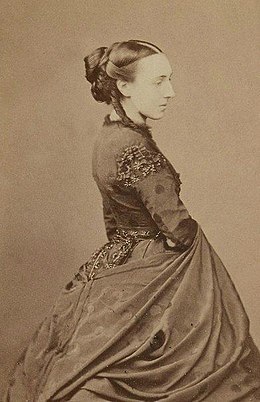 Grand Duchess Olga Fedorovna, 1860 | |||||||
| |||||||
| Birth | September 20, 1839 Karlsruhe , Baden | ||||||
| Death | April 12, 1891 (51 years old) Kharkov , Russian Empire | ||||||
| Burial place | |||||||
| Kind | Tseringenov , Romanovs | ||||||
| Birth name | |||||||
| Father | Leopold of Baden | ||||||
| Mother | Sofia Wilhelmina of Sweden | ||||||
| Spouse | Mikhail Nikolaevich | ||||||
| Children | Nikolay , Anastasia , Mikhail , George , Alexander , Sergey , Alexey | ||||||
| Religion | |||||||
| Awards |  | ||||||
The youngest daughter of the Grand Duke Leopold of Baden and Sophia Wilhelmina of Sweden , the niece of Empress Elizabeth Alekseevna .
Content
- 1 Biography
- 2 Marriage and children
- 3 Charity
- 4 Chef
- 5 Perpetuation of memory
- 6 notes
- 7 Literature
Biography
Princess Cecilia grew up in Spartan conditions, which she never regretted. Her father was strict with his children, but gentle with his subjects. He was considered the first German ruler to carry out liberal reforms in his state. All this left a definite imprint on the worldview of the future Grand Duchess.
Grand Duchess Olga Fedorovna had a strong temperamental character and had a sharp mind. With her sharp tongue, she delivered many unpleasant minutes to Alexander III and Empress Maria Fedorovna . She was especially outraged by the emperor’s decision to limit the circle of great princes, which her own grandchildren did not fall into. Alexander III once said with annoyance about her:
Everyone recognizes Olga Fedorovna as an intelligent woman. What is this mind expressed in? Gossips and reads the most empty novels, but does not want to engage in any serious business.
- [1]
Olga Fedorovna, the only one from the whole family, had no state or public duties, devoting herself to children and her husband. She became her husband not only a loving wife, but also a loyal and wise ally. For almost 20 years, the family lived in the Caucasus . In addition to official duties as the wife of the imperial governor, Olga Fedorovna provided all kinds of support to Mikhail Nikolayevich , who was in charge of the reforms of Emperor Alexander II in Georgia . The mother strictly watched the upbringing and education of children, demanding complete submission. Parents, according to their decision, married their only daughter Anastasia to Marry Mecklenburg-Schwerin , the heir to the duke’s throne , without asking her opinion. The grand duchess could not influence the matured sons. They arranged their fate at their discretion. The big blow for Olga Fedorovna was the marriage of her son Michael to Countess Sofia Merenberg in February 1891 . In March of the same year, the Grand Duchess obeyed the doctors and went to restore his upset health in the Crimea . The telegram announcing the marriage was handed over to Olga Fedorovna at the railway station in Kharkov , where the train made a short stop. The marriage report shocked the Grand Duchess so much that she began a heart attack. Olga Fedorovna died in Kharkov on April 12, 1891 at the age of 51. She was buried in the Peter and Paul Cathedral .
Marriage and children
On August 28, 1857, she married Mikhail Nikolayevich ( 1832 - 1909 ), the youngest son of Russian Emperor Nicholas I. For this, Cecilia Augustus converted to Orthodoxy and received the name of Olga Fedorovna and the title of Grand Duchess. The spouses had 7 children:
- Nicholas ( 1859 - 1919 )
- Anastasia ( 1860 - 1922 )
- Michael ( 1861 - 1929 )
- George ( 1863 - 1919 )
- Alexander ( 1866 - 1933 )
- Sergey ( 1869 - 1918 )
- Alexey ( 1875 - 1895 ).
The maternal spouses were brother and sister in the fifth knee, their common ancestor was Ludwig VIII (Landgrass of Hesse-Darmstadt) . In the House of Romanov, as in many European dynasties, distant kinship between spouses was commonplace.
Charity
Without taking any government posts, Olga Fedorovna paid great attention to charity, especially in the field of female education.
In 1864, Grand Duchess Olga Fyodorovna in Tiflis , to a large extent at her own expense, organized a women's school of the 1st category, later renamed the First Tiflis Grand Duchess Olga Fedorovna a female gymnasium. Later, a gymnasium appeared.
With the participation of Olga Fedorovna, the first Ossetian school for girls also existed. Created in 1866 by Archpriest Alexei Koliev in Vladikavkaz, later by order of the chairman of the Society for the Restoration of Christianity in the Caucasus, Grand Duke Mikhail Nikolaevich, the school was transformed and accepted under the auspices of Grand Duchess Olga Fedorovna. The school became known as the Ossetian Holguin Shelter.
In 1884, in St. Petersburg, Olga Fedorovna became the patroness of the new Alexander Male Hospital (now the city psychiatric hospital No. 7).
Olga Fedorovna became the patroness of a free hospital (shelter) for ten beds for "insufficient visitors to the Waters" in Pyatigorsk. The hospital itself was called St. Olga.
From the diary of A. Polovtsev “I defend the memory of Olga Fedorovna from the accusations of the crowd. She did her duty and was only intemperate in language. I express the idea that it would be useful to collect her letters, and especially letters to Queen Wirtemberg, or else I add, they would appear sometime as letters from Empress Elizabeth Alekseevna. She admires this person and compares her to the late Empress Maria Alexandrovna, who was her niece. "
Chief of Regiments
Grand Duchess Olga Fedorovna was the chief of the 21st artillery of Her Imperial Highness Grand Duchess Olga Fedorovna brigade.
Perpetuation of memory
The name of the princess was given to the village of Olginsky (now the Right-Bank District of North Ossetia ) [2] . The German village Olgafeld [Olgovka], founded in 1864 in the Tauride province of the Melitopol district of the Rogachik volost on the lands belonging to Grand Duke Mikhail Nikolaevich, was named after the princess.
In honor of the Grand Duchess Olga Fedorovna, one of the streets of Tiflis was named - Olginskaya (in Soviet times - Lenin, now Kostava), and also Baku - Olginskaya (in Soviet times - Japaridze (since 1929), nowadays - Mamed Emin Rasulzade ). [3]
Notes
- ↑ Bokhanov A.N. Emperor Alexander III. - M .: LLC "Trading House" Russian Word — RS ", 2001. - 512 p.: Ill. - S. 365.
- ↑ History of the village of Olginsky
- ↑ names of streets and squares of Baku " - www.window2baku.com. Retrieved July 24, 2013.
Literature
- Bees E.V. Romanovs. The history of the dynasty. - M .: OLMA-PRESS, 2004.
- Grigoryan V.G. Romanovs. Biographical reference. - M .: AST, 2007.