The Philippine eagle [1] [2] , or the Philippine monkey-eater [3] , or the monkey-eater [4] , or the Philippine harpy [5] , or the harpy-monkey [1] ( Latin Pithecophaga jefferyi ) is a bird of prey from the hawk family . One of the rarest, largest and strongest birds in the world. It lives exclusively in the tropical forests of the Philippines and is one of the national symbols of this country [6] . The killing of this endangered bird is punishable, according to the laws of the Philippines, with twelve years in prison and a heavy fine [7] .
| Philippine eagle |
 |
| Scientific classification |
|---|
| No rank : | Bilateral symmetrical |
| Gender: | Harpy Monkey Eaters ( Pithecophaga Ogilvie-Grant , 1896 ) |
|
| International scientific name |
|---|
Pithecophaga jefferyi
Ogilvie-Grant , 1896 |
| Area |
|---|
|
| Security status |
|---|
Endangered SpeciesIUCN 3.1 Critically Endangered : 22696012 |
|
Content
The Philippine harpy reaches a length of 80-100 cm, wingspan up to 220 cm. Females weighing 5 to 8 kg are slightly larger than males weighing 4 to 6 kg. Relatively short wings and a long tail make it easy to maneuver when flying in a dense forest.
The head of the Philippine harpy is whitish-buffy, on the back of the head is a crest of long and narrow feathers. The beak is very large and tall. The dorsal side and wings are brown, the tail with darker transverse stripes, the ventral side is buffy-whitish.
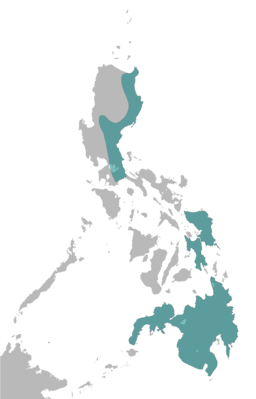
Filipino ape is one of the rarest species of hawk in the world. It is found on the Philippine islands of Luzon , Samar , Leyte and Mindanao , where it lives in the dense tall trunk rainforests . Due to the destruction of living space, the population today has declined to 200-400 individuals. Species, according to experts, are critically endangered.
The main food of the monkey-eater varies from island to island depending on the animals there, especially in Luzon and Mindanao , since these islands are in different faunistic areas . For example, in Mindanao, the Filipino woolly wing is the main prey, but not in Luzon [8] . The Philippine eagle prefers to hunt for woolly wings and Malay palm civets , but is sometimes content with small mammals ( palm squirrels and bats [2] ), rhinoceros birds , reptiles ( snakes and monitor lizards ); happens to attack even other birds of prey, in particular owls. Sometimes eagles prey on monkeys in pairs. One bird sits on a branch next to a flock of monkeys, distracting them, while the other at this time unnoticed flies to the prey and grabs it [9] .
Philippine monkey-eaters live monogamously and stay all their lives with their partner. Females build nests at a height of 30 m, preferably on trees of the dipterocarp family. The first such nest was found in 1963 . In clutch there is only one large egg ; parents take care of the hatched chick for 20 months.
The life expectancy of the Philippine harpy reaches 60 years.
The Filipino ape was discovered in 1896 by British explorer John Whitehead and named after his father, Jeffery Pithecophaga jefferyi . The first part of the scientific name translated from Greek means "monkey-eater."
It is distinguished in a separate genus, which, depending on the source, is determined either in the subfamily of serpent-eaters , or in the subfamily of buzzards . Scientists at the University of Michigan examined the DNA of a Filipino monkey-eater isolated from samples of his blood . It has been compared with the DNA of a large harpy ( Harpia harpyja ), Guiana harpy and New Guinea harpy . These three species are related to each other, but, as it turned out, are not close relatives of the Filipino monkey-eater. The similarity in size, habitat and behavior is a consequence of convergent evolution [10] . At this time, it is believed that the closest relatives of the Philippine monkey-eater are smaller snake-eaters [10] .
The Philippine Harpy was selected as the symbol of the 2005 Southeast Asian Games (SEA Games) [11] .
- ↑ 1 2 Dementiev G.P. , Galushin V.M. Order Falconiformes, or Birds of Prey (Falconiformes) // Life of animals. Volume 6. Birds / ed. V. D. Ilyichev, I.V. Mikheev, Ch. ed. V. E. Sokolov . - 2nd ed. - M.: Education, 1986. - S. 137. - 527 p.
- ↑ 1 2 Vinokurov A.A. Rare and endangered animals. Birds: Ref. allowance / ed. V. E. Sokolova . - M .: Higher School, 1992. - S. 137. - 446 p. : ill. - 100,000 copies. - ISBN 5-06-002116-5 .
- ↑ Akimushkin I.I. Animal World. T. 3. Stories about birds / Series Eureka. - M .: Young Guard, 1971. - S. 156. - 384 p.
- ↑ Fisher D., Simon N., Vincent D. Red Book. Wildlife at risk / trans. from English, ed. A. G. Bannikova . - M .: Progress, 1976. - S. 273—274. - 478 p.
- ↑ Boehme R. L. , Flint V. E. The Bilingual Dictionary of Animal Names. Birds. Latin, Russian, English, German, French / Ed. ed. Acad. V. E. Sokolova . - M .: Rus. lang., "RUSSO", 1994. - S. 47. - 2030 copies. - ISBN 5-200-00643-0 .
- ↑ Kennedy, RS, PC Gonzales, EC Dickinson, HC Miranda, Jr., and TH Fisher (2000). A Guide to the Birds of the Philippines. Oxford University Press. ISBN 0-19-854669-6
- ↑ Farmer arrested for killing, eating rare Philippines eagle: officials ". AFP. Farmer arrested for killing, eating rare Philippines eagle: officials." AFP 2008-07-18. http://afp.google.com/article/ALeqM5hmMr60RIPEBrwEzz1o1iP8QnMt5w . Retrieved 2009-01-07
- ↑ Rare Birds Yearbook 2008. England: MagDig Media Lmtd. 2007. pp. 127. ISBN 978-0-9552607-3-5 .
- ↑ Chandler D., Couzens D. (2008). 100 Birds to See Before You Die . London: Carleton Books. pp. 171. ISBN 978-1-84442-019-3 .
- ↑ 1 2 DNA study: RP eagle is one of a kind ". (Link unavailable) Sun.Star Davao. 2007-12-15. Retrieved 2008-11-21
- ↑ Philippine harpy in the Philippines dictionary
- Monkey-eater // Nikolai - Olonki - M .: Soviet Encyclopedia, 1954. - P. 303. - ( Great Soviet Encyclopedia : [in 51 vols.] / Ch. Ed. B. A. Vvedensky ; 1949-1958, vol. 30).
- Ferguson-Lees J., Christie DA 2001. Raptors of the world . Helm, London.